Walrus — Tusks, Whiskers and a Melting Home
The walrus (Odobenus rosmarus) is a large Arctic marine mammal and the only living member of the family Odobenidae, related to seals and sea lions. Most adult males weigh about 800–1,700 kg (some Pacific bulls over 2,000 kg) and both sexes have tusks, up to about 1 m long in males. Walruses live around the Arctic, in the Bering, Chukchi and Laptev seas and the North Atlantic Arctic, feeding on clams and other bottom animals they find with sensitive whiskers. They depend on sea ice, and the IUCN lists them as Vulnerable.
The walrus is the Arctic’s great bottom-feeder: a one-tonne pinniped that finds clams by touch, sucks them out of their shells, and rests between meals on floating sea ice. It is the last surviving member of a once-diverse family, and its future is tied closely to the ice that is now shrinking beneath it.
How big is a walrus?
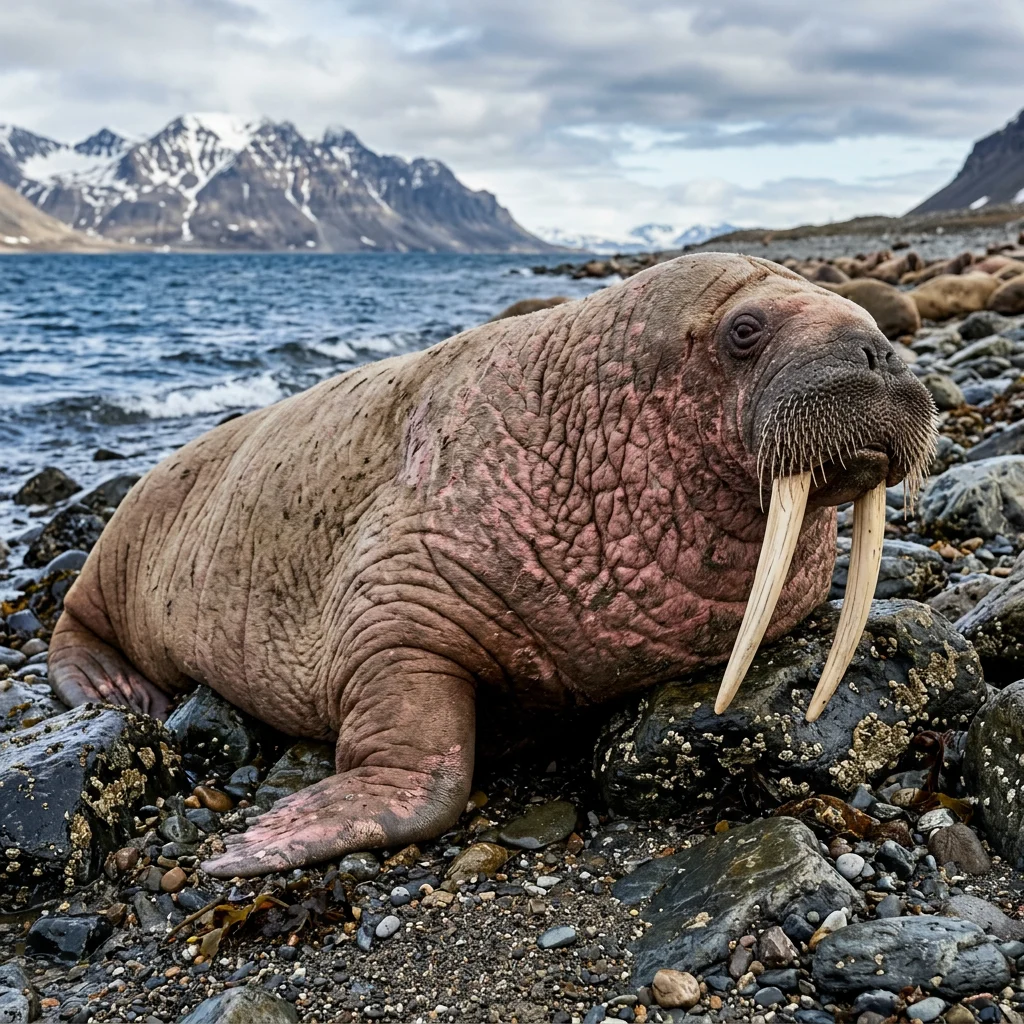
Most adult males weigh about 800–1,700 kg and outsized Pacific bulls can top 2,000 kg. Females weigh roughly two-thirds as much as males. Body length usually runs from about 2.2 to 3.6 m.
The walrus is one of only three marine mammals with tusks; see marine mammals with tusks for how its tusks compare with the narwhal’s and dugong’s.
Walruses are the third-largest pinnipeds, exceeded only by the two species of elephant seal. The two living subspecies differ noticeably. Pacific walruses are the larger: females average about 800 kg, and the biggest males are the true giants of the species. Atlantic walruses are about 10–20% lighter overall, with males averaging around 900 kg and females around 560 kg, sometimes as little as 400 kg. Atlantic animals also tend to have shorter tusks and a somewhat flatter snout.
Historical records hint at even larger individuals. In 1909 a walrus hide weighing about 500 kg was taken from a huge bull in Franz Josef Land, and in 1910 a hunter shot a walrus about 4.9 m long whose hide weighed about 450 kg. Because the hide usually makes up roughly a fifth of a walrus’s body weight, those animals probably weighed well over two tonnes. Such records are exceptional, and modern field guides give 1,200–1,500 kg as a typical weight for a large adult male.
Walrus calves are already big at birth, generally around 45–75 kg and about 1–1.4 m long, and they can swim almost immediately. Much of an adult’s bulk is blubber, which insulates it in near-freezing water and acts as an energy store during the long periods when feeding is difficult, such as the breeding season, when males eat very little.
What does a walrus look like up close?
Apart from its whiskers, a walrus looks almost hairless. Its skin is thick and deeply wrinkled, up to about 10 cm thick around the neck and shoulders of adult males, and the blubber beneath can reach about 15 cm. Mature males also develop lumpy nodules called bosses on the neck and shoulders, a secondary sexual trait that probably helps protect them during fights.
Colour changes with age and temperature. Young walruses are dark brown and become paler and more cinnamon-coloured as they grow older, and old males can look almost pink. When a walrus is in cold water, blood vessels in the skin constrict to conserve heat and the animal can look nearly white. When it hauls out and warms up, blood flows back to the skin and it flushes pink again, which is why a beach full of resting walruses often looks rosy.
The walrus body combines features of both other pinniped families. Like sea lions, it can turn its hind flippers forward and walk on all fours on land or ice. In the water, however, it swims more like a true seal, driving itself with its hind flippers and sinuous body movements rather than rowing with its front flippers. Like true seals, it has no external ear flaps. Walruses also have inflatable pharyngeal pouches in the throat that act as built-in buoyancy aids, letting an animal float upright with its head out of the water and even sleep at the surface.
Walrus eyes are small, and their vision appears suited to short distances. Well-developed eye muscles let them protrude the eyes and look both forwards and upwards, but on the dark, muddy sea floor where they feed, touch matters far more than sight.
What are walrus tusks for?
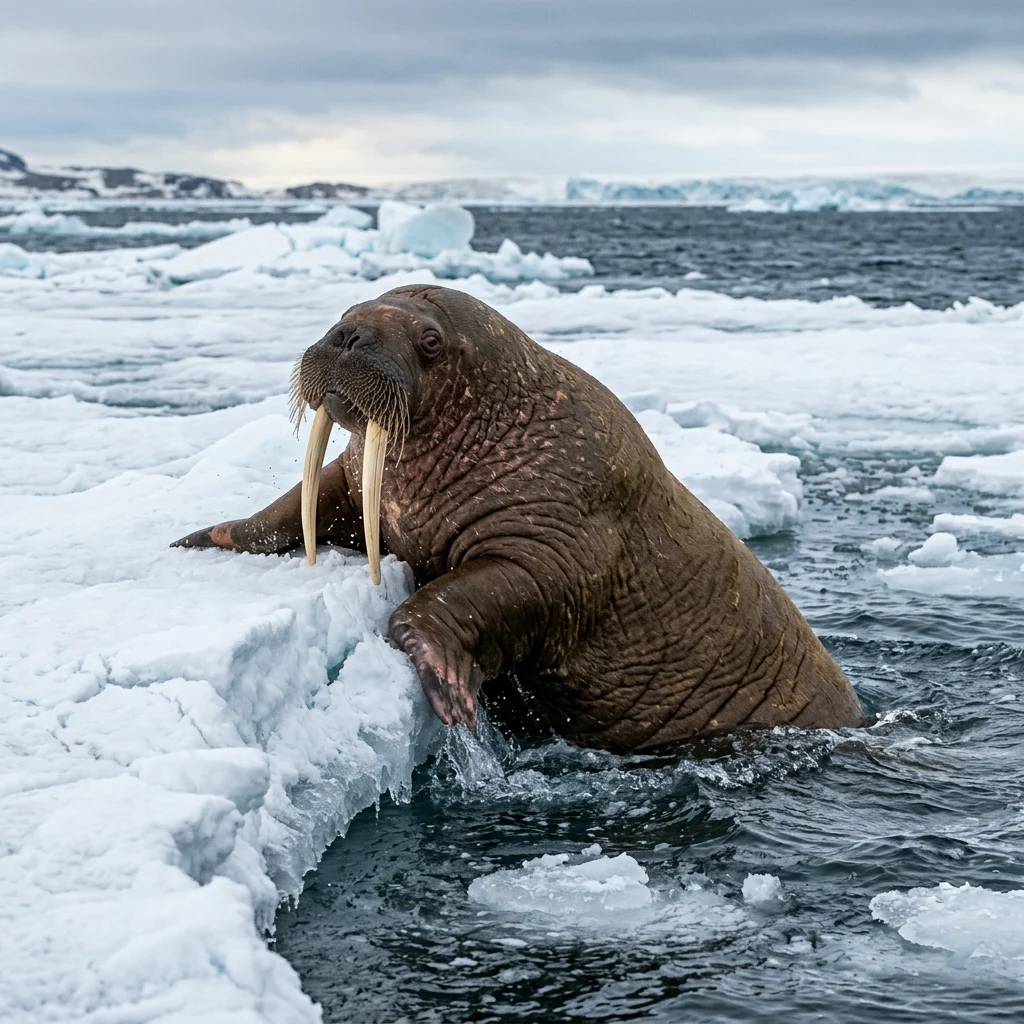
Both males and females have tusks. They are greatly elongated upper canine teeth that keep growing through life and can reach about 1 m in length and around 5 kg in weight. Male tusks tend to be longer and thicker than female tusks. Tusk size matters socially: the strongest males with the largest tusks usually dominate their groups, and males use their tusks in display and in fights over position and mates.
Tusks are also practical tools. Walruses hook them over the edge of an ice floe to haul their bulk out of the water, a habit reflected in the genus name Odobenus, from Greek words meaning “tooth-walker”. They use them to make and maintain breathing holes in ice, and as anchors to rest on the ice edge while still in the water.
A common misconception is that walruses use their tusks to dig up clams. Studies of wear on tusks show otherwise: the tusks are dragged through the sediment as the walrus feeds, but the actual digging and searching is done with the upper edge of the snout and its whiskers. Apart from the tusks, walruses have relatively few functional teeth. The theoretical maximum is 38, but many are rudimentary or absent, and a typical adult has only about 18.
Tusks can break, wear down or fail to develop, so tuskless or one-tusked walruses do occur. Walrus ivory has long been prized. Indigenous Arctic peoples carved it into tools and art, and much of the famous 12th-century Lewis chess set found in Scotland is carved from walrus ivory. International trade in walrus ivory is now regulated under CITES.
How do walrus whiskers work?
The broad moustache on a walrus’s snout is one of the most sensitive touch organs in the animal kingdom. A walrus has roughly 400–700 stiff whiskers, or vibrissae, arranged in about 13–15 rows. They can grow to about 30 cm, though in wild animals they are usually worn much shorter by constant contact with the sea floor.
Each whisker sits in a follicle richly supplied with blood vessels, nerves and muscles. Walruses can move them actively, sweeping them across the mud like a hand feeling for objects in the dark. Experiments with captive animals have shown that walruses can distinguish shapes only a few millimetres across by touch alone, which allows them to identify buried clams and tell them apart from stones in the murky, often pitch-dark water where they forage.
What do walruses eat?
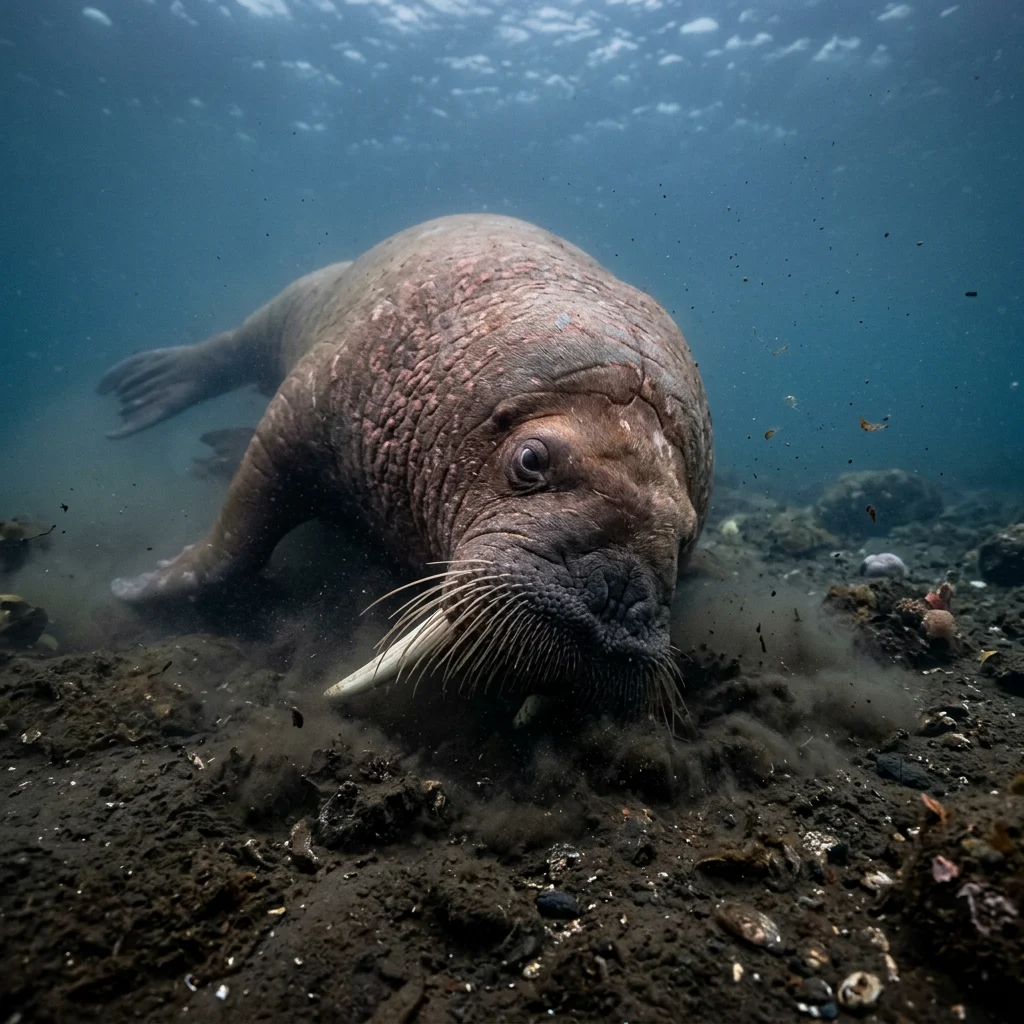
Mainly clams and other bottom-dwelling invertebrates. Walruses find them with their whiskers, uncover them with jets of water, and suck out the soft parts without eating the shell.
The walrus diet is broad in principle. More than 60 genera of marine animals have been recorded in walrus stomachs, including shrimp, crabs, tube worms, soft corals, tunicates, sea cucumbers, snails, octopuses and slow-moving fish. In practice, bivalve molluscs dominate. In the Pacific population, benthic invertebrates make up about 97% of the diet, and in the North Atlantic the soft parts of clams make up around 95% of food intake.
Feeding is a remarkable piece of engineering. A walrus grazes along the bottom, head down, searching with its whiskers. When it finds a clam, it can blast away sediment with a jet of water from its mouth or fan it away with its flippers. It then seals its thick lips around the clam and pulls its tongue back like a piston, creating strong suction that draws the soft body out of the shell. The walrus palate is unusually high and vaulted, which helps generate this vacuum. Shells are usually left behind on the sea floor.
The amounts involved are large. In one well-studied case, a satellite-tagged walrus in northeast Greenland fed on dives lasting about five to seven minutes and was estimated to eat around 53 bivalves per dive, or roughly 57 kg of clam meat a day, close to 5% of its body mass. Feeding on this scale reshapes the sea floor: walruses plough furrows and pits in the sediment, releasing nutrients into the water and changing the mix of animals living on the bottom.
Some walruses, mostly older males, also eat seals. Seal tissue turns up in a noticeable share of Pacific walrus stomachs, and walruses have been seen killing seals as large as a bearded seal. There are rare records of walruses taking seabirds such as Brünnich’s guillemots, and they may scavenge on whale carcasses. How important these meals are overall is still debated, but they are the exception rather than the rule.
How deep can a walrus dive?
Walruses are not especially deep divers for pinnipeds, because their food lives on shallow continental shelves. Most foraging happens in water less than about 80–100 m deep, and a study of Atlantic walruses near Svalbard found typical maximum dive depths of only around 30 m. In northeast Greenland, a tagged animal fed mostly between about 6 and 32 m.
They are capable of much more when the seafloor demands it. A 2018 study of tagged Atlantic walruses in the high Arctic between Greenland and Canada recorded dives deeper than 500 m in Smith Sound, showing that maximum dive depth depends mainly on where the prey and the sea floor are. This is a useful correction to older figures, which often quoted a little over 100 m as the record.
Where do walruses live?
| Population | Range | Recent estimate |
|---|---|---|
| Pacific walrus | Bering and Chukchi seas (US and Russia); Laptev Sea animals are of Pacific origin | About 257,000 (range 171,000–366,000), 2014–2017 |
| Atlantic walrus | Canadian Arctic, Greenland, Svalbard, Franz Josef Land, western Russian Arctic | Around 30,000 across the North Atlantic |
Walruses live around the Arctic in a broken ring of populations, mostly over shallow continental shelves where clams are plentiful and sea ice or beaches provide resting places. They are divided into two widely recognised subspecies. The Pacific walrus, Odobenus rosmarus divergens, is by far the more numerous. Most Pacific walruses winter in the Bering Sea, and in spring many females and young follow the retreating ice north through the Bering Strait into the Chukchi Sea, while many adult males stay farther south in summer, in areas such as Bristol Bay in Alaska and the Gulf of Anadyr in Russia.
The Atlantic walrus, O. r. rosmarus, ranges from the Canadian Arctic across Greenland to Svalbard and the western Russian Arctic, in a series of separate stocks. Some of the larger groups live in Foxe Basin and around Hudson Bay and Davis Strait in Canada, and in the Svalbard and Franz Josef Land region. A third population in the Laptev Sea off Siberia was long treated by Russian biologists as a separate subspecies, but genetic work has shown that it is of Pacific walrus origin.
The walrus once ranged much farther south. Until the early colonial period, a breeding population lived on Sable Island off Nova Scotia, and in the 18th century large herds were found in the Gulf of St. Lawrence. Both were wiped out by hunting, and Canada now lists the northwest Atlantic population as extirpated. A genetically distinct population in Iceland disappeared within a few centuries of Norse settlement. Fossils show that during ice ages walruses lived as far south as San Francisco Bay and North Carolina.
Individual walruses still sometimes wander well beyond the Arctic. In March 2021 a young walrus nicknamed Wally turned up on Valentia Island in Ireland and days later on the coast of Wales, and in 2022 lone walruses were seen in the Baltic Sea and off Finland. These vagrants make headlines precisely because they are so far from home.
How do walruses spend the year?
Walrus life revolves around ice. In winter they gather in areas of broken pack ice, polynyas and leads where they can reach open water to breathe and feed. They can break through new ice up to about 20 cm thick with their heads, but thicker ice forces them to move to areas of drifting pack. Floating ice works as a mobile resting platform over the feeding grounds, allowing a walrus to haul out, digest and nurse a calf without swimming back to shore.
In spring and summer, Pacific walruses make one of the largest seasonal movements of any pinniped, with hundreds of thousands passing through the Bering Strait. Where ice is absent in summer and autumn, walruses come ashore at traditional beach haul-outs, known in Inuktitut as uglit. These gatherings can be enormous, with thousands or tens of thousands of animals packed shoulder to shoulder. From a haul-out, walruses may travel long distances to feed; studies in the North Atlantic recorded trips of up to about 100 km.
Walruses are highly social and tactile. Haul-outs are noisy, crowded places full of jostling, grunting and tusk displays, and animals often lie touching one another. Outside the breeding season, adult males and females with young tend to live in separate groups for much of the year.
How do walruses breed?
Walruses mate in winter, mainly from January to March with a peak in February, often in remote pack ice. Females gather on the ice, and males compete in the water nearby with elaborate underwater songs that include knocks, taps and bell-like tones. Females that are ready to mate join a male in the water, where copulation takes place. Males can be fertile from about seven years old but rarely win the chance to breed until they are fully grown, at around 15 years.
Pregnancy lasts about 15–16 months in total. As in many seals, the embryo pauses its development for the first three to four months before implanting in the uterus, a delay that lets mating and birth both happen at the best times of year. Calves are born from about late April to early June, often during the spring migration, either on pack ice or on land.
Walrus mothers invest heavily in each calf. A calf usually nurses for about two years, and young walruses may stay with their mothers for several years. Walrus milk is rich, but less fatty than that of many true seals, so calves grow relatively slowly. Because ovulation is suppressed while a female is nursing, females give birth at most every two years and more often every three. This gives the walrus the lowest reproductive rate of any pinniped, which means populations recover slowly from overhunting or other losses.
How long do walruses live?
Walruses typically live about 20–30 years in the wild, and some reach about 40. Age can be estimated from growth layers in the teeth, much like tree rings. Their long lives and slow breeding mean that adult survival matters enormously to the health of a population, and unusual losses of adult females or calves can have long-lasting effects.
What eats walruses?
Because of their size and tusks, adult walruses have only two natural predators: polar bears and killer whales. Neither depends heavily on walruses, and both mostly take calves and young animals. Polar bears sometimes charge crowded haul-outs, causing panicked stampedes towards the water and then feeding on animals crushed or injured in the rush. A healthy adult walrus is a dangerous opponent, and walruses have fatally wounded polar bears, especially in the water, where the bear is at a disadvantage.
Killer whales hunt walruses in some areas. Walruses are believed to have defended themselves successfully against orcas at times, but orcas have also been seen taking walruses with few or no injuries to themselves.
How has hunting affected walruses?
Indigenous Arctic peoples have hunted walruses for thousands of years and used almost every part of the animal: meat and fat for food, oil for heat and light, hide for rope and boat and house coverings, gut for waterproof clothing, and ivory and bone for tools and carving. Subsistence hunting by Chukchi, Yupik and Inuit communities continues today and remains culturally and nutritionally important.
Commercial hunting was another matter. For centuries, and above all in the 18th and 19th centuries, European and American sealers and whalers killed walruses on a huge scale for ivory, oil and hides. Atlantic walrus numbers collapsed, and several populations were wiped out entirely. In Svalbard, centuries of hunting left the walrus close to extinction by the middle of the 20th century. Norway gave the species full protection in 1952, and recovery has been slow but real: surveys estimated about 2,600 walruses in Svalbard in 2006 and about 5,500 across the wider Svalbard and Franz Josef Land stock in 2018.
The Pacific walrus was also heavily exploited, falling to perhaps 50,000–100,000 animals in the 1950s and 1960s before hunting limits allowed it to rebuild. Today commercial hunting is banned throughout the range. Subsistence harvests are managed by authorities and hunting communities in the United States, Russia, Canada and Greenland. One complication is that a significant share of walruses struck in hunts are lost and not recovered, with rates of roughly a third or more reported in some areas, which makes it harder to judge whether a harvest is sustainable.
How is climate change affecting walruses?
The biggest long-term threat is the loss of summer and autumn sea ice. Female and young Pacific walruses have traditionally rested on ice floating over the shallow Chukchi Sea shelf, close to rich clam beds. In recent decades the ice has retreated far beyond the shelf, over water too deep for feeding, in many late summers and autumns.
The walruses’ response has been to come ashore in huge numbers. Large haul-outs on the US side of the Chukchi Sea were first noted in 2007. In 2011 scientists estimated about 30,000 walruses on a short stretch of beach near the village of Point Lay, Alaska, and in 2014 an estimated 35,000 gathered there. Similar mass haul-outs occur on the Russian coast of Chukotka.
These crowds are dangerous, especially for calves. A low-flying aircraft, a boat, a hunter or a polar bear can trigger a stampede to the water in which young animals are crushed. After one stampede at Icy Cape, Alaska, in September 2009, more than 130 mostly young walruses were found dead. Communities such as Point Lay now work with wildlife agencies to keep people and aircraft away from haul-outs. Resting on shore also means longer swims to offshore feeding areas, which costs energy, especially for nursing females.
The conservation status of the Pacific walrus has been contested. In 2011 the US Fish and Wildlife Service concluded that the subspecies qualified for protection under the Endangered Species Act because of shrinking sea ice, but did not list it at the time. In 2017 the agency reversed course and decided listing was not warranted, citing new information on how walruses were coping. Conservation groups sued, and in 2021 a federal appeals court ruled that the agency had not adequately explained its change of position, sending the decision back for reconsideration. Globally, the IUCN has listed the walrus as Vulnerable since 2016.
Population trends are hard to measure for an animal spread across remote, ice-covered seas in two countries. A genetic mark–recapture study led by the US Geological Survey, using biopsy samples collected from 2014 to 2017, estimated about 257,000 Pacific walruses, with a wide range of roughly 171,000 to 366,000. Researchers have stressed that a single estimate cannot show whether the population is rising or falling, and newer methods such as drone surveys of haul-outs are being developed to track change.
Are walruses dangerous to people?
Walruses generally avoid people, and on land they are more likely to flee than attack. But they are very large, have formidable tusks and can be aggressive, especially males during the breeding season and mothers protecting calves. Walruses have attacked and damaged small boats, and Arctic hunters have long treated them with great respect. The risk also runs the other way: disturbing a haul-out can cause a stampede that kills walrus calves, which is why approaching resting walruses closely is discouraged and, in some places, restricted.
Where does the walrus come from?
The walrus belongs to the order Carnivora and is one of three living groups of pinnipeds, alongside the true seals and the eared seals (sea lions and fur seals). Genetic studies suggest that walruses and eared seals are each other’s closest relatives, separating roughly 15–20 million years ago. The walrus family, Odobenidae, was once far more diverse, with at least twenty species. Many early walruses had no tusks at all; what defined the family was its suction-feeding method, and tusks evolved later in the lineage that leads to the modern walrus, the only species left.
The Atlantic and Pacific subspecies separated relatively recently, with genetic estimates of roughly 500,000 to 785,000 years ago. The word walrus comes from Germanic languages, probably via Dutch, and has been linked to Old Norse words for “whale” and “horse”. The species name rosmarus comes from a Latinised Scandinavian name used by Olaus Magnus, who pictured the walrus on his 1539 map of Scandinavia, and the old English name “morse” is related to the Russian morzh.
Walruses have also earned a place in culture far from the Arctic. In Chukchi and Inuit traditions they appear in creation stories and beliefs about the afterlife, and in English literature they are best known from Lewis Carroll’s poem “The Walrus and the Carpenter”, in which the walrus eats a great many oysters. Real walruses rarely meet oysters, which live mainly near the shore, but Carroll was right that they have a big appetite for shellfish.
Further reading on this site: why walrus teeth are so big, walruses without tusks and do walruses get aggressive.
How big is a walrus?
Most adult males weigh about 800–1,700 kg, with some Pacific bulls over 2,000 kg. Females weigh about two-thirds as much. Length is usually 2.2–3.6 m.
What do walruses use their tusks for?
Hauling out onto ice, keeping breathing holes open, and display and fighting. They do not use them to dig for food.
What do walruses eat?
Mostly clams and other seafloor invertebrates, found with sensitive whiskers and sucked out of their shells. Some, mainly older males, also eat seals.
Where do walruses live?
Around the Arctic: the Bering and Chukchi seas, the Laptev Sea, the Canadian Arctic, Greenland, Svalbard and the western Russian Arctic.
How many walruses are there?
About 257,000 Pacific walruses (2014–2017 estimate, with a wide range) and roughly 30,000 Atlantic walruses.
Are walruses endangered?
The IUCN lists the walrus as Vulnerable, mainly because of sea-ice loss. The Pacific walrus is not listed under the US Endangered Species Act, but that decision is still under review.
How long do walruses live?
Usually about 20–30 years in the wild, and up to about 40.
How deep can walruses dive?
Most feeding dives are shallow, often under 100 m, but tagged walruses have dived deeper than 500 m in Smith Sound.
- US Geological Survey. Q&A: Estimates of abundance of the Pacific walrus (Beatty et al. 2022; Fischbach et al. 2022).
- Beatty, W.S. et al. (2022). Estimating Pacific walrus abundance and survival with multievent mark-recapture models. Marine Ecology Progress Series 697.
- US Fish & Wildlife Service (2023). Pacific walrus stock assessment report.
- NAMMCO. Atlantic walrus species account: stocks, biology, catches and status.
- Garde, E. et al. (2018). Diving behavior of the Atlantic walrus in high Arctic Greenland and Canada. Journal of Experimental Marine Biology and Ecology.
- Lowry, L. (2016). Odobenus rosmarus. IUCN Red List of Threatened Species.
- Fay, F.H. (1982). Ecology and biology of the Pacific walrus. North American Fauna 74.
- Kastelein, R.A. (2009). Walrus. Encyclopedia of Marine Mammals, 2nd ed.
- Anchorage Daily News (2021). Ninth Circuit rejects 2017 decision not to list the Pacific walrus.
- Associated Press (2014). 35,000 walrus come ashore in northwest Alaska.
Blane Perun has been exploring Earth’s oceans and marine life for over 25 years. Founder of TheSea.Org in 1999, underwater photographer, coral aquaculture pioneer, and explorer of 80+ countries.
About Blane Perun →More on Marine Mammals →