Tiger Shark Bite Force PSI — The Engineering Behind a Turtle-Cracking Jaw
Tiger shark bite force is estimated at roughly 6,000 PSI (about 41,400 kPa) at the rear of the jaw of a fully-grown adult. That figure is an extrapolation from Mara, Habegger & Motta (2010), who measured anterior bite force in juvenile tiger sharks and scaled to adult size using jaw lever mechanics. The headline number is in the same range as a saltwater crocodile’s bite, but the more interesting story is the tooth shape: a tiger shark’s serrated, deeply notched cutting tooth is engineered specifically to saw through turtle shell, which is why this species — alone among large sharks — routinely consumes adult sea turtles whole.
Bite force is one of the most-cited and most-misquoted statistics in shark biology. Numbers ranging from 325 PSI to 18,000 PSI circulate online, often without citation, and the question of which shark “bites hardest” gets conflated with which shark is most dangerous to humans. The actual answer for the tiger shark requires understanding both the measurement (which is harder than people think) and the underlying jaw anatomy — because raw force is only half the story.
The number itself — and where it comes from
The widely-cited 6,000 PSI figure for tiger shark bite force is not a direct measurement. No one has put a force transducer in the mouth of an adult tiger shark and read the dial.
What researchers have done is measure the bite force of juvenile tiger sharks in controlled conditions and scale up using anatomical modelling. The most cited paper is Mara, Habegger, and Motta (2010), published in Zoology, which measured anterior bite forces of around 320 N in 2-metre juveniles and used finite-element jaw modelling to extrapolate to adults. The extrapolation produced a posterior bite force of roughly 17,790 N for a 5-metre tiger shark — which converts to approximately 6,000 PSI at the contact area of the largest rear teeth.
Two important caveats. First, the value is posterior — the force at the back of the jaw, where the largest teeth bear on prey. Anterior (front-of-jaw) force is much lower, perhaps 1,500–2,000 PSI in the same animal. Second, “PSI” is a pressure unit, not a force unit, and depends entirely on the contact area you choose to divide by. Crocodile bite-force studies typically report total force in newtons (Erickson et al. 2012); shark studies often report PSI by dividing the modelled force by the area of the largest tooth tip. The two are not strictly comparable, which is why direct cross-species rankings are always approximate.
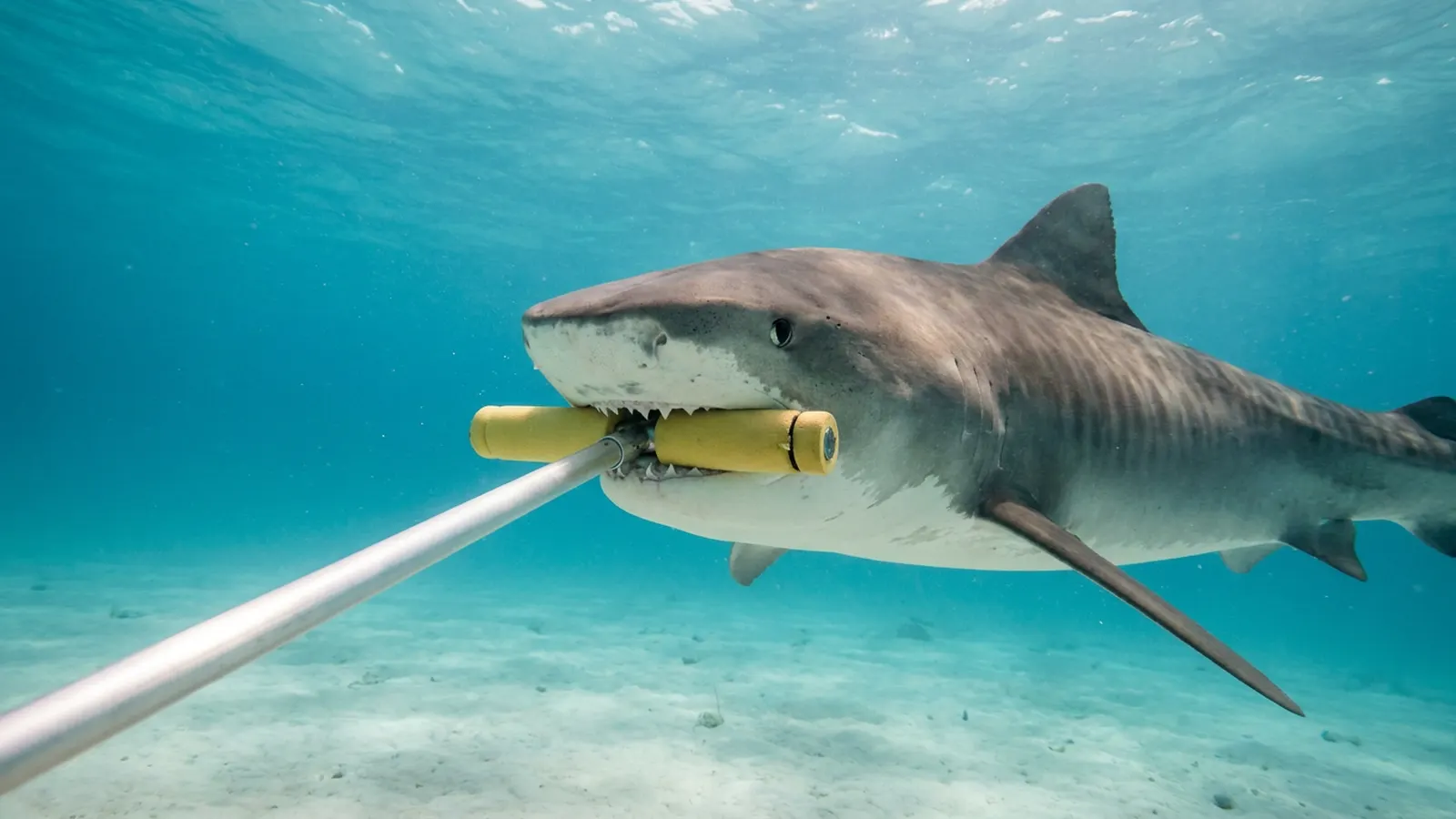
How shark bite force gets measured
Measuring bite force in any large predator is hard. In sharks, three approaches are used — each with limitations.
The tooth, not the force, is what makes a tiger shark dangerous to a turtle
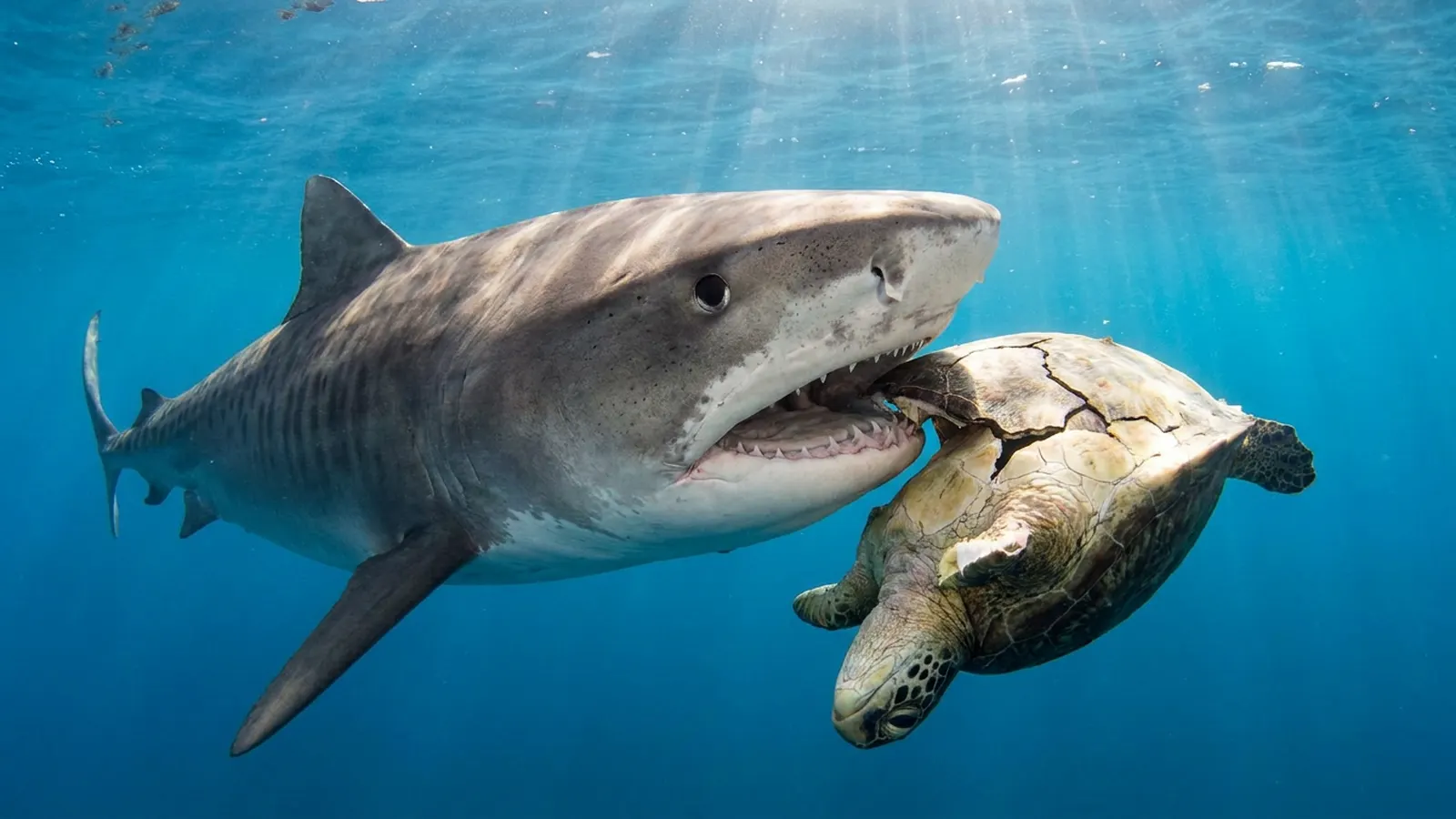
Most predators with bite forces over 1,000 PSI cannot consume an adult sea turtle. Tiger sharks can. The reason is tooth geometry — not raw clamping force.
A tiger shark tooth is one of the most distinctive in the entire chondrichthyan lineage. It combines four features that, together, make it a precision shell-cutting instrument:
Why this tooth, and not just force, opens turtles
- Bilateral serration. Both edges of every tooth are heavily serrated — like a steak knife, but with the serrations themselves serrated. This concentrates force along microscopic edges, multiplying effective pressure at the contact line.
- Deep notch on the trailing edge. Found in no other large shark. The notch lets the tooth grip and saw, rather than just puncture — the tooth carves a path through hard tissue rather than driving straight in.
- Identical upper and lower jaws. Most sharks have differentiated upper (cutting) and lower (grasping) teeth. Tiger sharks have the same cutting tooth in both jaws, so any closure of the mouth is a sawing action.
- Curved profile. The tooth curves laterally, matching the curvature of a turtle carapace. Pressure stays distributed along the cutting edge rather than concentrated at one point that might glance off.
The implication: a great white shark, with about 4,000 PSI at the jaw, can shear off chunks of seal because the seal is soft tissue. A tiger shark with 6,000 PSI can saw through the carapace of a 100-kg adult green turtle because the tooth shape distributes that pressure along a sawing edge. Force matters; geometry matters more.
What 6,000 PSI feels like in real-world terms
Pressure values in the thousands of PSI are abstract. Concrete comparisons help.
6,000 PSI at the rear of a tiger shark’s jaw, applied to a contact area of roughly 1 cm² (the cross-section of the largest cutting tooth at the gum line), works out to about 4,100 N of force at that single tooth tip — roughly the weight of a small adult pig hanging on the tooth, concentrated on a few square millimetres of cutting edge. By comparison:
The 37× multiplier is what people are imagining when they hear “the bite force of a tiger shark.” But that ratio depends on contact area assumptions, and a more honest framing is that an adult tiger shark can deliver more force, more concentrated, and along a sharper edge, than essentially any other predator a swimming animal is likely to encounter. The exact number is less important than the practical consequence: there are very few materials in the marine environment that will resist it, and turtle shell — sea otter shell, large bony fish skulls, conspecific bite wounds — is one of them only at the margin.
Caveats — what the 6,000 figure does not say
A few things the headline number is sometimes used to imply, but does not actually establish.
Three other caveats worth flagging when 6,000 PSI numbers come up in discussion:
The figure is for adults near maximum size. A 3-metre tiger shark — the size most often encountered by divers — bites with significantly less force, perhaps 2,500–3,500 PSI extrapolated. Most tiger sharks people actually meet are not delivering anywhere near the headline number.
The figure compares posterior vs anterior, not closure vs closure. When a tiger shark mouths an unfamiliar object — the behaviour responsible for most non-fatal bites on humans — the contact is at the front of the jaw, where bite force is roughly a quarter of the posterior figure. This is why many tiger shark “bites” on humans cause severe lacerations but stop short of removing limbs: the animal is not biting hard, it is sampling.
Direct cross-species ranking is approximate. The Erickson crocodilian figures are direct measurements; the shark figures are extrapolations and models. Treating “tiger shark 6,000” and “saltwater crocodile 3,700” as if they were measured the same way is misleading. Tiger shark posterior force probably exceeds saltwater crocodile force at comparable jaw closure, but the precision implied by single-digit differences is false.
Does the tiger shark have the strongest bite of any shark?
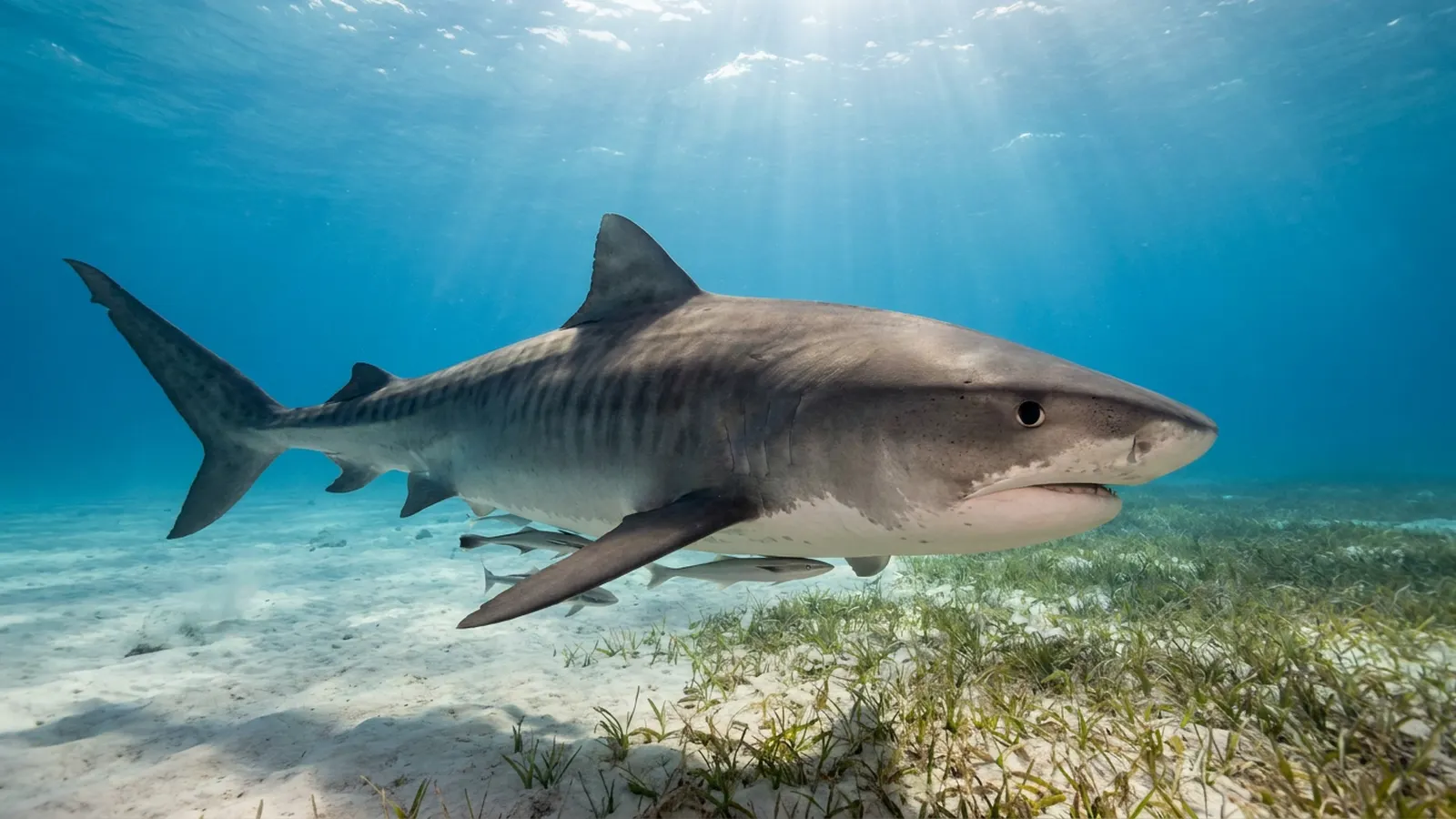
By the most cited figures, yes — tiger shark posterior bite force (~6,000 PSI) exceeds great white (~4,000 PSI), bull shark (1,250 PSI), and the lamnid mackerel sharks (mako, salmon shark, porbeagle). Larger filter feeders like whale sharks and basking sharks have effectively zero bite force because they don’t use their jaws to process prey.
Is a tiger shark’s bite stronger than a saltwater crocodile’s?
By raw PSI, the modelled tiger shark figure (~6,000) exceeds the directly-measured saltwater crocodile figure (~3,700). But the two numbers were obtained by different methods — the crocodile via force transducer, the tiger shark via jaw modelling and extrapolation — so direct comparison is approximate. Functionally, tiger sharks can saw through turtle shell that defeats most crocodilians, which suggests the tooth-shape advantage matters more than the raw force gap.
Can a tiger shark bite a human in half?
Mechanically, an adult tiger shark has the bite force and tooth geometry to remove a leg or a torso section in a single closure of the rear jaw. In practice, the species’ bite-and-release behaviour means most attacks involve a single sampling bite at the front of the jaw and the shark moves on. Fatalities almost always result from blood loss from a severed femoral artery, not from being divided.
What’s the highest PSI ever measured in a shark?
The Mara et al. (2010) extrapolation for a maximum-size adult tiger shark (5.5+ m) yields posterior bite forces above 6,000 PSI — the highest published figure for any shark. The extinct megalodon (Otodus megalodon) is estimated at 100,000+ N total force based on jaw mechanics, but PSI conversion depends so heavily on assumed tooth area that a meaningful PSI figure for megalodon doesn’t really exist.
Why is bite force usually given in PSI rather than newtons?
PSI (pounds per square inch) is a pressure unit — force divided by area — while newtons measure raw force. PSI is more intuitive when comparing biting through different materials, because what matters at the tooth–prey interface is pressure. The downside is that PSI depends on which contact area you divide by, so two researchers studying the same skull can produce quite different PSI numbers from the same underlying force estimate.
- Mara, K. R., Habegger, M. L., & Motta, P. J. (2010). Examination of the feeding mechanism in the tiger shark, Galeocerdo cuvier. Zoology, 113, 165–174. The primary source for the extrapolated 6,000 PSI figure.
- Wroe, S., Huber, D. R., et al. (2008). Three-dimensional computer analysis of white shark jaw mechanics: how hard can a great white bite? Journal of Zoology, 276, 336–342. Companion paper for great white comparison.
- Erickson, G. M., et al. (2012). Insights into the ecology and evolutionary success of crocodilians revealed through bite-force and tooth-pressure experimentation. PLoS ONE, 7(3): e31781. Direct-measurement crocodilian benchmark.
- Florida Museum International Shark Attack File (ISAF). Tiger shark attack records since 1580. Updated annually.
Blane Perun has been exploring Earth’s oceans and marine life for over 25 years. Founder of TheSea.Org in 1999, underwater photographer, coral aquaculture pioneer, and explorer of 80+ countries.
About Blane Perun → Back to Tiger Shark →