Shipwrecks of Aruba — The Antilla, Pedernales, Jane Sea and More
Aruba’s most famous wreck is the Antilla, a German freighter of about 120–130 metres that its crew scuttled off the north-west coast on 10 May 1940. The Pedernales, an oil tanker torpedoed by U-156 in February 1942, lies in shallow water nearby. Artificial reefs, including the Jane Sea, Star Gerren and Debbie II, and two airliners sunk off Renaissance Island complete one of the Caribbean’s best wreck-diving line-ups.
Aruba’s wrecks fall into two groups: ships lost in the Second World War, when the island’s oil refinery made it a target, and vessels and aircraft sunk deliberately since the 1980s to create dive sites and reef habitat.
Aruba has some of the most accessible wreck diving in the Caribbean. The island lies just off the coast of Venezuela, outside the main hurricane belt, with warm water, good visibility and a calm, sheltered west coast where most of the dive sites are found. Its waters hold a German freighter scuttled at the start of the Second World War, the remains of a tanker torpedoed by a U-boat, and a collection of ships, barges and aircraft sunk on purpose as artificial reefs. Several wrecks lie in water shallow enough for snorkellers, while others suit advanced divers.
The wrecks also tell the story of Aruba itself. In the twentieth century the island was home to one of the largest oil refineries in the world, the Lago refinery at San Nicolaas, which processed Venezuelan crude. That made Aruba strategically important in the Second World War and brought both the Antilla affair of 1940 and the U-boat attack of 1942. Later, as tourism replaced oil as the island’s main business, old ships and aircraft were sunk to create attractions for divers and new habitat for reef life.
What is the Antilla wreck?
The Antilla is the largest and most famous wreck in Aruba, and one of the largest wrecks in the Caribbean. It was a German cargo steamer, built in Hamburg in 1939, with a length usually given as around 120 to 130 metres, about 400 feet. When war broke out it took refuge in the neutral waters of the Dutch Caribbean, anchored off Aruba’s north-west coast.
On 10 May 1940 Germany invaded the Netherlands. The Dutch authorities on Aruba moved to seize German ships, and the Antilla’s captain chose to scuttle his ship rather than let it fall into enemy hands. Accounts describe the boilers being run hot and the sea cocks opened, with an explosion as cold water hit the hot boilers. The ship sank in shallow water off what is now Malmok, and its crew were taken into custody. Stories that the Antilla was a supply ship for U-boats have circulated ever since; they make a good tale, but the firm history is of a German freighter trapped by the war.
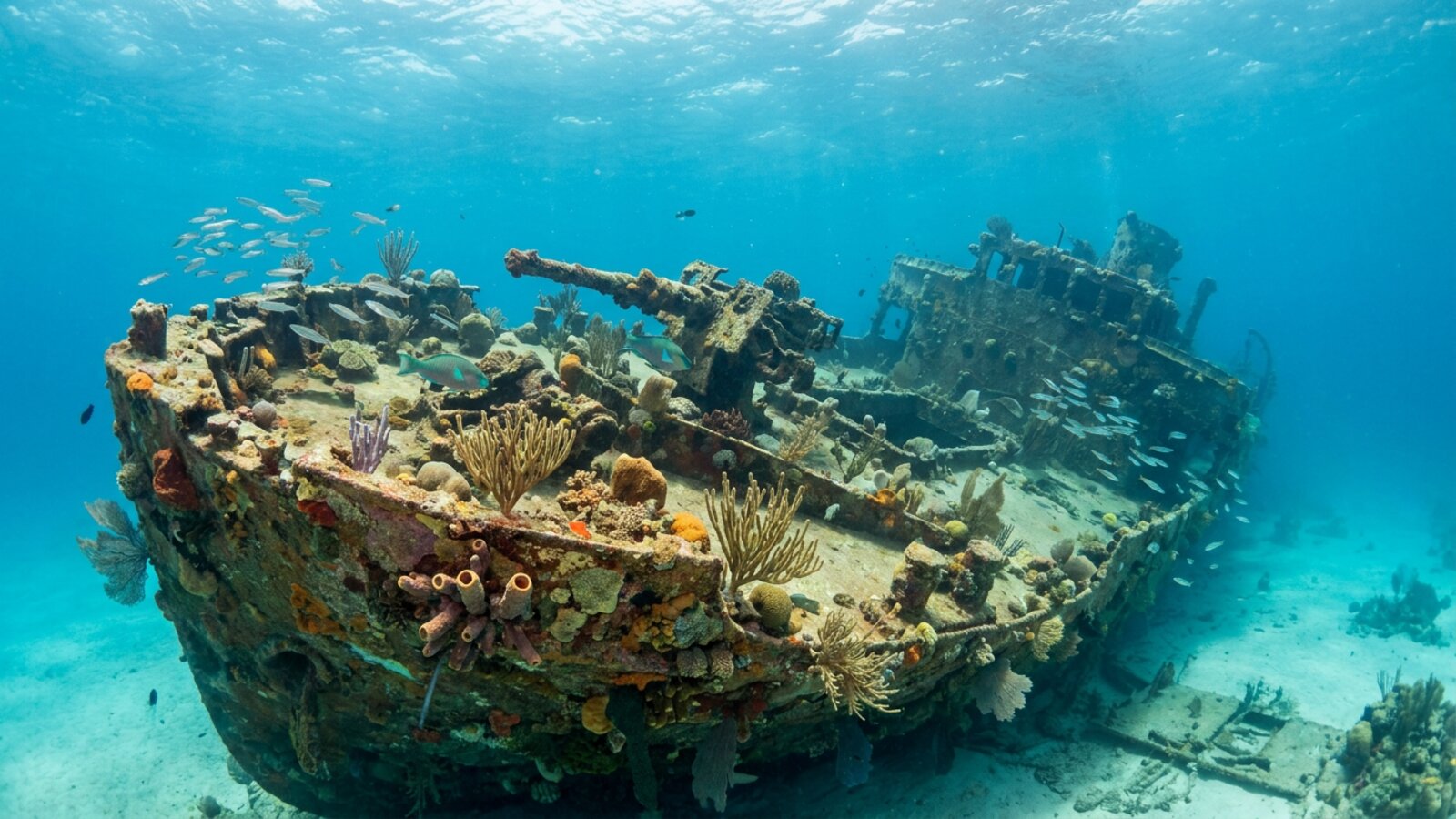
How deep is the Antilla, and what is it like to dive?
The Antilla lies in about 15 to 18 metres of water, with parts of the wreck rising close to the surface, so it can be explored by divers of all levels and even seen by snorkellers on a calm day. The hull lies mostly on its port side and has been broken up by storms over the decades, but it is still huge, with large open holds and compartments that divers can look into. Some sections can be penetrated by trained wreck divers; others are unstable and best viewed from outside.
After more than 80 years on the bottom the Antilla is heavily encrusted with coral, sponges and tube worms. Schools of fish such as snapper, grunts, silversides and glassy sweepers shelter inside the holds, and divers commonly see moray eels, lobsters, angelfish and sometimes turtles. Locals sometimes call it the ghost ship, for the way its dark hull looms out of the blue. It is usually dived from a boat, as it lies a short ride from the hotels of Palm Beach and Malmok.
What happened to the Pedernales?
The Pedernales was an oil tanker that carried Venezuelan crude to the Aruba refinery. On the night of 16 February 1942, the German submarine U-156 surfaced off San Nicolaas and torpedoed tankers lying off the Lago refinery, as part of a German operation against the oil traffic of the southern Caribbean. The Pedernales was hit and burned through the night. It did not sink entirely: it was run aground, and the shattered middle section was cut out. The bow and stern were then joined together and the shortened ship sailed for repair in the United States and later returned to service.
The same attack went badly wrong for the U-boat. When U-156 tried to shell the refinery with its deck gun, the crew had forgotten to remove the watertight plug from the muzzle, and the gun exploded, killing one gunner and wounding another. Other tankers were hit that night, including the Oranjestad, while the Arkansas was damaged but stayed afloat.
Can you dive the Pedernales?
Yes, and it is one of the easiest wreck dives on the island. The remains of the cut-out midsection lie scattered in only about 7 to 8 metres of water, so the Pedernales is often used as a training dive and is popular with snorkellers. The wreckage includes pipes, tanks and sections of hull plating, with the outlines of cabins, wash basins and toilets still recognisable. Because it is so shallow and sunlit, it is a good place for photography, and it is home to schools of reef fish, small invertebrates and sometimes octopus.
What is the Jane Sea?
The Jane Sea is a cement carrier, usually given as about 76 metres long, that was sunk as an artificial reef in 1988. It sits upright on a slope, with the bow in shallower water and the stern and propeller deeper. Depths run from about 10 metres at the top of the bow to about 30 metres at the stern, so the dive can be tailored to a range of experience. The wreck is heavily overgrown with corals and sponges, and it lies close to natural reef, so it combines a wreck dive with a reef dive.
The Jane Sea is known for colourful encrusting growth, especially orange cup corals and sponges on the hull, and for the reef fish that gather around it. Currents can be stronger here than at the north-west sites, so it is generally recommended for divers with some experience.
What are the Star Gerren and Debbie II?
The Star Gerren is a small cargo vessel, built in Germany in the 1960s and given lengths of around 65 to 75 metres, that was sunk as an artificial reef in 2000. It lies on its side on a sandy bottom at about 18 to 22 metres, and it has shifted over time. It attracts large schools of fish and offers simple swim-throughs for trained divers.
The Debbie II is a fuel barge of about 37 to 40 metres that was sunk in 1992 next to the Malmok reef. It lies at around 24 metres. The wreck is compact and easy to circle in a single dive, and its proximity to the reef means it is often combined with a reef dive. It is a good place to see moray eels, lobsters and schools of snapper and grunts.
Are there aircraft wrecks in Aruba?
Yes. Off Renaissance Island, near the airport, two airliners have been sunk as dive sites. The first is a Convair twin-propeller aircraft that was confiscated from drug smugglers and sunk in the late 1980s; Hurricane Lenny in 1999 broke it apart. The second is a Japanese-built NAMC YS-11 turboprop airliner, formerly flown by Air Aruba, that was sunk in 2004 and remains largely intact. They lie at around 20 to 26 metres and can usually be seen on the same dive.
Diving on aircraft is unusual and makes for striking photographs: the wings, fuselage and cockpit are easy to recognise, and fish quickly colonise the interiors. Other sunken aircraft lie elsewhere on the island’s west coast, and dive operators can advise which ones are currently diveable.
What other wrecks can you dive in Aruba?
The island has several more. A tugboat sunk in the 1980s lies on Harbour Reef near Oranjestad, at depths from about 13 to 30 metres, and is known for green moray eels and coral growth. The Kappel, a small steel boat, was sunk around 2009 or 2010 in about 15 metres off Mangel Halto. Deeper wrecks, including the Morning Star cargo ship and the Topaz, which lies below 35 metres, are for experienced and appropriately trained divers.
On the rough, windward north coast lie the remains of the steamship California, which sank in the late nineteenth century and gave its name to the California Lighthouse at the island’s north-western tip. The sea there is usually too rough for diving, and little of the wreck survives.
Why was Aruba a target in the Second World War?
Because of oil. The Lago refinery at San Nicolaas, at the island’s south-eastern end, and the smaller Eagle refinery near Oranjestad processed huge volumes of Venezuelan crude, shipped across from Lake Maracaibo in shallow-draught tankers. Fuel from Aruba and neighbouring Curaçao was vital to the Allied war effort, and Germany knew it. The U-boat attack of February 1942 was designed to choke that supply by sinking tankers and, if possible, damaging the refineries.
The raid caused real losses and alarm, but it failed to put the refineries out of action. Allied defences in the area were strengthened afterwards, with more patrols, convoys and coastal guns. The broken remains of the Pedernales on the seabed are one of the few physical reminders of that campaign that visitors can see today.
What marine life lives on the wrecks?
Most of Aruba’s wrecks are now covered in a living skin of hard and soft corals, sponges, hydroids and tube worms. Typical residents include green and spotted moray eels, spiny lobsters, scorpionfish, trumpetfish, angelfish, parrotfish, sergeant majors and schools of grunts and snapper. Night dives on the shallow wrecks reveal crabs, shrimp and octopus, while eagle rays and turtles are sometimes seen passing by. Invasive lionfish, a problem throughout the Caribbean, also shelter in wrecks, and local divers and dive shops take part in culling efforts.
When is the best time to dive Aruba’s wrecks?
Diving is good all year. Aruba sits south of the main hurricane belt, although storms occasionally pass close by, and the water is warm year-round, typically around 26 to 29°C. The constant trade winds blow from the east, so the sheltered west and south-west coasts, where most wrecks are found, usually stay calm. Visibility is often good, though it varies with plankton and with runoff after rain, and it can be reduced near the harbour and the airport.
The busiest months for tourism are the winter high season, from about December to April, when dive boats fill up and booking ahead helps. Summer and autumn bring warmer water and fewer visitors.
What should divers know before going?
Most wreck dives in Aruba are boat dives, run by local dive shops from the hotel areas around Palm Beach and Oranjestad. The Pedernales and Antilla are suitable for beginners in calm conditions, while the deeper airliners and the Jane Sea suit divers with more experience. Penetration of any wreck should only be attempted with proper training, a guide and suitable equipment, as interiors can be silty, confined and unstable. Currents are usually mild on the west coast, but they can pick up, so listen carefully to the dive briefing.
Respect the wrecks and their marine life. Do not remove anything; touching coral and sponges damages them, and sharp metal and fire coral can injure you. Many of Aruba’s reefs and wrecks fall within the Parke Marino Aruba, a marine park established to protect the island’s coastal waters, and park rules apply. Snorkellers can see the Antilla and Pedernales from the surface in good conditions, but should stay with a guide or boat, as the sites are in the path of dive and tour boats.
Why do artificial reefs matter?
Deliberately sunk ships and aircraft provide hard surfaces where corals, sponges and other organisms can settle, and they create shelter for fish. In a place like Aruba, where tourism depends on diving and snorkelling, artificial reefs also spread visitor pressure away from natural reefs. Vessels sunk for this purpose must be cleaned of fuel, oils, asbestos and other pollutants first, and modern projects follow environmental guidelines that did not exist when some earlier wrecks were sunk.
Over time an artificial reef becomes something like a natural one. On the Jane Sea, decades of growth have turned a cargo ship into a living structure that is now as much reef as ship, and the older wartime wrecks have gone through the same transformation without any planning at all.
How do Aruba’s wrecks compare with the rest of the Caribbean?
Aruba is one of the Caribbean’s strongest wreck destinations for its size, because of the combination of shallow, accessible wrecks, a genuine Second World War history and a cluster of artificial reefs within a short boat ride. Neighbouring Bonaire is better known for shore-dived reefs, and Curaçao has its own wrecks, including the Superior Producer and the Tugboat. Further afield, the Cayman Islands offer the Kittiwake and the Captain Keith Tibbetts, and Grenada has the cruise liner Bianca C. Divers who want to see as many wrecks as possible in a week will find Aruba hard to beat.
Several of these wrecks can also be snorkeled; see the best snorkeling in Aruba.
What is the most famous shipwreck in Aruba?
The Antilla, a German freighter scuttled off the north-west coast in May 1940.
How deep is the Antilla wreck?
Roughly 15–18 metres, with parts of the wreck rising close to the surface.
Can you snorkel shipwrecks in Aruba?
Yes. The Pedernales and parts of the Antilla can be seen from the surface in calm conditions.
Who sank the Pedernales?
The German submarine U-156, on 16 February 1942.
Are there plane wrecks in Aruba?
Yes, a Convair and a YS-11 off Renaissance Island at about 20–26 metres.
When was the Jane Sea sunk?
In 1988, as an artificial reef.
Do I need to be advanced to dive Aruba’s wrecks?
No. Several are shallow; deeper wrecks and any penetration need more training.
- Divernet (2010), Aruba: Isle of Wrecks
- Aruba Tourism Authority: Aruba’s top wreck dives
- uboat.net: U-156 and the attack on Aruba, February 1942
- PADI dive site guide: Antilla wreck
Blane Perun has been exploring Earth’s oceans and marine life for over 25 years. Founder of TheSea.Org in 1999, underwater photographer, coral aquaculture pioneer, and explorer of 80+ countries.
About Blane Perun →