Rose Bubble Tip Anemone — The Red Morph Reef Keepers Clone by the Thousand
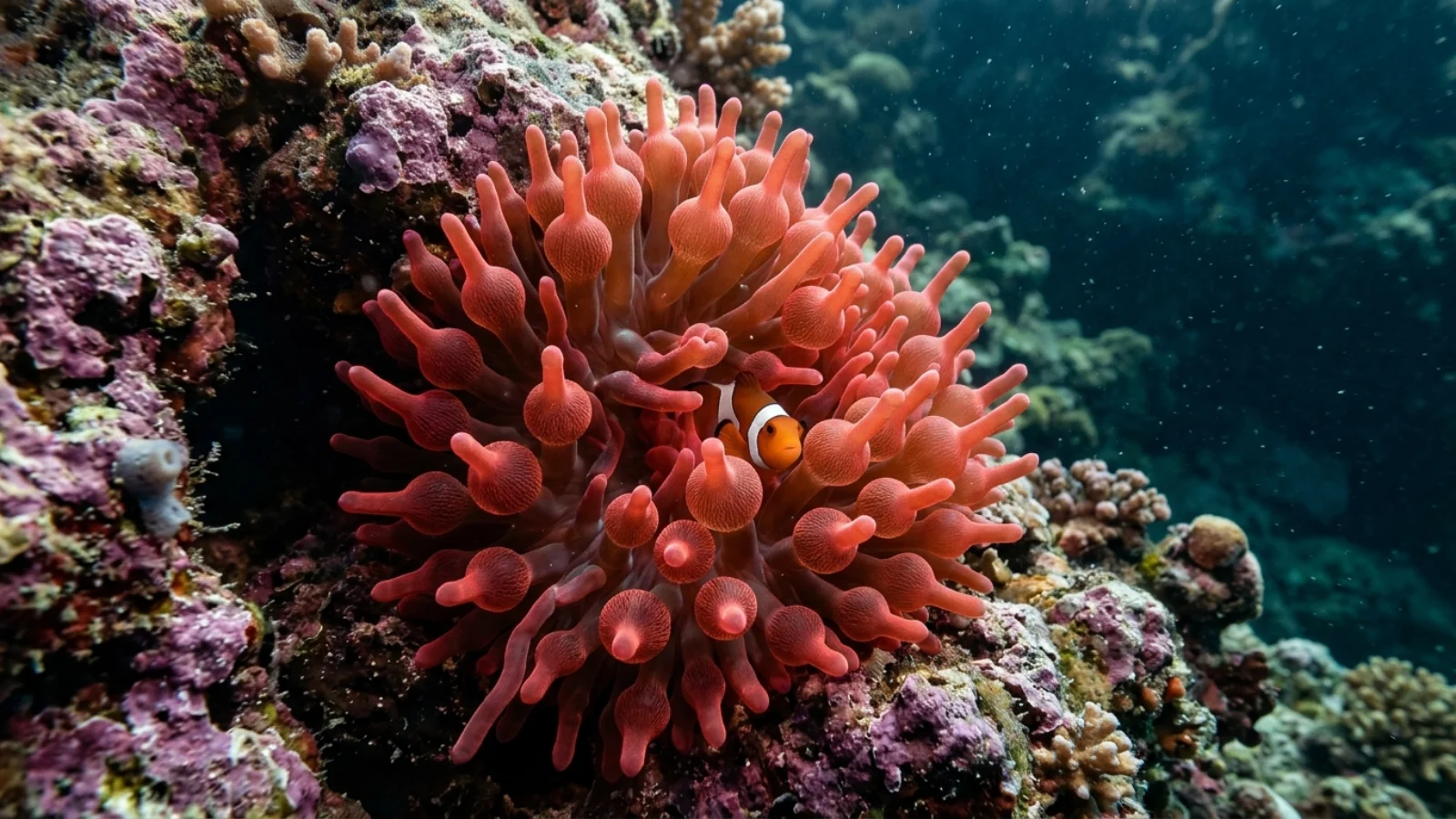
A rose bubble tip anemone is not a species of its own. It is a red colour morph of the ordinary bubble tip anemone, Entacmaea quadricolor, and most RBTAs sold today are clones produced by splitting a small number of red individuals in aquariums.
That single fact explains almost everything about the RBTA: why it behaves exactly like a brown bubble tip, why its colour can vary from tank to tank, and why it is now one of the most widely available host anemones in the hobby. If you want the full species biology and wild host-fish list, start with our main bubble tip anemone profile. This page is about the red form: where the colour comes from, why it is a scientific workhorse, how the clone lines arose, and how to keep one healthy.
The species behind the colour
Entacmaea quadricolor was described in 1828 by Leuckart, in a work co-authored with Rüppell, and its name records an early naturalist’s impression of four colours in one animal. It lives across the tropical Indo-Pacific, from the Red Sea and East Africa to Micronesia, Melanesia, Australia and Japan, and SeaLifeBase gives a depth range from the surface to about 200 m. It has gathered dozens of scientific synonyms over two centuries, because its shape and colour vary so much that early workers described the same animal many times under different names.
In the wild it grows in two forms. Smaller individuals live in shallow, bright water, often in dense clusters, with oral discs around 5 cm across and the swollen, bulb-tipped tentacles that give the species its common name. Large solitary individuals live deeper, in dimmer water, with longer, stringier tentacles and oral discs that can reach about 30 to 40 cm across. The bulbs are not a fixed trait: flow, light, health and whether the anemone is hosting a fish all seem to affect whether the tentacle tips swell. A rose BTA in an aquarium usually resembles the shallow-water clustering form.
What makes a rose bubble tip anemone red?
The red is mostly the anemone’s own pigment, not its algae. Like many corals and anemones, E. quadricolor makes proteins in the green fluorescent protein (GFP) family, some fluorescent and some simply coloured. In 2002 Wiedenmann and colleagues described one of them, eqFP611, in the Proceedings of the National Academy of Sciences. It absorbs light most strongly at 559 nm and emits at 611 nm, which at the time was the most red-shifted emission and the largest Stokes shift of any unmodified protein in the GFP family. It fluoresced with a quantum yield of 0.45 and stayed stable from pH 4 to 10, and its red chromophore reached about 90% maturity after roughly 12 hours, passing through a green intermediate.
Rose morphs carry a lot of red pigment in the column and tentacles, which shows through the brown of the symbiotic algae (zooxanthellae) living in the tissue. Under the blue-heavy lighting common in reef tanks, some of that pigment also fluoresces, which is why RBTAs can look almost luminous under actinic light. The algae add brown. When an RBTA is kept under weak light, or recovers from stress, the balance can shift: the algae increase, the red is masked, and the anemone turns a muddy rose-brown. A bleached anemone that has lost its algae can look shockingly bright, which is a warning sign rather than a good colour.
A laboratory star
The bubble tip’s red proteins have had a second career in biology laboratories. Red fluorescent proteins are valuable because red light penetrates tissue better than green and produces less background glow, so researchers can tag genes and cells and watch them inside living organisms. Proteins first isolated from E. quadricolor have been engineered into a family of red and far-red tags used in cell biology and whole-body imaging. One recent example, published in ACS Sensors in 2021, is a modified red protein derived from the species that responds to chloride, allowing researchers to measure chloride concentrations inside living cells. A pink-and-red anemone in a home aquarium is therefore a close relative, chemically speaking, of tools used in medical research worldwide.
Why are most rose bubble tips clones?
Bubble tips can reproduce by splitting in two, and a well-fed anemone in a stable tank may divide repeatedly. Hobbyists who owned an attractive red individual therefore found they could multiply it without collecting more from the reef. Every split is genetically identical to its parent, so a line of RBTAs traced back to a single founder can end up in thousands of tanks. That is why rose lines from different sellers often look so alike, and why keepers sometimes notice that two RBTAs bought years apart behave in the same way.
Deliberate cutting can speed the process up. In a 2014 study in PLOS ONE, Anna Scott and colleagues cut E. quadricolor into halves or quarters to test whether the method could supply the aquarium trade and restock reefs. Survival was high: 89.3% and 93.8% of anemones cut in half survived in two experiments, and 62.5% and 80.4% of those cut in quarters. Halves healed and grew faster, but quartering produced the most anemones overall. Feeding improved growth of the oral disc and reduced weight loss, and the cut pieces took up to 56 days to form a new, off-centre mouth. The authors described it as a low-technology method that could produce anemones year-round, including the colour morphs most valued in the trade.
That is good news for reefs. Host anemones are slow-growing and, in the wild, are already under pressure from collection and heat stress. In 2023 a marine heatwave in the central Red Sea bleached every host anemone of a related species monitored on three Saudi reefs, and was followed by the death of 94.3% to 100% of their resident anemonefish and 66.4% to 94.1% of the anemones. Choosing an aquacultured clone over a wild-collected anemone is one of the easiest conservation decisions a reef keeper can make. Read more in our guide to bubble tip anemone splitting.
How bubble tips reproduce on the reef
Splitting is only half the story. Like other anthozoans, bubble tips can also reproduce sexually, releasing eggs and sperm through the mouth into the water, where fertilised eggs develop into tiny swimming larvae called planulae that drift, settle on the reef and grow into new anemones. Sexual reproduction mixes genes and lets the species spread across reefs; splitting copies a successful individual on the spot. The dense clusters of small bubble tips seen in shallow water are generally interpreted as the products of repeated splitting, which is also how a single red anemone in an aquarium becomes a whole field of rose clones.
The balance between the two matters for conservation. A reef population built mostly from clones can look healthy but carry little genetic variety, which may make it less able to cope with disease or heat. That is one reason researchers interested in restocking reefs, such as the team behind the 2014 cutting study, have focused on propagation methods that can be applied to many different wild individuals rather than to a single attractive line.
Are rose bubble tip anemones harder to keep than brown ones?
No. An RBTA has the same requirements as any other Entacmaea quadricolor. The difference is that tank-raised clones are usually already adapted to aquarium light and food, so they tend to ship and settle better than a freshly collected wild anemone. The basics are the same for every bubble tip: a mature, stable reef, good light, a place to anchor and protection from pumps.
Water quality matters more than any single piece of equipment. Anemones react badly to sudden swings in temperature or salinity, to copper-based medications, and to the toxins released when another anemone or a large coral dies in the system. Many keepers add an anemone only after the tank has run for months with stable readings, and they keep activated carbon or another chemical filter on hand in case something goes wrong. Quarantine new fish elsewhere if they may need copper treatment, because an anemone in the display tank rules that option out.
Feeding, light and the zooxanthellae balance
Like corals, bubble tips get much of their energy from photosynthesis by their zooxanthellae, so light is food. Supplemental feeding with small pieces of marine meaty food helps growth and recovery and is what drives splitting, but overfeeding fouls the water and large chunks are often regurgitated. Many keepers feed a small piece every few days and let the anemone’s tentacle response guide them.
Light also controls colour. Brighter light tends to keep the zooxanthellae population in check relative to the anemone’s own pigments, which helps hold the red; under dim light, algal brown dominates. A sudden jump in light intensity can stress or bleach an anemone, so changes should be made gradually. If an RBTA does bleach, it is not necessarily doomed. A 2019 study in Toxins kept E. quadricolor under light-induced bleaching for five months and found that its venom quality and stinging-cell production were largely maintained, a sign of how resilient the species can be, although a bleached anemone is still starving and needs stable conditions and careful feeding to recover.
Choosing and placing a healthy RBTA
Buying well avoids most problems. A healthy rose bubble tip has a tightly closed or neatly puckered mouth, an intact foot attached firmly to rock or glass, inflated tentacles that grip lightly when touched, and even colour without pale or translucent patches. Avoid anemones with a gaping or torn mouth, a damaged foot, or tentacles that look stringy and deflated for long periods. Where possible, buy a captive-propagated clone that has been in the seller’s system for a while and is already eating.
Expect it to wander at first. Bubble tips move by gliding on the foot until they find a place with the light and flow they like, usually a hole or crevice where the foot is protected and the disc can spread into the light. During this period they can sting corals they brush against and can be pulled into unguarded pump intakes, which is the most common cause of sudden anemone death in home aquariums. Once settled, most stay put unless conditions change. Leaving clear space around the chosen spot, and keeping corals out of tentacle reach, prevents most chemical and stinging conflicts.
Which clownfish go with a rose bubble tip anemone?
In the wild E. quadricolor is the most generalist host anemone, recorded with 14 species of anemonefish, around half of all species. The classic aquarium matches are tomato, Clark’s, red-and-black, two-band and maroon clownfish; maroons associate only with the large solitary form in nature. Captive-bred ocellaris and percula clowns often accept a BTA too, even though they use different hosts on the reef. A maroon clown in a rose BTA is a striking colour match, but maroons grow large and the females become aggressive, so plan the rest of the tank around them.
The partnership benefits both sides. The clownfish gains shelter among stinging tentacles that deter predators, and the anemone gains a defender that chases off fish that would nip its tentacles, along with nutrients from the fish’s wastes and leftover food. In aquariums, a hosted anemone often looks fuller and more active, though an over-enthusiastic clownfish can also stress a small anemone by constantly wriggling into it or stuffing food into its mouth. Matching the clownfish to the anemone’s size helps.
| Clownfish | Wild BTA host? | Notes |
|---|---|---|
| Tomato (A. frenatus) | Yes | Hardy, territorial |
| Clark’s (A. clarkii) | Yes | Hosts almost any anemone |
| Maroon (Premnas biaculeatus) | Yes | Large, aggressive female |
| Ocellaris (A. ocellaris) | No | Often adopts BTAs in tanks |
How is a rose bubble tip different from a rainbow bubble tip?
Both are colour morphs of the same species. A rose BTA is mostly one colour, pink to red. A rainbow bubble tip layers several colours: often a green or orange mouth, a red or orange disc and tentacles that fade through other hues to the tips. Rainbow lines are rarer and usually cost more; rose lines are the more established and widely available. Because the colours come from pigment proteins and algae rather than from different species, both forms need identical care, and both can drift in colour with lighting and health.
Do rose bubble tip anemones keep their colour?
They can, but colour is not fixed. Light intensity and spectrum, nutrient levels and the anemone’s health all shift it. Many keepers find that an RBTA moved from a supplier’s tank looks paler for a few weeks and then colours up again once it settles. Splits from the same rose parent usually share its colour under the same conditions, which is a practical sign that the trait is in the anemone’s own tissue rather than its algae. Persistent loss of red alongside shrinking, a gaping mouth or expelled brown material points to stress rather than a normal colour shift.
Is a rose bubble tip anemone a different species?
No. It is a red colour morph of Entacmaea quadricolor, the ordinary bubble tip anemone.
Why is my rose bubble tip anemone turning brown?
Usually because zooxanthellae are increasing under lower light or higher nutrients, masking the anemone’s red pigment.
Are rose bubble tip anemones aquacultured?
Most on the market are clones produced by splitting or cutting red individuals in aquariums.
How big does a rose bubble tip anemone get?
In tanks usually 10 to 25 cm across; large wild individuals of the species reach about 30–40 cm.
What clownfish host rose bubble tip anemones?
Tomato, Clark’s, red-and-black, two-band and maroon clownfish naturally; captive ocellaris and percula often adopt them too.
Can you keep two rose bubble tips together?
Clones of the same anemone usually tolerate each other; different anemone species should not share a small tank.
Why does a rose bubble tip glow under blue light?
Its red pigment proteins, related to GFP, fluoresce; one of them, eqFP611, emits at 611 nm.
Why is my RBTA so bright and shrunken?
That combination often means bleaching. Look for a recent change in temperature, salinity or lighting.
- Wiedenmann, J. et al. (2002). A far-red fluorescent protein with fast maturation and reduced oligomerization tendency from Entacmaea quadricolor. PNAS 99: 11646–11651.
- Scott, A., Hardefeldt, J.M. & Hall, K.C. (2014). Asexual propagation of sea anemones that host anemonefishes. PLoS ONE 9: e109566.
- Hoepner, C.M., Abbott, C.A. & Burke da Silva, K. (2019). Sea anemones maintain toxic defence when bleached. Toxins 11: 266.
- Bennett-Smith, M.F. et al. (2025). Near complete local extinction of iconic anemonefish and their anemone hosts following a heat stress event. npj Biodiversity.
- Salto, R. et al. (2021). New red-emitting chloride-sensitive fluorescent protein with biological uses. ACS Sensors.
- SeaLifeBase: Entacmaea quadricolor, size, depth and distribution; Wikipedia: Bubble-tip anemone (host anemonefish list).
- Fautin, D.G. & Allen, G.R. (1992). Field Guide to Anemonefishes and Their Host Sea Anemones. Western Australian Museum.
Blane Perun has been exploring Earth’s oceans and marine life for over 25 years. Founder of TheSea.Org in 1999, underwater photographer, coral aquaculture pioneer, and explorer of 80+ countries.
About Blane Perun →