Coral Reef Types — Fringing, Barrier, Atoll and Patch Reefs Explained
There are three main types of coral reef: fringing reefs, which grow from the shore; barrier reefs, which lie offshore behind a deep lagoon; and atolls, rings of reef around a lagoon with no central island. Many scientists add a fourth, the patch reef, a small isolated reef in a lagoon or on a shelf. Charles Darwin showed in 1842 that the three main types can be stages in the life of a single reef around a slowly sinking volcanic island.
Reefs are classified mainly by their shape and by their position relative to land. The same coral species can build all of them; what differs is the setting — how close the reef is to shore, how deep the water is behind it, and whether there is still any land in the middle. Knowing the type tells you a lot about a reef: how it formed, which animals live there, how it protects the coast and how vulnerable it is.
What are the main types of coral reefs?
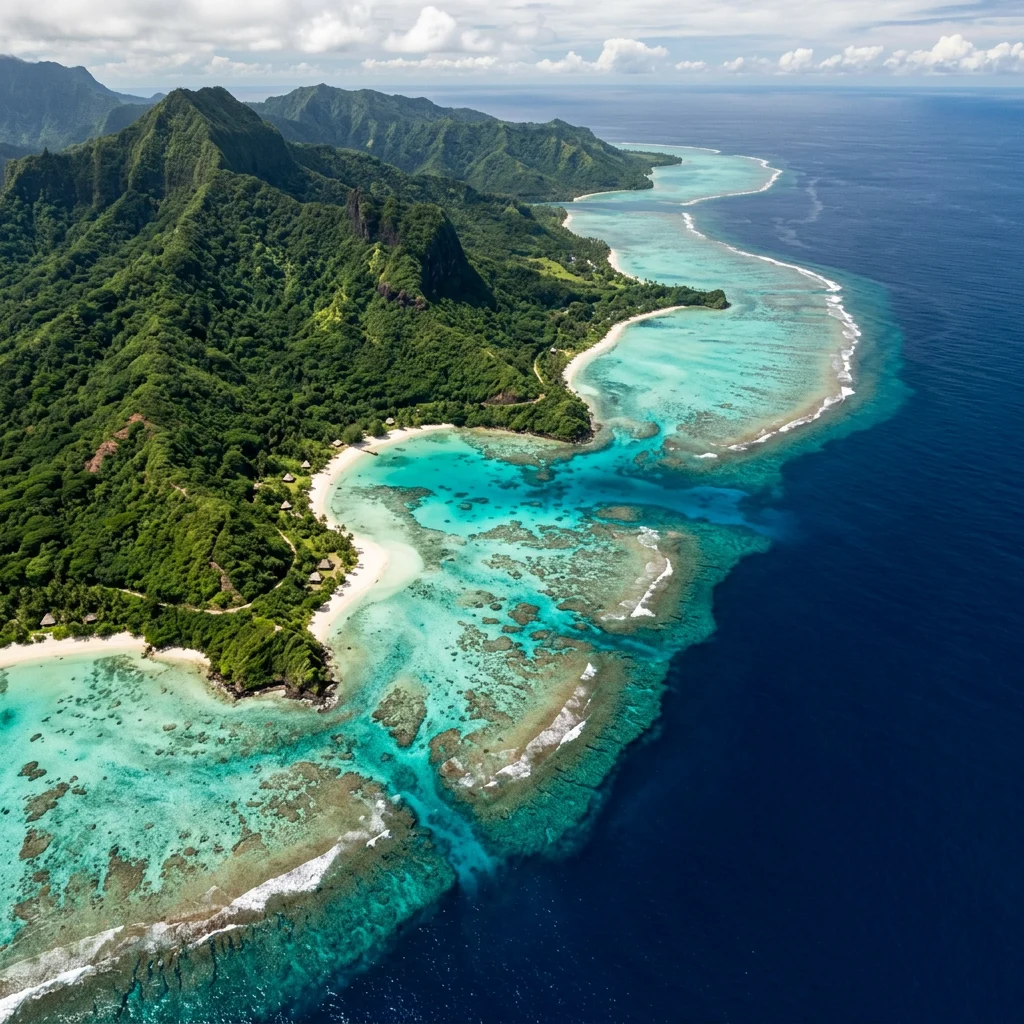
Fringing, barrier and atoll are the three classic types; patch reefs are usually added as a fourth.
| Type | Position | Lagoon | Typical size | Best-known examples |
|---|---|---|---|---|
| Fringing reef | Attached to or very close to shore | None, or a shallow back-reef | Strips along coasts; up to ~260 km | Ningaloo, Red Sea, Hawaii |
| Barrier reef | Offshore, parallel to the coast | Wide and deep | Tens to thousands of km | Great Barrier Reef, Belize, New Caledonia, Florida |
| Atoll | Open ocean, no central island | Enclosed central lagoon | A few km across to the vast Great Chagos Bank | Maldives, Marshall Islands, Tuamotus |
| Patch reef | Isolated, in lagoons or on shelves | Surrounded by sand or seagrass | Metres to hundreds of metres | Florida Keys, Belize lagoon |
What is a fringing reef?
The most common reef type: it grows straight out from the shoreline, often within a short swim of the beach.
A fringing reef grows directly from the shoreline or very close to it, so a swimmer can often walk or snorkel from the beach straight onto living coral. It is the most common type of reef in the world and, in Darwin’s scheme, the first kind to form around any new piece of land in warm, clear water. Fringing reefs line much of the Red Sea coast of Egypt, Sudan and Saudi Arabia, and they are widespread in the Philippines, Indonesia, Timor-Leste, East Africa, the Caribbean and the Bahamas. Even the Great Barrier Reef includes many fringing reefs, mostly around high continental islands such as the Whitsundays. The longest fringing reef is Ningaloo in Western Australia, which runs for about 260 kilometres and in places lies only a short swim from the beach.
A typical fringing reef has two main parts. Closest to shore is the reef flat, a broad, shallow platform that may be exposed at low tide. Because it takes the brunt of freshwater runoff and sediment from the land, the flat often has relatively few corals and more seagrass, seaweed and soft corals. On its seaward side the flat ends at the reef crest, where waves break, and then drops down the reef slope. The slope is usually the richest part of the reef: cleaner water and wave-driven nutrients support the most coral cover and the most species, and on many reefs it is cut into spur-and-groove formations, fingers of coral separated by sand channels that carry sediment downslope.
Because they sit right against the coast, fringing reefs are the first to suffer from what happens on land: sediment from construction and farming, nutrient pollution from sewage and fertiliser, and physical damage from boats and trampling. They are also the reefs that do the most to protect shorelines from waves, and the ones most people experience first-hand when they snorkel from a resort beach.
What is a barrier reef?
A reef running parallel to the coast but separated from it by a wide, deep lagoon.
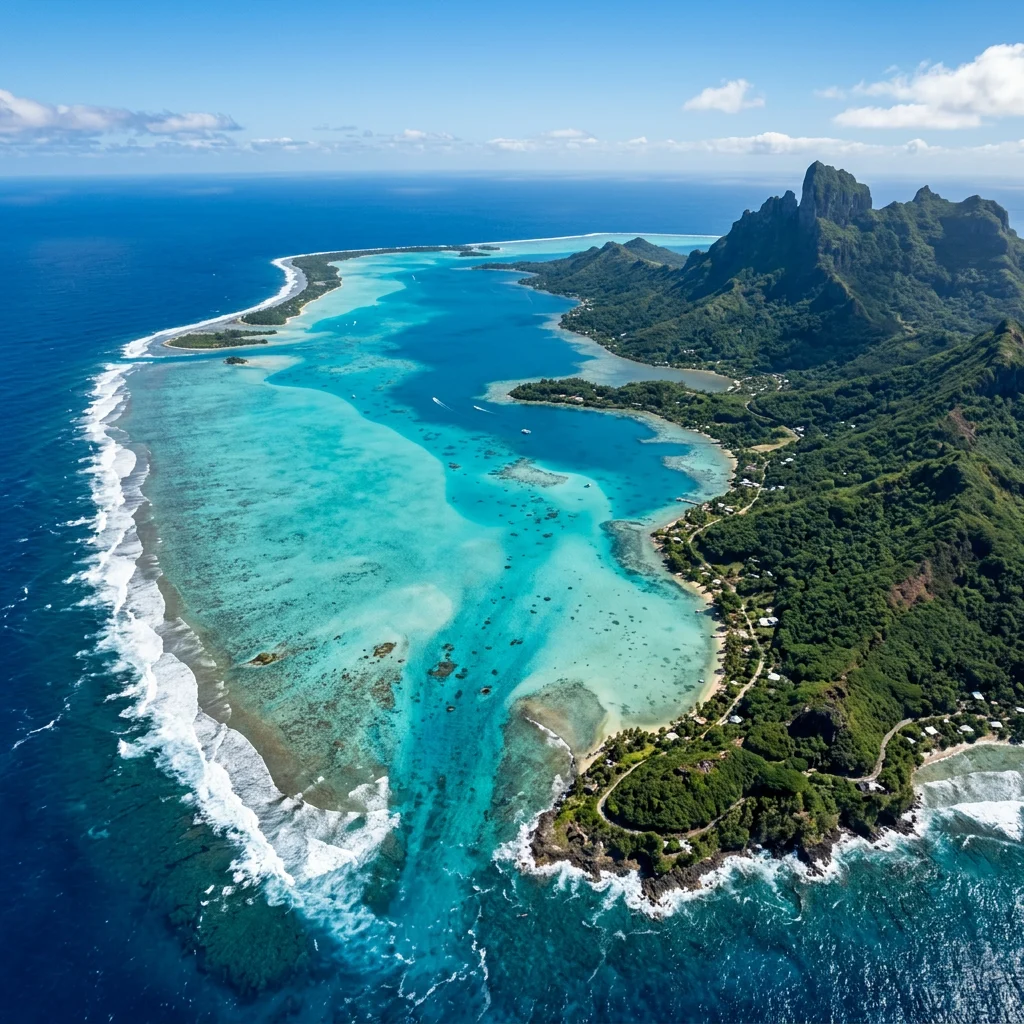
A barrier reef runs roughly parallel to a coast but is separated from it by a lagoon or channel that is wider and deeper than anything behind a fringing reef. The reef acts as a breakwater, so the lagoon behind it is sheltered and often supports seagrass meadows, mangroves and scattered patch reefs. Darwin explained barrier reefs around oceanic islands as former fringing reefs that kept growing upward while the island beneath them slowly sank, leaving a widening gap of water between reef and shore.
The Great Barrier Reef off Queensland is by far the largest example. It stretches for more than 2,300 kilometres, its marine park covers about 344,400 square kilometres, and it is made up of more than 2,900 individual reefs and about 900 islands. It was inscribed as a UNESCO World Heritage Site in 1981. Despite its size, the living reef on top is geologically young: the present reef began growing within roughly the last 10,000 years, when rising seas after the last ice age flooded the continental shelf. In the north, long narrow ribbon reefs line the edge of the shelf.
The Caribbean’s best-known barrier is the Belize Barrier Reef, part of the larger Mesoamerican Reef that runs from Mexico’s Yucatán coast to Honduras. Darwin described it as the most remarkable reef in the West Indies, and it became a World Heritage Site in 1996. In the Pacific, New Caledonia’s barrier reef encloses one of the world’s largest lagoons and was added to the World Heritage List in 2008. The Florida Reef, running from near Miami past Key West, is the only living coral barrier reef in the continental United States; Hawk Channel separates it from the Keys.
What is an atoll?
A ring or horseshoe of reef, often topped with low sandy islands, around a lagoon with no high island in the middle.
The word atoll is one of the few English words borrowed from Dhivehi, the language of the Maldives, where it described the great circular groups of coral islets; Darwin popularised it in his 1842 book. There are roughly 440 atolls in the world, most of them in the tropical Pacific, with others in the Indian Ocean and a handful in the Caribbean, including Lighthouse Reef, Turneffe and Glover’s Reef off Belize. Lighthouse Reef holds the Great Blue Hole, a drowned sinkhole made famous by Jacques Cousteau.
Atolls vary enormously in size. The Great Chagos Bank in the Indian Ocean is the largest atoll structure, covering more than 12,000 square kilometres but with only a few square kilometres of dry land. Kiritimati (Christmas Island) in Kiribati has the largest land area of any atoll, though published figures vary depending on how the lagoon and wetlands are counted. Because most atoll islands rise only a few metres above sea level, entire nations such as the Maldives, Tuvalu, Kiribati and the Marshall Islands depend on healthy reefs both for food and for the sand that builds and repairs their land. Read more in atoll reefs.
What is a patch reef?
A small, isolated outcrop of coral rising from a sandy or seagrass floor, usually inside a lagoon or on a shallow shelf.
Patch reefs can be anything from a single large coral head to a mound hundreds of metres across. They are common in the lagoons behind barrier reefs and inside atolls. Off the Florida Keys, many patch reefs lie in shallow water between Hawk Channel and the outer reef, and the reef tract as a whole includes thousands of individual reefs. For snorkellers, patch reefs are often the easiest and calmest places to see reef life, because they sit in protected water away from the surf on the outer reef. They also act as stepping stones for fish moving between seagrass nurseries and the outer reef. See patch reefs.
How do the reef types form?
Darwin’s subsidence theory links fringing reefs, barrier reefs and atolls; ice-age sea-level swings shaped them further.
In Darwin’s subsidence theory, a fringing reef grows around a young volcanic island. As the island sinks, the reef keeps growing upward and is left farther offshore with a deepening lagoon behind it — a barrier reef. When the island finally disappears below sea level, the reef ring around the lagoon becomes an atoll. Darwin developed the idea during the voyage of HMS Beagle (1831–1836) and set it out in The Structure and Distribution of Coral Reefs in 1842. His key prediction was that beneath every atoll lagoon there should be volcanic rock, buried under a thick cap of reef limestone.
Not everyone agreed. The oceanographer John Murray argued that atolls grew on shallow banks built up from sediment, with no need for sinking. The question was settled by drilling. In 1952 a US Geological Survey team drilled at Enewetak Atoll in the Marshall Islands, and two holes reached volcanic basalt beneath well over a kilometre of reef limestone. Fossils in the cores showed shallow-water reef growth going back tens of millions of years, so the reef had kept pace with a sinking volcano, exactly as Darwin predicted.
Modern geologists add an important refinement. During ice ages, sea level fell by more than a hundred metres, exposing reef tops to rain. Rainwater dissolves limestone and tends to hollow out the centre of a flat reef platform faster than its hard, cemented rim. When the sea rose again, corals recolonised the raised rim, producing a ring-shaped reef around a basin. This “antecedent karst” model helps explain why many atolls and barrier lagoons have the shape they do, and a 2021 review by André Droxler and Stéphan Jorry argued that many atolls owe their present form more to these repeated sea-level swings than to subsidence alone. The ideas are complementary: subsidence provides the volcanic foundation and thick limestone, while glacial sea-level changes sculpt the surface.
Not every reef follows the sequence. Many fringing reefs grow on continental coasts that are not sinking, and continental barrier reefs such as the Great Barrier Reef grew on the edge of a continental shelf. See how atolls form.
Are there other kinds of reefs?
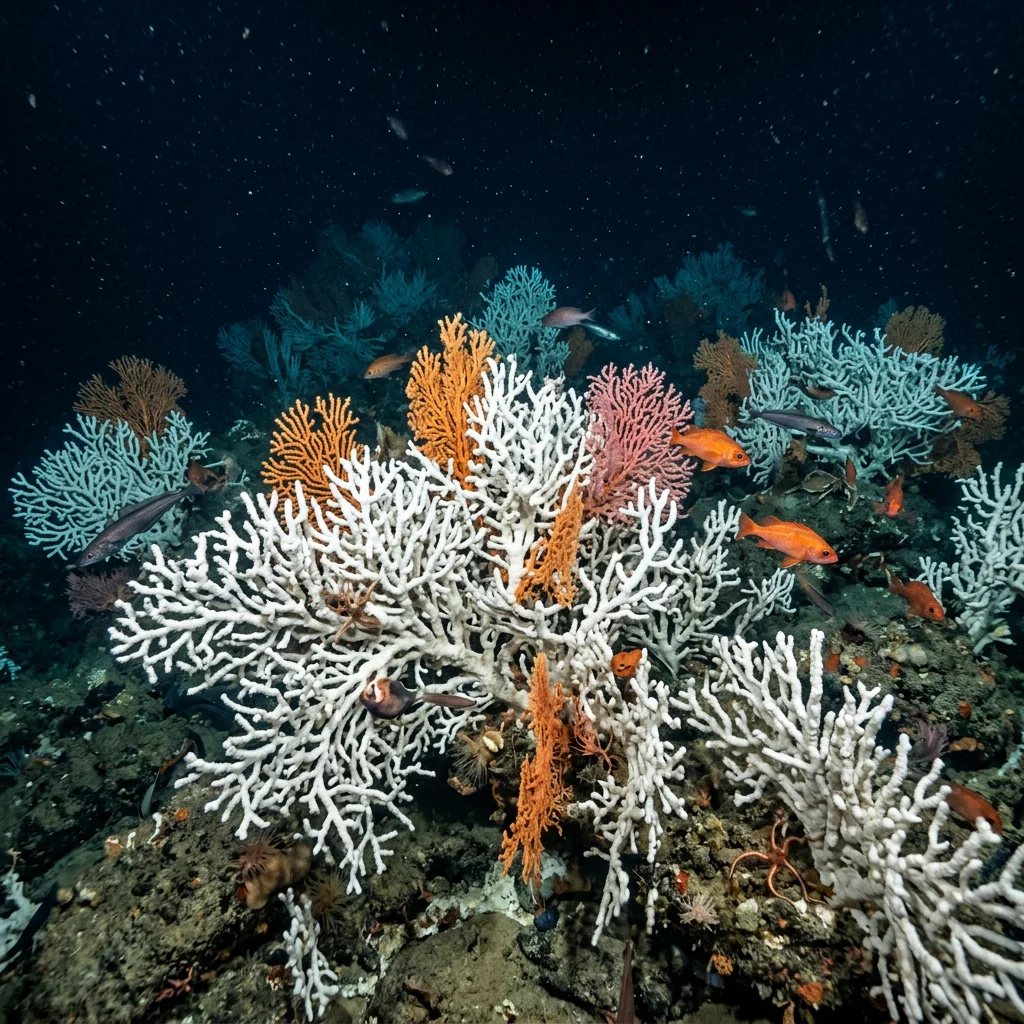
Yes — from platform and ribbon reefs to deep mesophotic and cold-water coral reefs.
Reef scientists use more detailed terms too. Platform or bank reefs are broad, flat-topped reefs on continental shelves that can expand in all directions. Ribbon reefs are long, narrow reefs, such as those on the outer edge of the northern Great Barrier Reef. Apron reefs are short reefs extending from a point or peninsula. Faros are small ring-shaped reefs, each with its own little lagoon, that form on the rims and inner banks of larger atolls; the name comes from the Maldives, where they are best known. A microatoll is a single coral colony whose top has died back at low-tide level while its sides keep growing. In the Red Sea, a habili is a reef pinnacle that does not quite reach the surface, so it shows no breaking waves and is a hazard to boats.
Not every reef is shallow or tropical. Mesophotic reefs are light-dependent coral communities in the deeper part of the sunlit zone, generally from about 30–40 metres down to around 150 metres, below the depths most recreational divers reach. Deeper still, cold-water coral reefs are built by corals that have no symbiotic algae and feed on plankton in total darkness. Some of the largest known lie off Norway, such as the Røst Reef near the Lofoten Islands, built mainly by the stony coral Lophelia pertusa (now often called Desmophyllum pertusum) in water only a few degrees above freezing. Within any shallow reef you will also find distinct reef zones — back reef, reef flat, crest and fore reef — each with its own community.
Why do reef types matter?
Reef type affects which animals live there, how well the reef protects the coast and how vulnerable it is.
Fringing reefs are closest to land and suffer first from runoff and coastal development. Barrier reefs shelter huge lagoons full of seagrass, mangroves and patch reefs. Atoll nations depend on their reefs for both food and the ground they live on. Altogether, coral reefs of every type cover only about 284,300 square kilometres, under 0.1% of the ocean, yet they support around a quarter of all marine species, including thousands of species of fish.
Reef type shapes which of those species live where. The sheltered lagoon behind a barrier reef acts as a nursery for juvenile fish that later move to the outer reef; the steep outer walls of atolls attract sharks, rays and open-water fish; and the turbid reef flat of a fringing reef supports hardy corals and grazers that tolerate sediment. Every type has been hit by marine heatwaves and coral bleaching. On the Great Barrier Reef, mass bleaching struck in 1998, 2002, 2016, 2017, 2020, 2022 and 2024.
How to see each type of reef
Fringing reefs from the beach, barrier reefs by boat, atolls through their channels.
Fringing reefs are the easiest to visit, because many can be reached from shore. The Red Sea coast of Egypt, Ningaloo in Western Australia and many Indonesian and Philippine islands offer shore entries onto good coral. Barrier reefs usually require a boat: the outer Great Barrier Reef is typically one to several hours from the mainland, while the Belize Barrier Reef and the Florida Reef can be reached on half-day trips. The lagoons behind them are good places for calm-water snorkelling over patch reefs and seagrass.
Atolls offer some of the most dramatic diving anywhere, especially in the channels that cut through the rim, where tidal currents bring in nutrients and large animals; the Maldives, French Polynesia’s Tuamotus and the Belize atolls are well-known examples. Whatever the type, use reef-safe sun protection, avoid touching or standing on coral, and choose operators that use moorings rather than anchors.
What are the three main types of coral reefs?
Fringing reefs, barrier reefs and atolls. Fringing reefs grow from the shore, barrier reefs lie offshore behind a deep lagoon, and atolls are rings of reef around a lagoon with no central island. Patch reefs are often added as a fourth type.
What is the most common type of coral reef?
The fringing reef. It forms along the shores of continents and islands throughout the tropics and is usually the first reef type to develop around new land.
What is the difference between a fringing reef and a barrier reef?
A fringing reef grows right against the shore with little or no lagoon. A barrier reef lies farther offshore and is separated from land by a wider, deeper lagoon or channel.
Can a fringing reef turn into an atoll?
In Darwin’s model, yes. Around a sinking volcanic island, a fringing reef becomes a barrier reef and finally an atoll once the island disappears. Drilling at Enewetak Atoll in 1952 found volcanic rock beneath thick reef limestone, supporting the idea.
What is the largest coral reef?
The Great Barrier Reef off Queensland, Australia, a barrier reef system more than 2,300 km long made up of thousands of individual reefs.
Who classified the types of coral reefs?
Charles Darwin, in The Structure and Distribution of Coral Reefs (1842), described fringing reefs, barrier reefs and atolls and explained how they relate.
- Darwin, C. (1842), The Structure and Distribution of Coral Reefs
- Ladd, H. S. et al. (1953), Drilling on Eniwetok Atoll, Marshall Islands, AAPG Bulletin
- Droxler, A. W. & Jorry, S. J. (2021), The origin of modern atolls: challenging Darwin’s deeply ingrained theory, Annual Review of Marine Science
- Spalding, M., Ravilious, C. & Green, E. (2001), World Atlas of Coral Reefs, UNEP-WCMC
- Great Barrier Reef Marine Park Authority, reef facts; UNESCO World Heritage Centre listings
Blane Perun has been exploring Earth’s oceans and marine life for over 25 years. Founder of TheSea.Org in 1999, underwater photographer, coral aquaculture pioneer, and explorer of 80+ countries.
About Blane Perun → More on Coral Reefs →