How to Cycle a Reef Tank — Growing the Bacteria Before You Add the Fish
Cycling a reef tank means establishing the bacteria that convert toxic ammonia into nitrite and then into much less harmful nitrate. You supply an ammonia source (pure ammonia dosed to about 1–2 ppm, fish food, or the natural die-off on live rock), add a bottled bacteria starter to speed things up, and test until the tank can clear a 2 ppm ammonia dose to below about 0.2 ppm within 24 hours, with nitrite near zero. With a quality bottled bacteria product many tanks finish in about 1–2 weeks; without one, a dry-rock cycle commonly takes several weeks. Keep ammonia at about 2 ppm and never above 5 ppm. Add livestock slowly afterward.
What does cycling a reef tank actually do?
It grows a living filter. Cycling means building up populations of microbes on the rock, sand and filter surfaces that turn toxic ammonia into nitrite and then into much less harmful nitrate. Until those microbes are established, any ammonia from fish, food or decay simply accumulates in the water.
Every animal in an aquarium produces ammonia. Fish excrete most of their nitrogen waste as ammonia directly through their gills, and uneaten food, faeces and dead tissue release more as bacteria break down proteins. On a natural reef that ammonia is diluted into an ocean and taken up by algae, corals and microbes almost as fast as it appears. In a closed glass box it has nowhere to go. A new tank filled with clean saltwater and dry rock has almost none of the organisms needed to process it, so the first job of any reef keeper is to grow them before adding animals. That process takes days to weeks, and understanding the biology behind it makes the steps below much easier to follow.
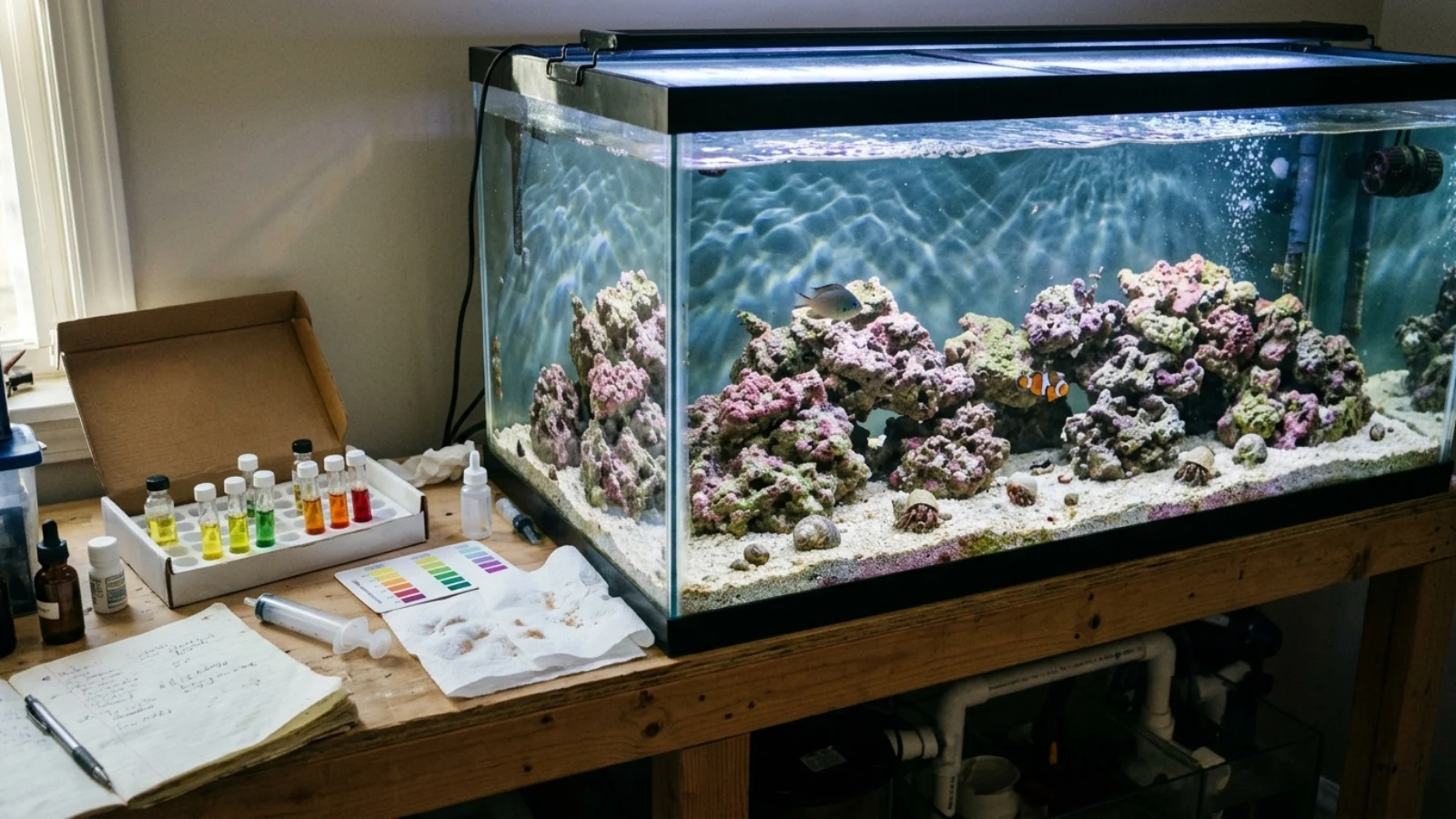
What is the nitrogen cycle in a reef tank?
Fish waste, uneaten food and decaying organisms release ammonia, which is toxic to fish and invertebrates even at low levels. Ammonia-oxidizing bacteria and archaea turn it into nitrite, which is also toxic. Nitrite-oxidizing bacteria then convert nitrite into nitrate, which is far less harmful and is removed by water changes, algae and export. A “cycled” tank has enough of these microbes living on rock, sand and filter surfaces to handle the waste of the animals you plan to keep.
This two-step process is called nitrification. It was first worked out in the late nineteenth century, when the Russian microbiologist Sergei Winogradsky showed that separate groups of soil bacteria carry out the two steps, and that they get their energy from the chemical reactions themselves rather than from eating organic matter. Nitrifiers are chemoautotrophs: like plants, they build their bodies from carbon dioxide, but they power the process by oxidising ammonia or nitrite instead of capturing sunlight. That way of life yields very little energy, which is the main reason a cycle takes time. Nitrifying microbes grow far more slowly than the bacteria that feed on organic waste, with doubling times measured in many hours or days rather than minutes, so building a large enough population is a matter of weeks unless you add a starter culture.
Which microbes cycle a saltwater aquarium?
For most of the twentieth century, textbooks credited two bacterial genera, Nitrosomonas for the ammonia step and Nitrobacter for the nitrite step. Modern DNA methods have shown that the real cast is larger and that aquarium filters were part of the discovery. The first ammonia-oxidising archaeon ever grown in pure culture, Nitrosopumilus maritimus, was isolated in 2005 by Martin Könneke and colleagues from the sediment of a tropical marine tank at the Seattle Aquarium. Its genome closely matches genetic material recovered from the open ocean, and archaea of this kind turned out to be among the most abundant ammonia oxidisers in the sea. Some have an astonishing affinity for ammonia, able to use it at concentrations of a few billionths of a mole per litre.
A 2022 review in Water Research X by Josh Neufeld’s group at the University of Waterloo summarised what has been found in aquarium filters since then. In saltwater aquaria, the ammonia step is carried out by archaea, by Nitrosomonas-type bacteria, or by both, and the balance between them appears to depend largely on how much ammonia is present: archaea tend to win in low-ammonia systems, bacteria in heavily loaded ones. The nitrite step in many systems is handled by Nitrospira rather than Nitrobacter. A third group, “comammox” Nitrospira, discovered in 2015, can carry out both steps in a single cell; surveys found it in every freshwater aquarium filter sampled but not in the saltwater systems studied. For the reef keeper, the practical lesson is that the community that matures in a well-run reef tank, adapted to low ammonia levels, may differ from the one that grows during a high-ammonia cycle, so stocking slowly gives it time to adjust.
Why is ammonia so dangerous in a reef tank?
Ammonia exists in water in two forms: the ammonium ion (NH4+) and un-ionised ammonia gas dissolved in the water (NH3). Test kits usually measure both together as total ammonia. It is the un-ionised form that does most of the damage, because it passes easily through gill membranes, and the share present as NH3 rises steeply with pH and temperature. At a typical reef-tank pH of about 8.2 and 25°C, roughly 5 to 8 percent of the total is un-ionised ammonia. In a freshwater tank at pH 7, the figure is well under 1 percent. The same reading on a test kit is therefore roughly ten times more dangerous in a reef tank than in a soft-water freshwater tank. Aquaculture guidelines associate chronic stress and disease in fish with un-ionised ammonia above about 0.1 milligrams per litre.
Nitrite works differently. In fresh water it is very toxic because it is taken up across the gills and converts haemoglobin into a form that cannot carry oxygen. In seawater, the high concentration of chloride ions competes with nitrite for uptake, so marine fish tolerate nitrite much better than freshwater fish. That is no reason to stock during a nitrite spike, since many invertebrates are less tolerant, but it explains why the ammonia phase is the most dangerous part of a cycle in a saltwater tank. Nitrate, the end product, is far less toxic and is managed over the long term by export; see how to lower nitrates and reef tank nitrate level.
How do you cycle a reef tank step by step?
- Set up the tank, rock, sand, pumps and heater; fill with saltwater at about 35 ppt and 25–26°C.
- Add an ammonia source: dose pure ammonia or ammonium chloride (no surfactants) to about 2 ppm, never above 5 ppm, or add a pinch of fish food every day or two.
- Add a bottled nitrifying bacteria product to seed the system; many makers advise turning off UV, ozone and the skimmer for about 48 hours afterward.
- Test ammonia and nitrite every one to three days.
- When ammonia drops, nitrite will rise; keep feeding the cycle with ammonia as needed.
- The cycle is complete when a 2 ppm ammonia dose drops below about 0.2 ppm within 24 hours and nitrite is near zero.
- Do a water change if nitrate is very high, then begin adding livestock slowly.
Two details are worth adding. First, use pure ammonia or ammonium chloride: household cleaners often contain surfactants, perfumes or colourings that can poison the very bacteria you are trying to grow. Second, nitrification consumes oxygen and alkalinity. Oxidising one milligram of ammonia nitrogen to nitrate uses about 4.6 milligrams of oxygen and about 7.1 milligrams of alkalinity measured as calcium carbonate, which is why strong circulation and surface agitation matter during a cycle, and why alkalinity can drift down in a new tank. Check alkalinity once or twice during the process and correct it if it falls well below your target.
How long does it take to cycle a reef tank?
| Method | Typical time | Notes |
|---|---|---|
| Dry rock + ammonia, no bacteria | Several weeks | Slowest but cleanest start |
| Dry rock + ammonia + bottled bacteria | ~1–2 weeks | Most common modern method |
| Fully cured live rock | Days to ~2 weeks | Brings bacteria and biodiversity, plus possible pests |
| Uncured live rock | Several weeks | Die-off fuels the cycle; can be messy |
Temperature, rock porosity and the bacteria product all change the timeline, so always rely on tests rather than the calendar.
The classic pattern is easy to read on a graph of daily tests. Ammonia rises first and stays high until ammonia oxidisers multiply, then falls. Nitrite climbs as ammonia falls, often to well above 1 ppm in a cycle without a starter culture, and lingers because nitrite oxidisers lag behind. Nitrate rises steadily as the second group catches up. A tank is not cycled the first time ammonia reads zero; it is cycled when it can repeatedly process a test dose of ammonia within a day without nitrite building up. Warm water speeds things up, and a tank held at the normal reef temperature of about 25 to 26°C will cycle faster than one left cool. Very high ammonia slows the cycle down, because nitrite oxidisers are inhibited by excessive ammonia, which is why most guides advise dosing to about 2 ppm and never above 5 ppm.
How should you test during a cycle?
Use kits made or validated for saltwater, test at the same time of day, and record the results so you can see the trend rather than a single number. Ammonia, nitrite and nitrate are the three that matter during the cycle; pH and alkalinity are worth checking once or twice. Some ammonia-binding water conditioners can interfere with certain ammonia test methods, so avoid dosing them during a cycle unless the maker confirms compatibility with your kit. If a result looks impossible, retest before acting, because a misread colour chart causes more panic in new tanks than real chemistry does.
Does bottled bacteria really speed up the cycle?
Good products usually do, provided they contain live nitrifiers rather than only heterotrophic bacteria and have been stored as the maker recommends. Seeding a tank with an established culture skips the slowest part of the process, waiting for a few stray cells to multiply into a large population. Many reef keepers now finish a dry-rock cycle in one to two weeks this way. Results vary between products and batches, so the test-based endpoint matters more than the label. Some products are designed to be dosed with livestock already present; they can work, but they still place animals in water where ammonia may briefly rise, so a fishless cycle remains the safer choice.
Other ways to seed a tank include a piece of established live rock, a handful of sand or a filter sponge from a healthy, disease-free reef tank. These bring a whole community of microbes and small invertebrates, but they can also bring pests such as aiptasia, nuisance algae or parasites, so they should only come from a trusted source.
Should you cycle with dry rock or live rock?
Dry rock is now the most common starting point. It is clean, pest-free and easy to aquascape, but it starts biologically empty, so it needs an ammonia source and ideally a bacterial starter. Some dry rocks mined from old reef deposits can also release phosphate for months, which feeds algae during the early stages. Cured live rock carries an established community of nitrifiers, other bacteria, sponges, worms and crustaceans, and a tank built on it can be ready within days, though it may also carry hitchhikers you do not want. Uncured live rock that has been out of water for a while will shed decaying organisms, which produce a strong but messy cycle. Whichever you choose, the rock surface and the sand bed are where most of the nitrifying community will eventually live, more than in any filter. Our guide to substrate and live rock covers the options.
What happens after the cycle?
Expect an “ugly phase” of diatoms, then green or hair algae, as nutrients settle and new rock matures. That is normal. Add a cleanup crew of snails and hermit crabs first, then two or three hardy fish at most, and space new additions about two weeks apart so bacteria populations can keep up. Hold off on sensitive corals until nitrate, phosphate, alkalinity and calcium are stable. See diatoms in a new tank, and if red slime or brown snot-like films appear later, cyanobacteria and dinoflagellates.
The reason for the slow stocking schedule is that the nitrifier population is only as large as the ammonia supply that built it. A tank cycled on 2 ppm of ammonia a day can handle roughly that load, but adding a dozen fish at once can produce more than the microbes can process, causing a mini-cycle with fresh ammonia and nitrite spikes. Adding animals in small steps lets the community grow with the load. The same thing can happen later in a tank’s life after a large animal dies unnoticed, after heavy overfeeding, when a large amount of rock or filter media is replaced at once, or after some medications that harm bacteria are dosed into the display. Regular tests for ammonia and nitrite after any big change catch these problems early.
Can you cycle a reef tank with fish?
It is possible but not recommended. Fish-in cycles expose animals to ammonia and nitrite, which damage gills and cause stress. With bottled bacteria and pure ammonia readily available, a fishless cycle is safer and usually just as fast.
A cycle also does not end the need for patience. A tank can be biologically cycled within two weeks yet still be months away from the stable chemistry and mature microbial community that demanding corals prefer. Most experienced reef keepers stock fish and hardy soft corals first, then add more sensitive stony corals once nitrate, phosphate, alkalinity, calcium and salinity have held steady for several weeks. For the full set-up sequence, see reef tank setup.
How long does it take to cycle a reef tank?
About 1–2 weeks with a good bottled bacteria product; several weeks with dry rock and no bacteria. Rely on tests, not time.
How do I know my reef tank is cycled?
A 2 ppm ammonia dose falls below about 0.2 ppm within 24 hours, nitrite is near zero, and nitrate is present.
Do I need to add ammonia to cycle a reef tank?
With dry rock, yes, or a food source that produces ammonia. Cured live rock may provide enough on its own.
Does bottled bacteria really work?
Good products can shorten the cycle considerably, though results vary. Keep testing to confirm.
Why is ammonia more dangerous in saltwater?
At reef pH (about 8.2) a much larger share of ammonia is in the toxic un-ionised form than in neutral fresh water.
Can I add corals during the cycle?
No. Wait until ammonia and nitrite are zero and alkalinity, calcium and salinity are stable.
What should I add first after cycling?
A cleanup crew of snails and hermit crabs, then one or two hardy fish, added slowly.
Why is my tank brown after cycling?
Diatoms commonly bloom in new tanks as silicate and nutrients settle. It usually clears in a few weeks.
- Al-Ajeel, S., Spasov, E., Sauder, L.A., McKnight, M.M. & Neufeld, J.D. (2022). Ammonia-oxidizing archaea and complete ammonia-oxidizing Nitrospira in water treatment systems. Water Research X (PMC8990171).
- Könneke, M. et al. (2005). Isolation of an autotrophic ammonia-oxidizing marine archaeon. Nature 437: 543–546.
- Huang, Z. et al. (2018). Ammonia-oxidizing bacteria and archaea within biofilters of a commercial recirculating marine aquaculture system. AMB Express 8 (PMC5810308).
- Holmes-Farley, R. “Ammonia in Reef Aquaria” and nitrogen cycle articles, Reefkeeping magazine.
- Bulk Reef Supply / Dr. Tim’s Aquatics. Fishless cycling with ammonium chloride and bottled bacteria: dose, challenge test and stocking pace.
- Hanna Instruments. Saltwater aquarium parameter guidelines: ammonia and nitrite targets.
- U.S. EPA nitrification manuals (oxygen and alkalinity consumed per unit of ammonia oxidised).
Blane Perun has been exploring Earth’s oceans and marine life for over 25 years. Founder of TheSea.Org in 1999, underwater photographer, coral aquaculture pioneer, and explorer of 80+ countries.
About Blane Perun →