Pirates Rarely Buried Treasure: What They Actually Did With It
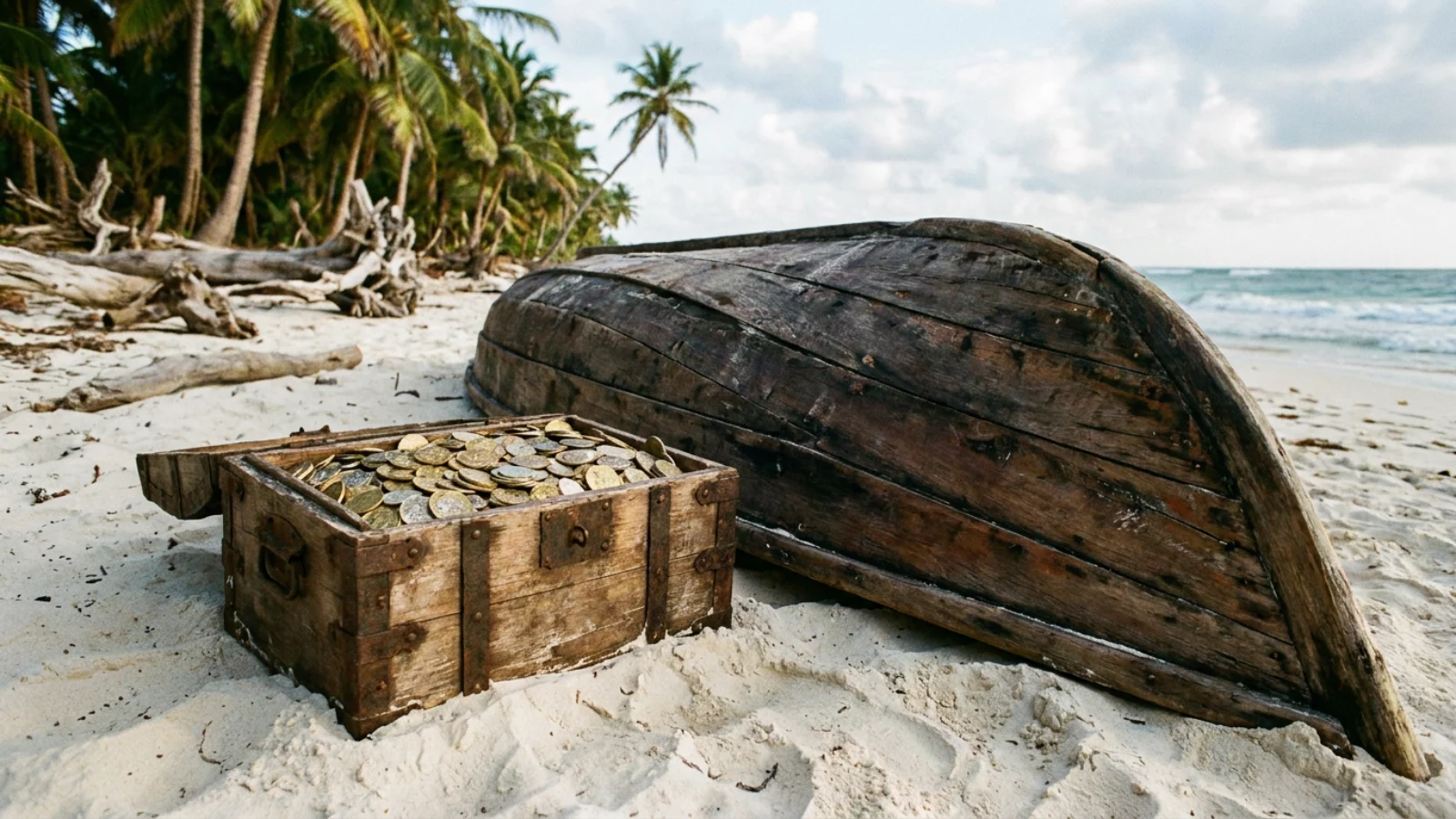
Pirates rarely buried treasure in the way popularised by Robert Louis Stevenson’s Treasure Island. The dominant practice was immediate division of plunder among the crew according to the ship’s articles — no single person retained a hoard to bury. Most captured goods were cargo: sugar, tobacco, naval stores, textiles, and other trade commodities that had to be disposed of through fences and port merchants quickly. Gold and silver were divided and spent. A small number of documented cases exist where pirates concealed wealth, but these are exceptions, and the buried-chest-with-a-map image has no basis in historical practice.
The buried treasure narrative is probably the single most persistent and most historically unsupported element of popular pirate mythology. It has generated three centuries of treasure hunts, inspired an enormous body of fiction, and shaped the public image of pirates more thoroughly than almost any documented historical fact. The actual economic practices of Golden Age pirates were practical, immediate, and completely incompatible with the buried-chest-with-a-map image.
What pirates actually took from prizes
Understanding why pirates rarely buried treasure requires first understanding what they actually took from the vessels they captured. The answer is considerably less romantic than the popular image suggests.
The cargo of a typical 18th-century Atlantic merchant vessel was trade goods: sugar, tobacco, rum, molasses, naval stores (tar, pitch, timber), textiles, manufactured goods, and provisions. These were the commodities that drove the Atlantic economy, and they were what pirates primarily captured. A prize vessel might also carry specie — gold and silver coin — but this was not the primary cargo of most merchant ships, and the amount varied enormously by route and timing.
Burying sugar and tobacco was not practical. These goods had to be disposed of quickly, through port merchants and fences who would buy stolen cargo without asking too many questions, in exchange for cash and provisions. The immediate disposal of cargo through these networks was an essential part of pirate economics, and it was incompatible with long-term concealment. Pirates needed liquid assets, not buried stockpiles.
How plunder was actually divided
The articles that governed Golden Age pirate ships specified how plunder would be divided, and those articles reflect a system designed for immediate distribution rather than long-term accumulation.
After a successful prize, the captured goods were assessed and valued. Shares were allocated according to the agreed formula: the captain typically received one and a half to two shares; specialists including the carpenter, gunner, and surgeon received slightly elevated shares; ordinary crew received one share each. This division happened relatively promptly after a prize was taken, distributing the value among the crew before they returned to port.
Once distributed, individual shares went where they had always gone in maritime culture: they were spent. Port towns that accommodated pirates — Nassau, Tortuga, Port Royal at various periods — had economies partly built around absorbing sailor spending. Taverns, gambling houses, merchants selling provisions and personal goods, and various other services consumed pirate earnings quickly. The pirate who returned from a successful voyage with a substantial share typically left port with much less. Long-term accumulation by individual crew members was the exception rather than the rule.
The documented exceptions: Kidd and Lafitte
A small number of documented cases exist where pirates or privateers did conceal wealth rather than distributing or spending it immediately. These exceptions are historically interesting precisely because they are exceptions.
William Kidd’s concealment of treasure on Gardiners Island in 1699 is the most documented real case. Kidd was returning to New York from a privateering voyage that had crossed into piracy, and he was attempting to negotiate with Governor Bellomont of New York for protection. He left a significant cache of gold, silver, and jewels with John Gardiner on Gardiners Island as a demonstration of good faith and a potential bargaining chip. Governor Bellomont had the cache seized and used it as evidence at Kidd’s trial. The treasure was recovered by authorities — it was never a long-lost hoard waiting for a map.
Jean Lafitte, the Gulf of Mexico privateer active in the early 19th century, is documented as having buried caches near Lake Borgne off the Louisiana coast between approximately 1823 and 1830. Lafitte’s operations were considerably later than the Golden Age and in a different operational context. His buried caches appear in regional folklore with varying degrees of documentation, and their contents — if they exist — have not been recovered. Lafitte is the most plausible candidate for buried pirate treasure in a real historical sense, but his case is atypical and considerably post-dates the Golden Age.
Why burying treasure was impractical
Even setting aside the documented evidence, the buried treasure myth fails on practical grounds. Pirates operated in circumstances that made long-term concealment of wealth both unnecessary and unwise.
The primary problem with burying treasure was that it required trust that the burial location would remain secret and accessible. Pirates operated in communities characterised by shifting alliances, democratic governance that could change leadership rapidly, and social dynamics that made keeping significant secrets extremely difficult. A captain who buried the crew’s share of plunder rather than distributing it would face mutiny. A captain who buried his own share in a known location risked having it taken by rivals, colonial authorities, or his own crew.
More fundamentally, buried treasure was inaccessible capital. Pirates needed working capital to maintain their vessels, recruit crew, provision for voyages, and operate in port. Money buried in a remote location generated no return and provided no operational benefit. The rational economic choice for a pirate captain was to use accumulated wealth to fund continued operations or to convert it into durable goods — not to bury it and hope to return.
Did pirates actually bury treasure?
Rarely, and not in the way popular culture depicts. The dominant practice was immediate division of plunder among the crew. Most cargo had to be sold quickly through port networks. A small number of documented cases exist, with William Kidd’s 1699 Gardiners Island cache the most evidenced, but these are exceptions to standard pirate economic practice.
Where did the buried treasure myth come from?
Primarily from Robert Louis Stevenson’s 1883 novel Treasure Island, which invented the map-with-an-X narrative. Stevenson acknowledged the map was drawn for entertainment. Subsequent pirate fiction built on his template, and the image became inseparable from the pirate archetype in popular culture despite having no real historical basis.
What did pirates do with their plunder instead?
They divided it immediately according to the ship’s articles, sold cargo through port fences and merchants, and spent cash in port towns. Port economies around Nassau, Tortuga, and other pirate havens were partly built around absorbing sailor and pirate spending. Long-term wealth accumulation by individual pirates was the exception rather than the rule.
Is there any documented buried pirate treasure?
William Kidd buried a cache on Gardiners Island in 1699 — the most documented real case — but it was recovered by colonial authorities and used as evidence at his trial. Jean Lafitte buried caches near Lake Borgne in the 1820s according to regional documentation. No buried pirate treasure cache has been recovered through the kind of map-following process that fiction depicts.
Why was burying treasure impractical for pirates?
Pirates needed working capital for vessel maintenance, provisions, and operations. Buried wealth was inaccessible, required keeping the location secret in a community where secrets were hard to keep, and provided no operational benefit. A captain who buried crew shares faced mutiny. The rational economic choice was to use wealth immediately or convert it to useful assets.
Blane Perun has been exploring Earth’s oceans and marine life for over 25 years. Founder of TheSea.Org in 1999, underwater photographer, coral aquaculture pioneer, and explorer of 80+ countries.
About Blane Perun →