Nautilus — The Last Shelled Cephalopods and Their Species
Nautiluses are the last survivors of a group of shelled cephalopods that once filled the world’s oceans. They are relatives of octopuses, squids and cuttlefish, but unlike those animals they live inside a large, coiled external shell divided into gas-filled chambers that they use to control their buoyancy. Today they are found only in the tropical Indo-Pacific, between roughly 30 degrees north and 30 degrees south, on the steep slopes of coral reefs at depths of about 100 to 500 metres, occasionally deeper.
The family, Nautilidae, contains just two living genera, Nautilus and Allonautilus, and somewhere between six and nine species, depending on which authority you follow. This page introduces the family, explains why the number of species is still argued about, and links to TheSea.Org’s profile of each species and name, including several old names whose status is doubtful.
Why are nautiluses called living fossils?
Nautiloids, the broader group to which nautiluses belong, first appeared in the late Cambrian, more than 500 million years ago, and in the Ordovician they were among the largest predators in the sea, some with straight shells over two metres long. They declined over hundreds of millions of years as other groups, including the ammonites and the coleoids, the ancestors of modern squids and octopuses, rose to dominance. The family Nautilidae itself dates back to the Triassic, and fossil nautilids such as Cenoceras and Eutrephoceras look much like living nautiluses. When the ammonites died out at the end of the Cretaceous, the nautilids survived, and their descendants are the only shelled nautiloids left.
The term living fossil is a little misleading, because living nautiluses are modern species that have continued to evolve. But their basic body plan, a coiled, chambered shell with a siphuncle running through the septa, has changed remarkably little, making them a unique window on how ancient cephalopods may have lived.
How do the two genera differ?
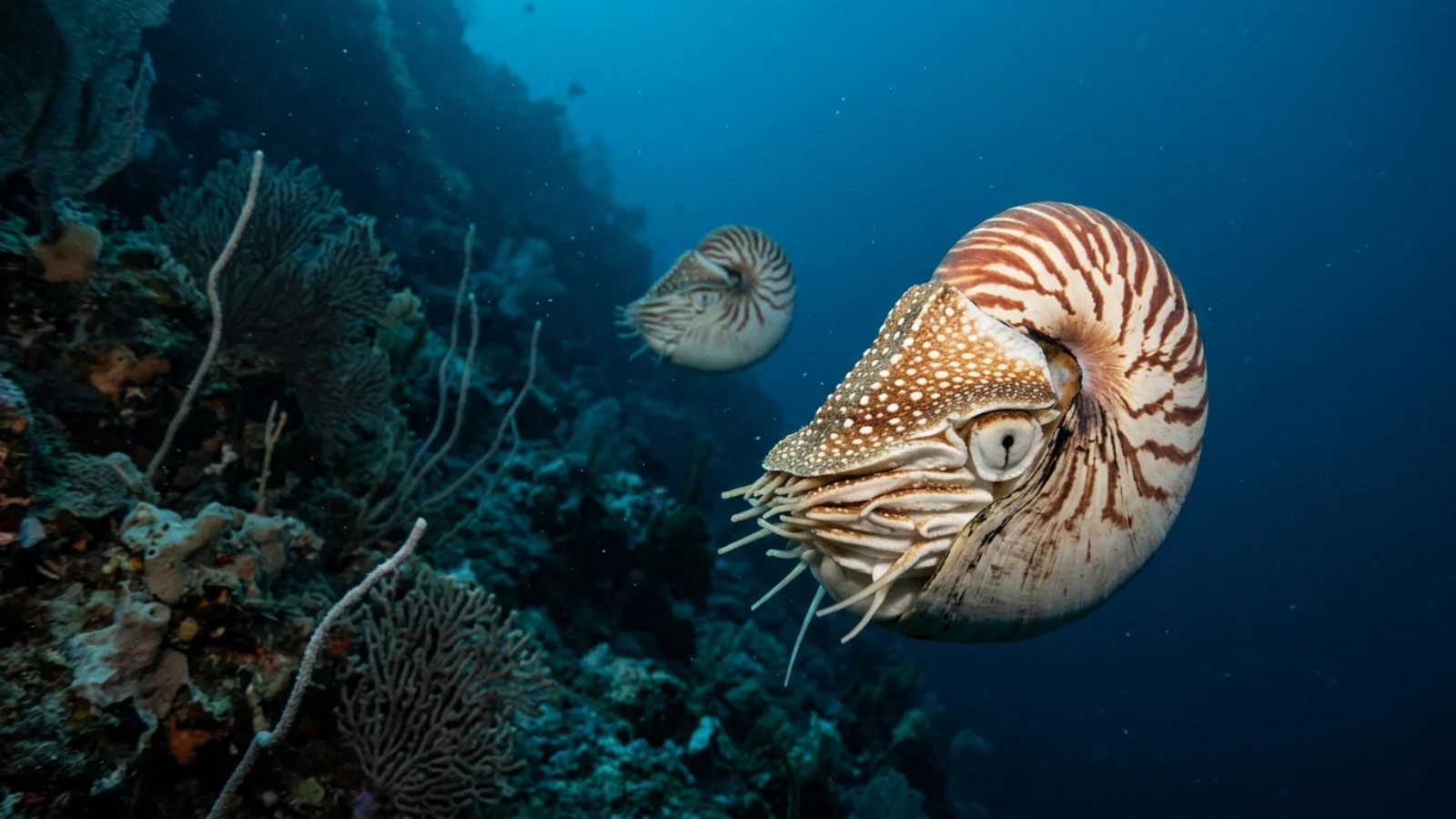
The genus Nautilus, the larger of the two, has smooth shells with orange-brown or reddish stripes on a white background. In most species the centre of the coil, the umbilicus, is closed or covered by a plug of shell. Allonautilus, separated from Nautilus in 1997, has a wide, open umbilicus and, in living animals, a shaggy, hair-like outer coating on the shell called the periostracum, which has earned the crusty nautilus, Allonautilus scrobiculatus, its common name. Allonautilus is known mainly from Papua New Guinea and the Solomon Islands and is rarely seen.
How many nautilus species are there?
The answer depends on whom you ask. Three species are recognised by virtually everyone: the chambered nautilus, Nautilus pompilius, described by Linnaeus in 1758; the bellybutton nautilus, Nautilus macromphalus, of New Caledonia; and the white-patch nautilus, Nautilus stenomphalus, of the Great Barrier Reef. The Palau nautilus, Nautilus belauensis, is accepted by some authorities but treated by others as a form of N. pompilius. Genetic studies have shown that it groups closely with other N. pompilius populations.
In 2023 a team of nautilus researchers described three new species, Nautilus samoaensis from American Samoa, Nautilus vitiensis from Fiji and Nautilus vanuatuensis from Vanuatu, based on shell colour patterns, shell shape and genetic data. They argued that deep water more than 800 metres deep between island groups keeps these populations isolated, so that each has followed its own evolutionary path. Not everyone yet accepts all of them, but they are increasingly used in research and conservation.
Then there are older names that most specialists now regard as doubtful. Nautilus repertus, named by the Australian malacologist Tom Iredale in 1944 for large shells from Western Australia, is currently treated as uncertain. Nautilus alumnus, also named by Iredale in 1944 from Queensland, and Nautilus pompilius moretoni, named by Arthur Willey in 1896 from New Guinea, are considered species dubia, names that cannot be reliably tied to a distinct species. We cover each of these names on its own page because they still circulate in shell catalogues and online.
How can you tell nautilus species apart?
Mostly by the shell, and even then with difficulty. The key features are the size of the adult shell, whether the umbilicus at the centre of the coil is open, closed or plugged, and the extent and pattern of the colour stripes. Nautilus macromphalus has a small open umbilicus, the bellybutton of its common name. Nautilus stenomphalus has a white patch around the umbilicus, and Allonautilus has a wide open umbilicus and a hairy coating. The three species described in 2023 differ in the proportion of the shell covered by stripes, from about 15 to 30 percent in the Fiji species to 40 to 50 percent in the Vanuatu species, and the Samoa species has distinctive branching stripes. Because shell features vary within populations, genetic data increasingly decide where species boundaries lie.
How do nautiluses live?
All living nautiluses share the same basic biology. They swim by jet propulsion, usually backwards, using a muscular funnel called the hyponome. They control buoyancy with gas and liquid in the shell chambers, regulated slowly through a tube of tissue called the siphuncle. They find food mainly by smell, using dozens of sucker-less tentacles called cirri, and they feed as scavengers and opportunistic predators on carrion, crustacean moults and slow-moving animals. Their eyes are open pinhole cups without a lens.
Their life histories are slow. Nautiluses take a decade or more to mature, may live for 20 years or longer, and lay only a few large eggs a year, which take around a year to hatch. Unlike other cephalopods, they breed repeatedly over several years. These traits make them unusually vulnerable to overfishing, and populations on isolated reefs may take decades to recover if they recover at all.
Why are nautiluses protected?
Nautiluses have been fished for centuries for their shells, which are sold as ornaments, carved into souvenirs and jewellery, or mounted in precious metals. Modern trap fisheries in parts of the Philippines, Indonesia and elsewhere have depleted some local populations. In 2016 all species of the family were listed on Appendix II of CITES, which regulates international trade, and in 2018 the United States listed the chambered nautilus as threatened under the Endangered Species Act. Some countries, including Indonesia, protect them under national law. Because the species boundaries are still being worked out, conservationists have argued that naming distinct regional species helps managers protect populations that may be small and isolated.
Where can you see a living nautilus?
In the wild, nautiluses are usually far below diving depths, but there are exceptions. In Palau and some other locations, researchers and dive operators have used baited traps to bring nautiluses to the surface for study and release. In New Caledonia and Vanuatu, where surface waters are cooler, nautiluses have occasionally been seen in water as shallow as 5 metres. Several public aquariums keep nautiluses, and some have bred them, giving visitors a chance to see the slow, deliberate movements of these animals up close.
What about the golden nautilus?
The nautilus shell is often said to grow in a perfect golden spiral, a claim repeated in countless books, websites and design courses. It is a myth. Our page on the golden nautilus explains what the spiral really is and why the golden ratio does not fit it.
How many species of nautilus are there?
About six to nine in two genera, depending on the authority.
Where do nautiluses live?
On deep coral reef slopes in the tropical Indo-Pacific.
How deep do nautiluses live?
Mostly 100–500 m; their shells implode near 800 m.
How long do nautiluses live?
20 years or more, longer than any other known cephalopod.
Are nautiluses endangered?
All are CITES Appendix II listed; the chambered nautilus is threatened under the US ESA.
Are nautiluses related to octopuses?
Yes. They are cephalopods, distant relatives of octopuses, squids and cuttlefish.
- Barord, G. J. et al. (2023), Three new species of Nautilus from the Coral Sea and South Pacific, ZooKeys 1143
- Saunders, W. B. & Landman, N. H. (eds) (2010), Nautilus: The Biology and Paleobiology of a Living Fossil, Springer
- Ward, P. D. & Saunders, W. B. (1997), Allonautilus: a new genus of living nautiloid cephalopod, Journal of Paleontology 71
- NOAA Fisheries (2018), Final rule to list the chambered nautilus as threatened
Blane Perun has been exploring Earth’s oceans and marine life for over 25 years. Founder of TheSea.Org in 1999, underwater photographer, coral aquaculture pioneer, and explorer of 80+ countries.
About Blane Perun →