Jacques Cousteau Quotes in French — The Captain’s Words in His Own Language
Jacques-Yves Cousteau’s best-known line in French is « On aime ce qui nous a émerveillé, et on protège ce que l’on aime »: we love what has filled us with wonder, and we protect what we love. This page collects only Cousteau quotes that can be traced to a published source, gives the French original where one exists, marks our own French translations of lines he said in English, and flags the popular “Cousteau quotes” that we could not trace at all.
Cousteau worked in two languages. He wrote his books in French, many with co-authors such as Frédéric Dumas and Philippe Diolé, but he became world-famous through American television, and many of his most-quoted sentences come from English-language interviews, magazines and congressional testimony. As a result, a quotation can exist in three forms: his original French, an English version made by a translator or journalist, and a French “back-translation” of that English made decades later by a quote website. Knowing which one you are reading matters if you want to quote him accurately.
Where does « On aime ce qui nous a émerveillé » come from?
It is the end of a longer statement about his purpose, quoted in French books since at least 2009.
The full passage reads: « Mon but n’est pas d’enseigner, je ne suis ni un scientifique ni un professeur. Je suis un découvreur, mon but est d’émerveiller. On aime ce qui nous a émerveillé, et on protège ce que l’on aime. » In English: “My aim is not to teach; I am neither a scientist nor a teacher. I am a discoverer; my aim is to fill people with wonder. We love what has filled us with wonder, and we protect what we love.”
The French Wikiquote page for Cousteau gives two printed sources for the passage: Philippe Folliot and Xavier Louy’s France-sur-mer : un empire oublié (Éditions du Rocher, 2009, page 41) and Guy Jacques’s Virer de bord : plaidoyer pour l’homme et la planète (L’Harmattan, 2011, page 34). Both are books quoting Cousteau, not a recording or a text written by him, and neither identifies the original interview or date in the citation, so the safest attribution is “as quoted in” one of those books. Wikiquote chose the line as its French quotation of the day on 17 June 2025, after the United Nations Ocean Conference held in Nice from 9 to 13 June 2025, which shows how central it has become to French ocean conservation.
The famous English slogan “People protect what they love” is a compressed paraphrase of this passage. It is a fair summary of his view, but it is not his wording, and the French version sometimes seen online, « Les gens protègent ce qu’ils aiment », is a translation of the paraphrase rather than a Cousteau original.
The first sentence deserves as much attention as the last. Cousteau repeatedly refused the label of scientist. In an interview with the Christian Science Monitor published on 24 July 1986 he put it in English as “I am not a scientist. I am, rather, an impresario of scientists.” Read together, the two statements describe his strategy: he saw his job as making people care, and believed that protection would follow.
Which Cousteau quotes can be sourced?
The table gives each line in the language he used, with a French or English version and the source.
| Quote | Translation | Source |
|---|---|---|
| On aime ce qui nous a émerveillé, et on protège ce que l’on aime. | We love what has filled us with wonder, and we protect what we love. | As quoted in Folliot & Louy (2009) and G. Jacques (2011) |
| Ce sport, la chasse sous-marine est magnifique parce qu’il est dur et qu’il se déroule dans un cadre inimaginable. | Spearfishing is a magnificent sport because it is hard and takes place in an unimaginable setting. | Film Par dix-huit mètres de fond (1942) |
| From birth, man carries the weight of gravity on his shoulders. He is bolted to earth. But man has only to sink beneath the surface and he is free. | « Dès sa naissance, l’homme porte sur ses épaules le poids de la pesanteur. Il est rivé à la terre. Mais il lui suffit de s’enfoncer sous la surface pour être libre. » (our translation) | Time, 28 March 1960 |
| Under water, man becomes an archangel. | « Sous l’eau, l’homme devient un archange. » (our translation) | Time, 28 March 1960 |
| The sea is the universal sewer. | « La mer est l’égout universel. » (our translation) | Testimony to the US House Committee on Science and Astronautics, 28 January 1971 |
| Farming as we do it is hunting, and in the sea we act like barbarians. | « L’élevage tel que nous le pratiquons est une chasse, et en mer nous agissons comme des barbares. » (our translation) | Interview, 17 July 1971, as cited by Goodall et al. (2005) |
| What is a scientist after all? It is a curious man looking through a keyhole, the keyhole of nature, trying to know what’s going on. | « Qu’est-ce qu’un scientifique, après tout ? C’est un curieux qui regarde par le trou de la serrure, celui de la nature, pour essayer de savoir ce qui se passe. » (our translation) | Christian Science Monitor, 21 July 1971 |
| I am not a scientist. I am, rather, an impresario of scientists. | « Je ne suis pas un scientifique. Je suis plutôt un imprésario de scientifiques. » (our translation) | Christian Science Monitor, 24 July 1986 |
What did Cousteau say in his first film?
One of his earliest recorded French texts celebrates spearfishing, the sport that first took him under water.
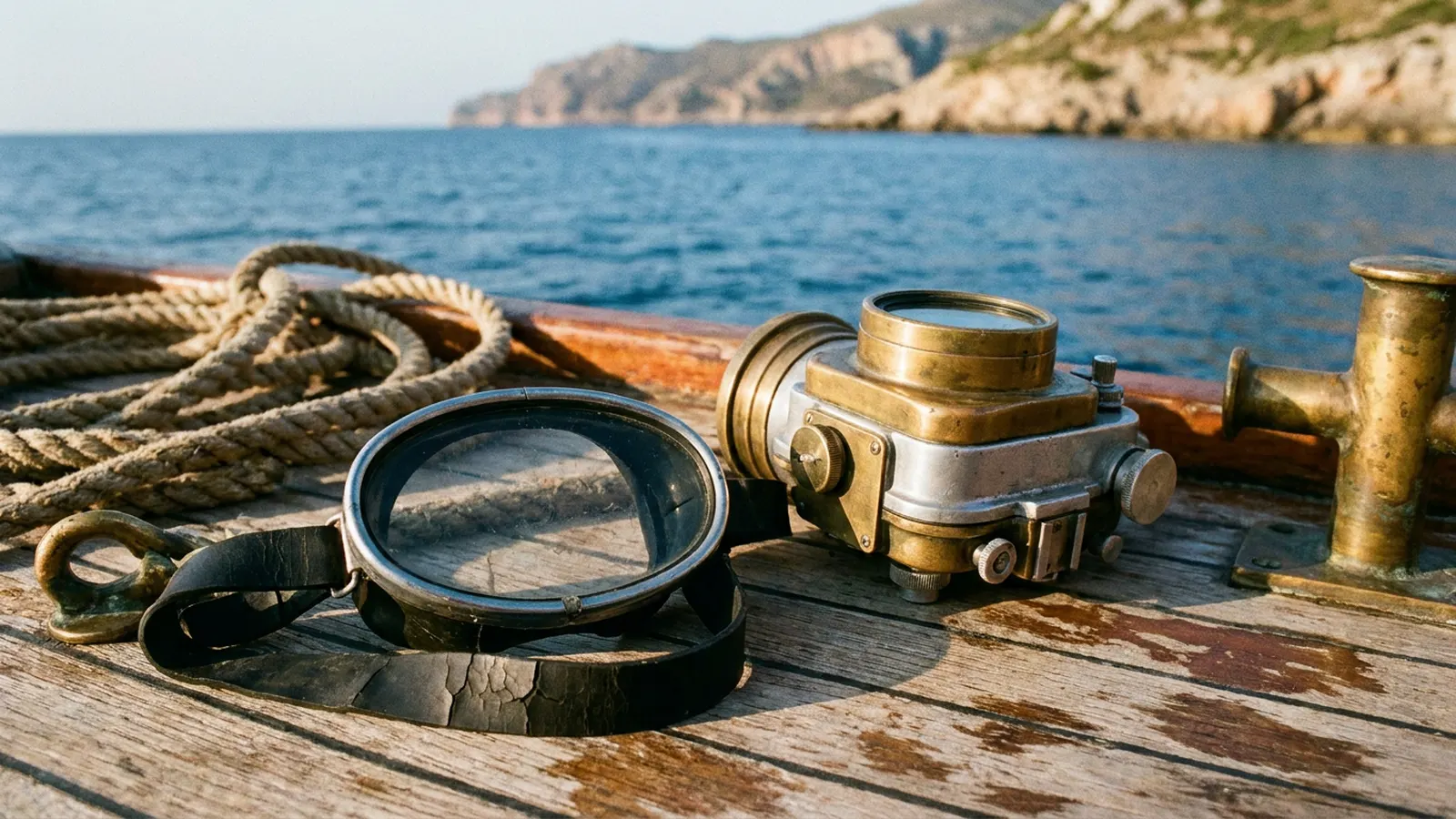
Before he became the face of ocean conservation, Cousteau was a young naval officer who hunted fish with goggles and a spear on the Mediterranean coast. His first underwater film, Par dix-huit mètres de fond (“Eighteen metres down”), made in 1942, carries a narration that French Wikiquote reproduces at length: « C’est un bain de vie animale, tranquille, dure, sans inutile cruauté. […] Pas de massacre inutile : la sélection naturelle, simple, émouvante. La jungle de Mowgli. » (“It is a bath of animal life, peaceful, harsh, without needless cruelty. […] No needless slaughter: natural selection, simple, moving. Mowgli’s jungle.”)
The passage is worth reading because it shows the starting point of his thinking. In 1942 he still saw the sea as a hunting ground governed by a kind of natural order that people could join. The following year, according to the Académie française biography, he designed and built with the engineer Émile Gagnan the prototype of the Cousteau-Gagnan compressed-air self-contained diving apparatus, the Aqua-Lung. Freed from surface hoses, his team began to film rather than hunt, and over the following decades his language shifted from the excitement of the chase to wonder and, eventually, alarm. For the story of that invention, see our page on Cousteau and the Aqua-Lung.
What did Cousteau mean by ‘man becomes an archangel’?
It is his description of the freedom of diving, given to Time magazine in 1960.
In March 1960 Time published two of his most vivid sentences about diving: that a person on land is “bolted to earth” by gravity but becomes free simply by sinking beneath the surface, and that “buoyed by water, he can fly in any direction — up, down, sideways — by merely flipping his hand. Under water, man becomes an archangel.” These lines circulate widely in French, often in slightly different wordings, because there is no single authorised French original. If you need them in French, translate from the English and say so, as in the table above.
By 1960 Cousteau had become an international figure. His first book, The Silent World, written with Frédéric Dumas, appeared in English in 1953, and the film version, co-directed with Louis Malle, won the Palme d’Or at Cannes in 1956. In 1957 he was elected director of the Oceanographic Museum of Monaco, a post he held until 1988. The archangel image captures the optimism of that period, before the pollution campaigns that dominated his later life.
Why did Cousteau call the sea ‘the universal sewer’?
He was warning the US Congress about ocean pollution in 1971.
On 28 January 1971, testifying before the US House Committee on Science and Astronautics, Cousteau described the sea as the place “where all kinds of pollution wind up” and called it “the universal sewer”. The phrase marks his turn from explorer to campaigner. A decade earlier, in October 1960, he had joined other French scientists in publicly opposing a plan by France’s atomic energy commission, the CEA, to dump radioactive waste in the Mediterranean. The CEA described the dumping as experimental and cited the oceanographer Vsevolod Romanovsky in support; Romanovsky, Louis Fage and Cousteau rejected that claim, saying Romanovsky had had a far smaller quantity in mind. French public opinion sided with the oceanographers rather than with the atomic energy scientists.
In interviews the same year he widened the argument to fisheries. In remarks dated 17 July 1971 and quoted in later books, he said people should “plant the sea and herd its animals”, using the sea “as farmers instead of hunters”, and that “in the sea we act like barbarians”. Modern readers may disagree with his enthusiasm for marine farming, but the quotes show how early he framed overfishing as a problem of civilisation rather than technology. Our page on Cousteau’s accomplishments covers his environmental campaigns in more detail.
Did Cousteau see himself as a scientist?
Not really. He described scientists with admiration but placed himself beside them.
In 1971 he told the Christian Science Monitor that a scientist is “a curious man looking through a keyhole, the keyhole of nature, trying to know what’s going on.” Fifteen years later he told the same newspaper that he was not a scientist but “an impresario of scientists”. The French passage behind the protect-what-we-love quote makes the same point: « je ne suis ni un scientifique ni un professeur. Je suis un découvreur. »
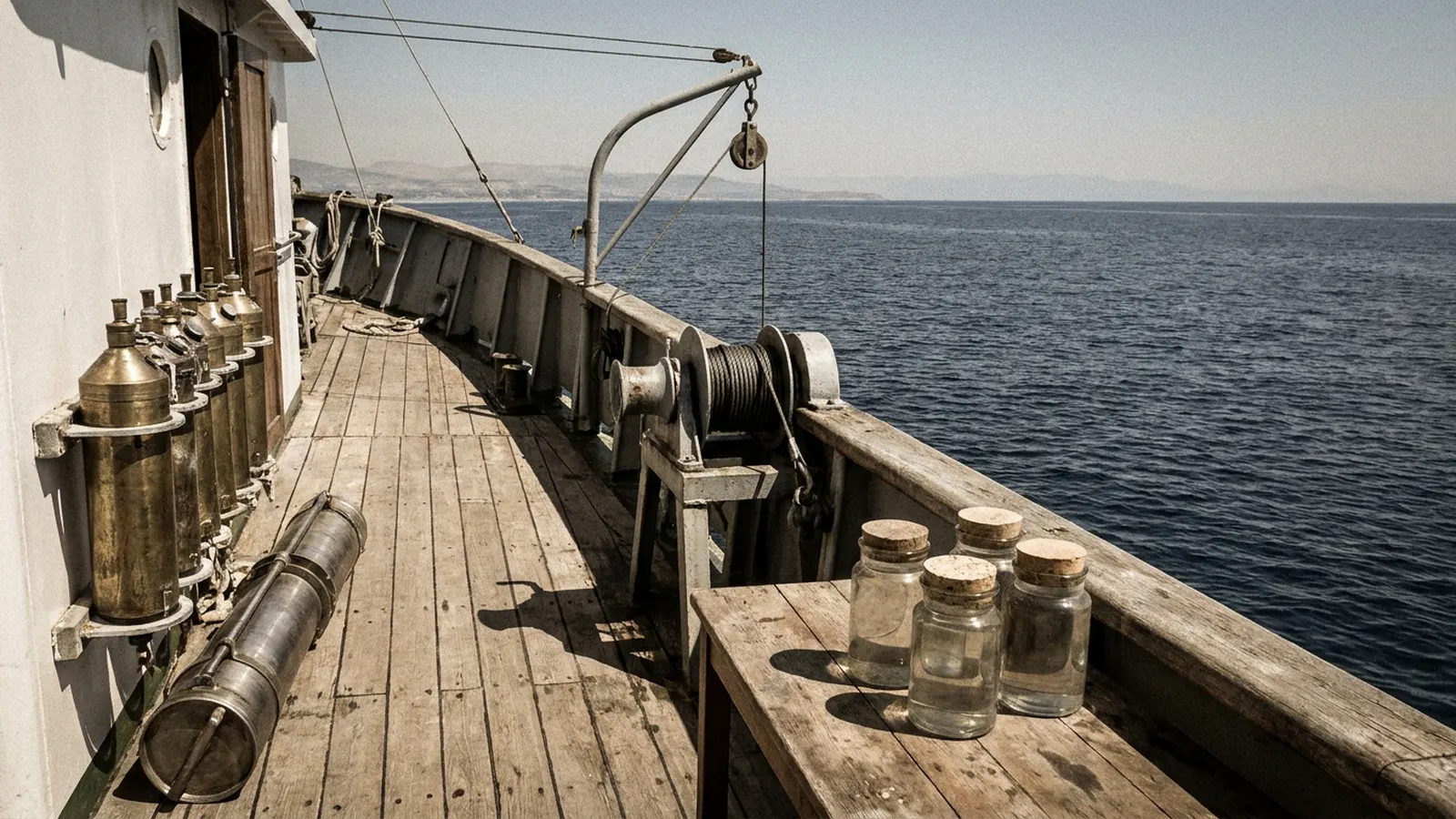
This self-image was not false modesty. Cousteau directed major scientific programmes, including the Précontinent undersea-habitat experiments of the 1960s, and was admitted as a foreign member of the US National Academy of Sciences in 1968. But his genius was for equipment, organisation, filming and storytelling. His ship Calypso, a former minesweeper he fitted out from 1950, carried scientists on more than fifty long expeditions, and his television series, The Undersea World of Jacques Cousteau (1966–1976) and The Cousteau Odyssey (1977–1982), brought their work to a mass audience.
Is there a good quote from Le Monde du silence?
Yes, but check the French edition before quoting it in French.
The English edition of The Silent World contains a much-quoted reflection on how diving changed his life: “Sometimes we are lucky enough to know that our lives have been changed, to discard the old, embrace the new, and turn headlong down an immutable course.” Wikiquote cites it from the 2004 National Geographic edition, page 5. Because the book was written in French and translated into English, the French original of this sentence is in Le Monde du silence itself, published by Robert Laffont; we have not reproduced it here because we could not check the French text. A back-translation would read roughly « Parfois, nous avons la chance de savoir que notre vie a changé… », but for any published use, copy the wording from the French book.
Which popular ‘Cousteau quotes’ are unsourced?
Several of the most shared lines have no traceable book, film, interview or date.
Quote websites in both languages attribute many more lines to Cousteau. Among the most common are “The sea, once it casts its spell, holds one in its net of wonder forever”, “The best way to observe a fish is to become a fish”, a line about happiness for a bee or a dolphin, “I found my moon in the depths of the sea” and “Impossible missions are the only ones that succeed”. We could not find a primary source for any of them in the material checked for this page, and the French versions online appear to be translations of the English. Some may be genuine paraphrases of things he said; others may not be his at all. Until a source turns up, they are best described as “attributed to Cousteau”.
A simple test helps. A reliable quotation names a specific book and page, a film, a dated interview or a recorded speech. If the only source is a quotation website, a poster or a social-media image, treat it as unverified. For French use, prefer lines that exist in French, such as those from his films and books, over translations of English sayings.
Why does Cousteau’s French carry extra weight?
He was a member of the Académie française, the guardian of the French language.
Cousteau was elected to the Académie française on 24 November 1988 to seat 17, succeeding Jean Delay, and was formally received under the cupola on 22 June 1989 by Bertrand Poirot-Delpech. His academician’s sword, presented on 15 June 1989 at the Musée de la Marine, has a pommel shaped as three Antarctic penguins and an ornament recalling the emblem of Calypso. After his death in Paris on 25 June 1997 his seat passed to the writer Érik Orsenna, elected on 28 May 1998.
The Académie’s list of his works shows how much he wrote in French: from Par dix-huit mètres de fond and Épaves in the 1940s, through Le monde du silence with Frédéric Dumas, to the twenty-volume Encyclopédie Cousteau and books written with Philippe Diolé in the 1970s. His legacy includes more than 50 books and more than 120 television documentaries. His French film titles have become phrases in their own right: Le Monde du silence (1956) gave the French language a lasting image of the undersea world, and Le Monde sans soleil (1964), released in English as World Without Sun, extended it to the undersea-habitat experiments of the Précontinent programme. Both titles are quoted far more often than any sentence from the films.
In his last years Cousteau’s public statements were increasingly addressed to governments. In 1992 he was invited to the United Nations Conference on Environment and Development in Rio de Janeiro, and he then became a regular consultant to the UN and the World Bank. Speeches and interviews from that period are another under-used source of genuine quotations, in both languages. That body of French writing is the best place to look for authentic quotations, and it is largely untapped by the quote websites, which recycle the same English lines.
How should you quote Cousteau in French?
Use the original, name the source, and label translations.
For a talk, poster or school project, « On aime ce qui nous a émerveillé, et on protège ce que l’on aime » is the obvious choice: it is in French, it is well documented in print, and it sums up his philosophy. Cite it as “Jacques-Yves Cousteau, cité dans” one of the books above. For divers, the 1960 archangel line is more evocative, but present it as a translation from Time.
A few translation notes help. The verb émerveiller means to fill with wonder or amazement, and the noun émerveillement has no exact English equivalent: “wonder” is closest, but the French also carries enchantment and delight. French speakers often refer to him simply as « le commandant Cousteau », his naval rank, and his full name is written with a hyphen, Jacques-Yves. For the wider story of his life and work, see our Jacques Cousteau hub and his discoveries. Many of these lines come from Cousteau’s books; for a famous line he almost certainly never said, see Cousteau and Lake Tahoe.
What is Jacques Cousteau’s most famous quote in French?
« On aime ce qui nous a émerveillé, et on protège ce que l’on aime »: we love what has filled us with wonder, and we protect what we love.
Did Cousteau say “people protect what they love”?
That English line is a paraphrase of his French statement; the French « Les gens protègent ce qu’ils aiment » is a translation of the paraphrase.
Where is the « on aime ce qui nous a émerveillé » quote from?
It is quoted in Folliot and Louy’s France-sur-mer (2009, p. 41) and Guy Jacques’s Virer de bord (2011, p. 34).
How do you say “under water, man becomes an archangel” in French?
« Sous l’eau, l’homme devient un archange. » Cousteau said it in English to Time (1960), so label the French as a translation.
Did Cousteau say “the best way to observe a fish is to become a fish”?
It is widely attributed to him, but we could not find a primary source.
Did Cousteau write in French or English?
His books were written in French, often with co-authors, and translated; many famous quotes come from English interviews and TV.
What is the French title of The Silent World?
Le Monde du silence, written with Frédéric Dumas; the English edition appeared in 1953.
Was Cousteau a member of the Académie française?
Yes. He was elected on 24 November 1988 to seat 17 and received on 22 June 1989.
- Wikiquote (fr): Jacques-Yves Cousteau, citing Folliot & Louy, France-sur-mer (Rocher, 2009) p. 41; G. Jacques, Virer de bord (L’Harmattan, 2011) p. 34; film Par dix-huit mètres de fond (1942).
- Wikiquote (en): Jacques-Yves Cousteau, citing Time (28 March 1960); House Committee on Science and Astronautics (28 Jan 1971); Christian Science Monitor (21 July 1971; 24 July 1986); The Silent World (National Geographic, 2004) p. 5.
- Académie française: Jacques-Yves Cousteau, biography, election and works (academie-francaise.fr).
- Encyclopedia summary: Jacques Cousteau (Palme d’Or 1956, Monaco museum 1957, TV series, 1960 radioactive-waste campaign, 50+ books, 120+ documentaries).
Blane Perun has been exploring Earth’s oceans and marine life for over 25 years. Founder of TheSea.Org in 1999, underwater photographer, coral aquaculture pioneer, and explorer of 80+ countries.
About Blane Perun →