Hawaii Coral Reef Bleaching — Heat in the Central Pacific
Yes. Hawaii’s coral reefs, once thought relatively sheltered from the worst bleaching, were hit by back-to-back mass bleaching in 2014 and 2015 — the most severe the islands had experienced — and by further bleaching in 2019. In the worst-affected areas most corals turned white, and parts of West Hawai‘i on the Big Island lost around half of their coral. Bleaching happened because a prolonged marine heatwave pushed Pacific waters around the islands above corals’ tolerance for weeks at a time. Hawaii has responded with expanded monitoring, protection for plant-eating fish, efforts to reduce runoff and a statewide reef-protection strategy, but the long-term outlook depends on slowing ocean warming.
Hawaii is one of the most isolated island chains on Earth, and its reefs are unlike any others. Thousands of kilometres from the nearest continent, they have evolved a remarkable number of species found nowhere else, from reef fish to corals and invertebrates. For many years, Hawaii’s position in the central Pacific seemed to protect its reefs from the mass bleaching that devastated other regions in 1998. That sense of safety ended in the mid-2010s. This guide explains what happened during the 2014–2015 bleaching, which reefs were hit hardest and why, how the islands have responded, and what Hawaii’s experience means for reefs everywhere.
Hawaii’s reefs before the heat
Young volcanic islands, cooler subtropical water and extreme isolation give Hawaii a reef system with its own character.
The main Hawaiian Islands are surrounded mostly by fringing reefs that hug the coastlines of relatively young volcanic islands, with a few more developed reef systems such as the barrier-like reef of Kāne‘ohe Bay on O‘ahu. Because the islands lie at the northern edge of the tropics, their waters are slightly cooler than those of the Coral Triangle, and Hawaii has fewer coral species than reefs in the western Pacific. The reefs are dominated by a handful of hardy species: lobe coral (Porites lobata), finger coral, rice coral (Montipora capitata) and cauliflower coral (Pocillopora meandrina).
What Hawaii lacks in coral diversity it makes up for in uniqueness. Its isolation means a high proportion of its reef fish and invertebrates are endemic, found only in the Hawaiian archipelago. Reefs here support traditional and recreational fishing, a large tourism industry and important cultural practices, and they protect shorelines from big winter swells. For an overview of the system, see the Hawaiian coral reef ecosystem.
Hawaii had seen bleaching before — Kāne‘ohe Bay bleached in 1996, and reefs in the remote Northwestern Hawaiian Islands bleached in the early 2000s — but the main islands had never experienced a statewide mass bleaching event. That changed in 2014.
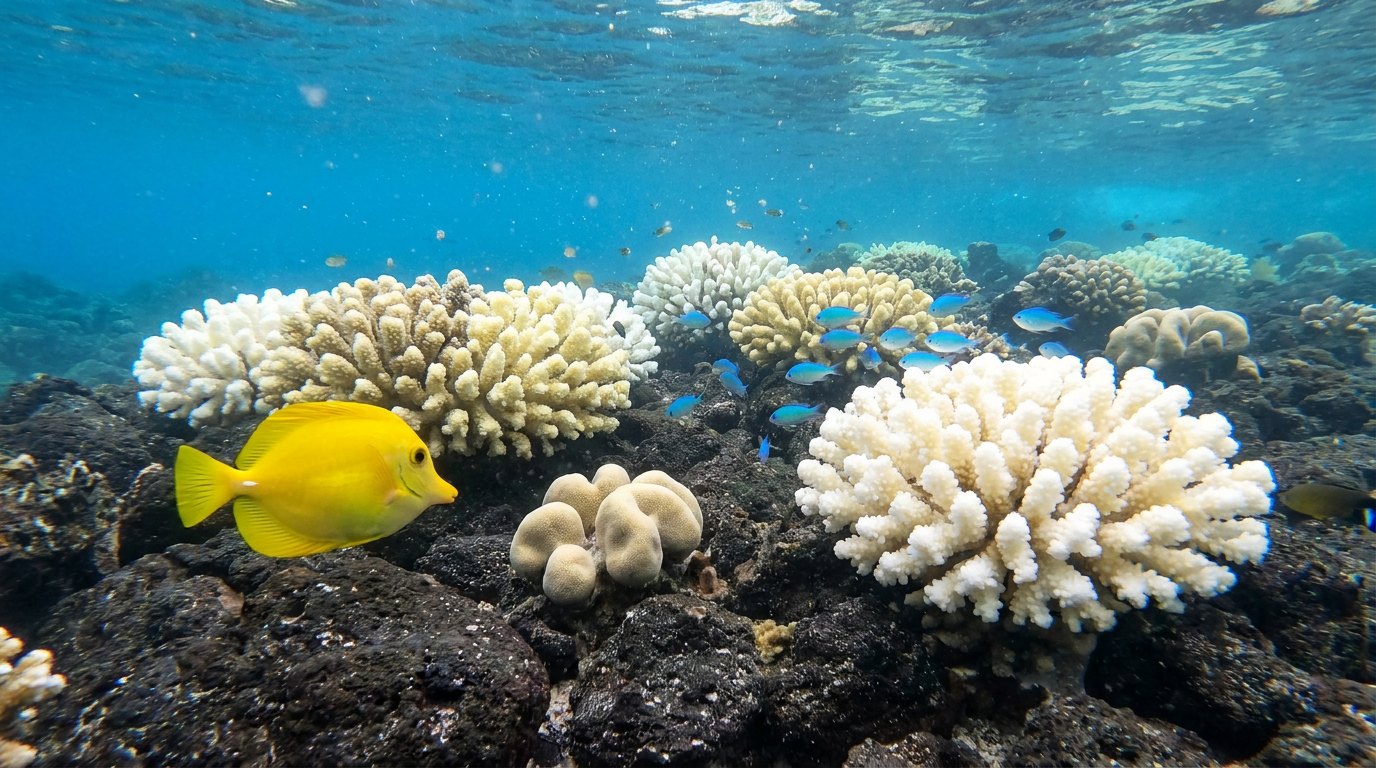
The 2014–2015 bleaching: back-to-back heat
Two consecutive summers of record heat pushed reefs across the islands past their limits, hitting many corals a second time before they could recover.
In 2014 an unusually large area of warm water developed across the north-east Pacific, and sea temperatures around Hawaii rose well above normal during late summer and autumn. Bleaching struck first in the northern and western parts of the chain, including O‘ahu’s Kāne‘ohe Bay, where many corals bleached. The following year, with a strong El Niño developing, the heat returned and was even more intense, and the 2015 event became the most severe bleaching recorded in the main Hawaiian Islands. The Big Island, particularly its leeward west coast, was hit especially hard.
Back-to-back heat is particularly damaging. Corals that have bleached and survived are weakened, short of energy reserves and slow to regain their algae. When a second heatwave strikes the following year, many of them die. In Hawaii, mortality was patchy but severe: surveys in West Hawai‘i found that roughly half of the coral at monitored sites died, and some shallow reefs lost far more. Cauliflower coral, an important reef-builder in wave-exposed areas, suffered heavy losses in many places. The event is now seen as part of the third global coral bleaching event of 2014–2017.
| Area | Island | What happened |
|---|---|---|
| Kāne‘ohe Bay | O‘ahu | Severe bleaching in a warm, sheltered bay in 2014 and 2015 |
| West Hawai‘i (Kona coast) | Hawai‘i (Big Island) | About half of monitored coral died after 2015 |
| West Maui | Maui | Widespread bleaching on reefs already stressed by runoff |
| Northwestern Hawaiian Islands | Papahānaumokuākea | Bleaching in 2014 on remote reefs, showing heat reaches protected areas |
Why some Hawaiian reefs bleached worse than others
Local water temperature, depth, flushing and the condition of each reef shaped who lived and who died.
Bleaching in Hawaii was far from uniform. Reefs in shallow, sheltered, poorly flushed water heated up the most and bleached worst. Enclosed bays such as Kāne‘ohe Bay trap warm water, while reefs on exposed coasts, mixed by waves and currents, were often cooled enough to escape the worst. On the Big Island, calm leeward waters on the Kona coast, sheltered from the trade winds, stayed warm and clear for long periods, maximising both heat and light stress.
Species mattered too. Some corals, such as certain rice corals in Kāne‘ohe Bay, showed noticeable differences between colonies: some individuals bleached completely while neighbours of the same species stayed brown. Scientists have studied these naturally heat-tolerant colonies closely, because understanding why some corals cope better may help guide restoration. Reef condition also counted. Reefs already stressed by sediment, nutrients or overfishing generally have less capacity to recover once a heatwave passes. To understand the mechanism in detail, read what causes the bleaching of coral reefs.
The 2014–2015 bleaching also changed how Hawaii watches its reefs. Before it, routine monitoring focused on fish populations and long-term coral cover. Since then, scientists, state agencies, volunteers and dive operators have coordinated rapid surveys during heatwaves, using satellite heat-stress alerts from NOAA Coral Reef Watch to decide where and when to look. Volunteer programmes in which snorkelers and divers report bleaching observations have added many more eyes in the water, giving managers a clearer picture of which reefs bleach, which recover and which may hold heat-tolerant corals worth protecting.
2019 and the road to recovery
Another marine heatwave in 2019 brought fresh bleaching, but it also showed that management and luck can soften the blow.
Hawaii’s reefs had barely begun to recover when warm water returned in 2019. Forecasts warned that heat stress could rival 2015, and bleaching was again recorded around the islands. In the event, conditions varied, and in many places the damage was less severe than feared, partly because weather patterns changed and partly because the most sensitive corals had already been lost in 2015. Even so, the 2019 heatwave added pressure to reefs still struggling to rebuild.
Recovery from bleaching in Hawaii tends to be slow. Many of the islands’ dominant corals grow slowly, and young corals must settle and survive among turf algae and sediment. Reefs with healthy populations of grazing fish such as surgeonfish and parrotfish recover faster, because these fish keep algae cropped and leave space for new corals. That is why fish management has become central to Hawaii’s response. See how reefs bounce back in can coral reefs recover from bleaching.
How Hawaii is protecting its reefs
Hawaii cannot cool the Pacific, so it is focusing on making reefs as healthy as possible between heatwaves.
After 2015, Hawaii’s Division of Aquatic Resources and its partners developed a coordinated response aimed at improving reef resilience. Priorities include protecting herbivorous fish, establishing and strengthening marine management areas, reducing land-based pollution, and identifying the reefs that survived best so they can be prioritised for protection. The state has committed to effectively managing a substantial share of its nearshore waters, and community-based fishing areas allow local residents to help manage their own reefs.
Land-based pollution is a major focus. Sediment from erosion, nutrients from fertiliser and wastewater from cesspools all degrade nearshore water quality, and Hawaii has set goals to replace cesspools over the coming decades. Hawaii also became the first US state to ban the sale of sunscreens containing oxybenzone and octinoxate, which took effect in 2021, a measure aimed at reducing chemical stress on heavily visited reefs. Federal support comes through programmes such as the NOAA Coral Reef Conservation Program. Researchers are also working on restoration, including growing corals from heat-tolerant colonies and outplanting them on damaged reefs.
A warning for “safe” reefs
Hawaii’s experience shows that no reef is beyond the reach of a warming ocean.
For decades, Hawaii was cited as a region that had escaped the worst bleaching. Its slightly cooler subtropical waters and central Pacific location seemed to offer protection. The events of 2014 and 2015 proved otherwise: once the ocean warms enough, reefs in any region can bleach, and they can be hit repeatedly in quick succession. Even the remote, protected reefs of the Northwestern Hawaiian Islands, far from local human impacts, bleached when the heat arrived. The same story has played out at the Great Barrier Reef, in the Maldives and at Ningaloo Reef.
The lesson is the same everywhere. Local protection matters — it helps reefs survive and recover — but the underlying cause is global warming driven by greenhouse-gas emissions. Hawaii’s reefs, with their unique endemic species, will have the best future if local stewardship is matched by global action to slow ocean warming. Explore wider responses in coral reef bleaching solutions and global warming and coral bleaching.
Related on TheSea
Is there coral bleaching in Hawaii?
Yes. Hawaii experienced its most severe mass bleaching in back-to-back events in 2014 and 2015, with further bleaching during a marine heatwave in 2019. Bleaching risk rises whenever late-summer sea temperatures stay well above normal.
How much coral has Hawaii lost to bleaching?
Losses varied widely. Monitored reefs in West Hawai‘i lost around half their coral after 2015, and some shallow reefs lost more, while exposed or deeper reefs often fared better.
Which Hawaiian reefs were hit hardest?
The Kona coast of the Big Island, Kāne‘ohe Bay on O‘ahu and parts of West Maui were among the worst affected. Warm, sheltered and poorly flushed waters suffered the most heat stress.
Why did Hawaii ban some sunscreens?
Hawaii banned the sale of sunscreens containing oxybenzone and octinoxate from 2021 because of concerns that these chemicals can harm corals at heavily visited sites. The ban addresses a local stress; it does not prevent heat-driven mass bleaching.
Are Hawaii’s reefs recovering?
Partly. Some reefs have regained coral, especially where grazing fish are abundant and water quality is good, but Hawaiian corals tend to grow slowly and repeated heatwaves limit recovery.
Can snorkelers still see healthy reefs in Hawaii?
Yes. Many sites still have good coral and abundant fish, though condition varies. Visitors can help by not touching or standing on coral, wearing reef-friendly sun protection and following local rules.
Blane Perun has been exploring Earth’s oceans and marine life for over 25 years. Founder of TheSea.Org in 1999, underwater photographer, coral aquaculture pioneer, and explorer of 80+ countries.
About Blane Perun → More on Coral Reef Bleaching →