Darth Maul Zoanthids — The Orange-and-Black Zoa With a Villain’s Name
Darth Maul zoanthids are an aquarium morph of colonial zoanthid polyps with orange to red colouring set against black or very dark markings. The name is a trade name, borrowed from Darth Maul, the red-and-black tattooed villain of the 1999 film Star Wars: Episode I – The Phantom Menace. Most are Zoanthus polyps, though the label has also been applied to Palythoa. They are generally hardy and easy to keep, but colonies sold under the name vary, and some hobbyists have reported lines that melt away unpredictably.
This guide covers what the name means, how to judge a colony, how Darth Maul compares with look-alike morphs, and how to light, feed, protect and frag it. For the biology shared by every named morph, see the zoanthids hub; for general husbandry, see zoanthid care.
What are Darth Maul zoanthids?
They are zoanthids, members of the order Zoantharia, a group of colonial anthozoans related to sea anemones and corals. A zoanthid colony is made of many small polyps, each a short column topped by an oral disc ringed with short tentacles, joined together by a shared base of tissue that spreads across rock. Like many reef cnidarians, zoanthids host symbiotic dinoflagellate algae, zooxanthellae, which photosynthesise and supply much of their energy. They have no skeleton.
“Darth Maul” is not a species. It is one of hundreds of names hobbyists and vendors give to particular colour patterns of zoanthids, usually Zoanthus, the genus with small, brightly coloured polyps. These names work like plant cultivar names in an informal way: they describe a look that collectors recognise and pay for. Unlike registered plant cultivars, however, zoanthid morph names have no official registry, no standard description and no guarantee that two colonies with the same name are genetically identical.
How do you recognise a Darth Maul zoa?
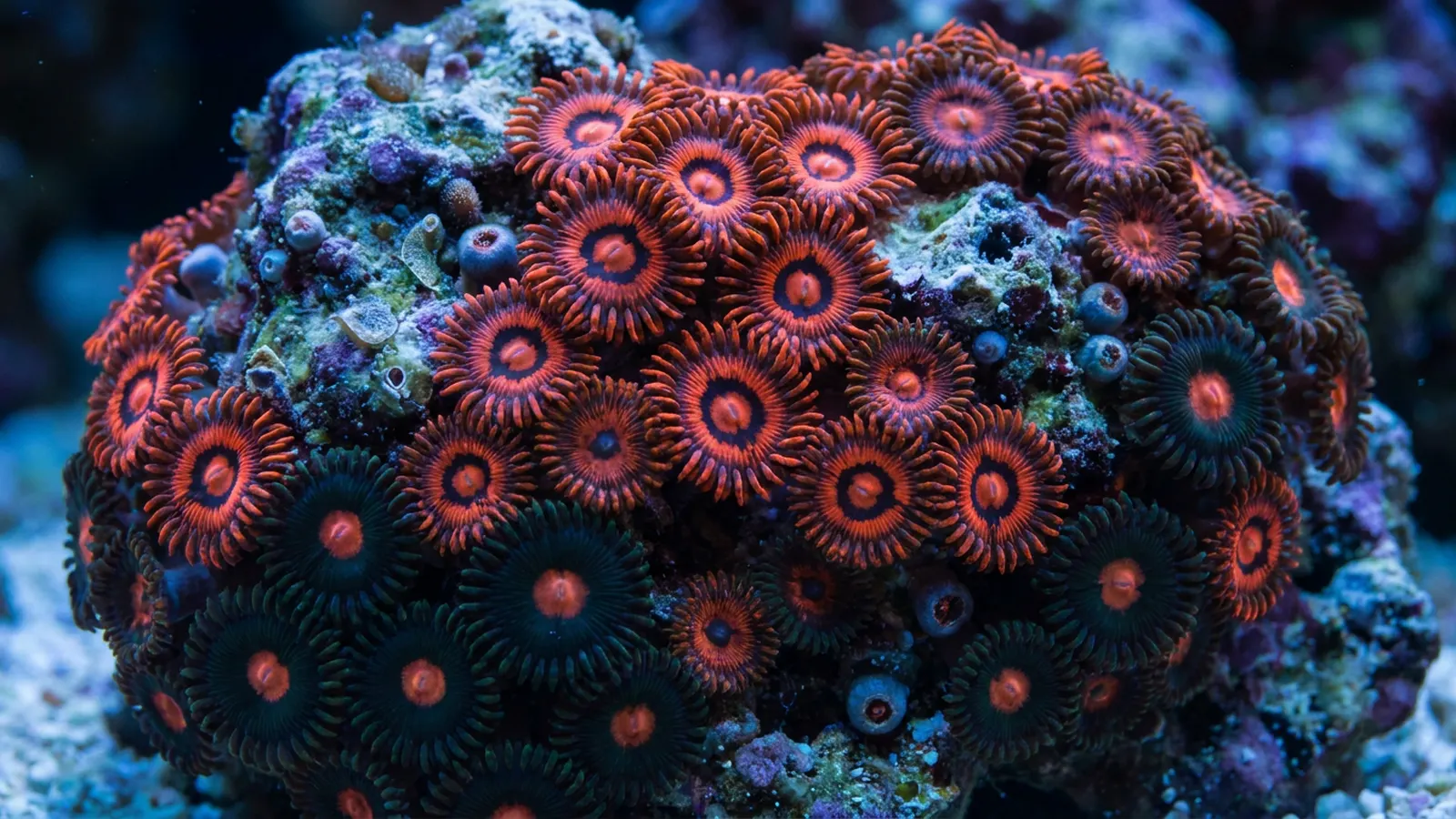
The core look, as described by sellers and collectors, is a high-contrast combination of orange to red and black. Sellers’ descriptions emphasise “contrasting black and orange colours,” and the name itself refers to a red face crossed with black markings. In practice, colonies sold as Darth Maul differ in where those colours sit on the polyp. Some show an orange or red oral disc with dark radiating marks or a black centre; others have a dark skirt or tentacles framing a bright centre.
Hobbyists comparing their own colonies on reef forums have noted that some Darth Mauls lean more orange and others more red, and that some carry a “splatter” of darker pigment across the disc. One keeper reported that his polyps shifted between both looks over time. Others in the same discussions questioned whether some colonies sold as Darth Maul were really other morphs. That disagreement is common across the zoa hobby and is worth keeping in mind when you pay for a name.
- Overall effect: bright orange to red against black or near-black
- Disc: orange or red, sometimes with dark radial marks or splatter
- Centre or skirt: dark, giving the “tattooed” contrast
- Polyp: small Zoanthus polyp on a short stalk, usually
- Colony: polyps joined by a shared base into a mat
How does Darth Maul compare with look-alike morphs?
Orange-and-dark zoas are a crowded field, and several morphs can resemble Darth Maul at frag size. Hobbyists discussing Darth Maul colonies have suggested that some looked more like the Nightmare morph, another orange-and-dark zoa, and the differences can be subtle, especially under heavy blue light that turns orange toward red and dark purples toward black. The table gives general pointers rather than fixed rules, because every named morph varies between sellers.
| Morph name | General look | How it differs |
|---|---|---|
| Darth Maul | Orange to red with black or very dark markings | High contrast; dark “tattoo” marks or centre |
| Nightmare | Orange tones with dark features | Often confused with Darth Maul; compare from the same source |
| Rasta | Orange centre, green ring, blue to purple skirt | Three distinct rings, more green and blue |
| Fire and Ice | Red-orange with icy blue or white | Cool blue or white instead of black |
| Darth Maul Porites | Ruby to pink stony coral | Not a zoanthid at all |
That last row is a common trap. The same Star Wars name has been given to a ruby-pink Porites, a small-polyped stony coral, which needs very different care, including calcium and alkalinity for its skeleton. Always check whether a listing is for a zoanthid, a Palythoa or a stony coral.
Why are Darth Maul zoas orange, red and black?
The bright colours of zoanthids come largely from GFP-like proteins, the same family of fluorescent proteins found in corals and mushroom corallimorphs. Zoanthids were among the reef animals in which Mikhail Matz and colleagues discovered new fluorescent proteins in 1999, including green and yellow proteins from a Zoanthus that were later sold to laboratories as ZsGreen and ZsYellow. Orange and red tones come from longer-wavelength members of the same family. Under the blue and violet light used over reef tanks, these proteins fluoresce strongly, which is why zoas look so much brighter in a tank than in daylight.
The black is different. Dark areas on a zoanthid are not black pigment in the usual sense but zones where little fluorescence is produced and the tissue absorbs most visible light, often deep brown, purple or grey that reads as black under blue light. The contrast between strongly fluorescent orange and non-fluorescent dark tissue is what gives a Darth Maul its graphic look. That also means the morph can look very different under white light, where the dark zones may appear brown or purple and the orange less fiery.
Is Darth Maul a Zoanthus or a Palythoa?
Usually Zoanthus, but not always. Most zoa morphs with small, vividly coloured polyps are Zoanthus. The same name has been used for Palythoa in some hobby discussions, and Darth Maul “palys” have been traded. Palythoa polyps are generally larger, their colonies are more embedded in a thicker, sand-encrusted base, and they are known to contain higher levels of palytoxin, one of the most potent non-protein toxins known. If you are buying, ask the seller which genus the colony is and look at polyp size: Zoanthus polyps are typically small, while Palythoa polyps are larger and fleshier.
How do you care for Darth Maul zoanthids?
Treat them like other Zoanthus morphs. Keep them in a stable reef tank at about 76–82°F (24–28°C) with normal reef salinity and steady pH. Give them low to moderate light; zoas can adapt to brighter light over time, but sudden increases tend to make them close, bleach or lose colour. A blue-rich spectrum brings out the orange and red fluorescence. Flow should be low to moderate and variable, enough to keep debris off the polyps without bending them flat.
Zoanthids get much of their energy from their algae and from dissolved and fine particulate food in the water, so a mature tank with moderate nutrients suits them. Supplemental feeding with fine foods such as rotifers, copepods, phytoplankton-based blends or powdered coral foods can help growth, but it is optional in many systems. Very low nutrients can leave zoas pale and slow-growing, while high nutrients can feed nuisance algae that smother them.
Why do Darth Maul zoas melt?
Melting is the hobby word for polyps that shrink, close and dissolve over days to weeks, sometimes taking a whole colony. Reports from Darth Maul keepers are mixed. In one long-running forum discussion, several keepers described colonies that melted, including one who lost 15 polyps after six months and another whose frags melted within days, while others kept theirs for a year and a half without problems. The cause was never identified.
Melting in zoanthids generally has several possible causes. Pests are a major one: zoa-eating nudibranchs, sea spiders and certain small snails can be hard to see and feed at night. Bacterial and fungal infections, sometimes called zoa pox when they cause white pustules, are another. Sudden changes in light, salinity or temperature, very low nutrients, and chemical stress from other corals can all contribute. When a colony begins to melt, inspect it at night with a torch, dip it in a coral dip, check water parameters and, if possible, move it to a separate tank.
How do you acclimate a new Darth Maul frag?
Start by dipping. Use a commercial coral dip at the recommended strength, gently blow water over the polyps with a pipette, and inspect the frag for nudibranchs, egg spirals, sea spiders and small snails. Repeat the dip after a week or two to catch anything that hatches. Then place the frag low in the tank, in modest light and gentle flow, and leave it alone for a week or two while it adjusts. Only move it higher if the polyps stay open and stretch upward. Expect some colour change in the first weeks; the true colour usually becomes clear after a month or so.
How do you frag and grow Darth Maul zoas?
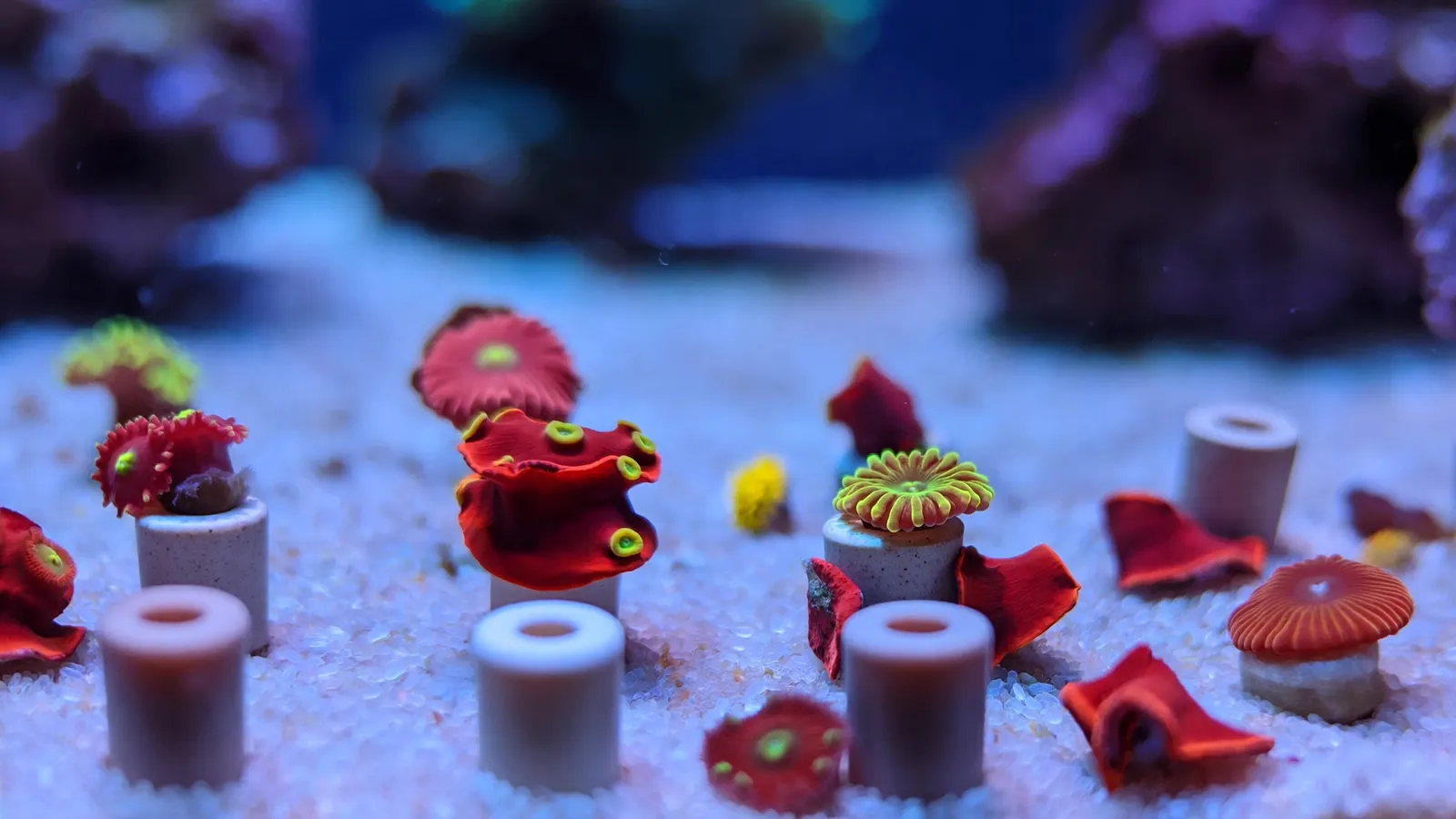
Zoanthids are among the easiest corals to frag. Colonies spread by budding new polyps from the shared base, and a frag of a few polyps can grow into a large patch. To cut a colony, remove the rock from the tank, use a sharp blade or bone cutters to separate a group of polyps along with a little of the base or rock beneath them, and attach the piece to a frag plug with reef-safe cyanoacrylate gel. Dipping the cut frag before returning it reduces infection risk. Healthy frags usually reopen within days.
Growth rate depends on light, flow, nutrients and the individual line. Hobbyists discussing Darth Maul palys reported growth from three polyps to about fifteen over a few months in good conditions, but other colonies grow slowly or not at all. Good water quality, stable conditions and a pest-free start matter more than any special additive.
Is it safe to keep Darth Maul zoas?
Yes, with sensible precautions. Palytoxin was first isolated in 1971 from the Hawaiian zoanthid Palythoa toxica, and it is found in varying amounts in many zoanthids, with Palythoa generally much more toxic than Zoanthus. Most poisonings in hobbyists have come from cutting, scrubbing or boiling Palythoa-covered rock, which can release toxin into the air, water or eyes. The U.S. Centers for Disease Control and Prevention has reported cases of palytoxin exposure among aquarium hobbyists. Keeping zoas in a tank is not dangerous in itself; the risks come with handling. Gloves, eye protection, good ventilation and never boiling rock are the key precautions.
Where should you place Darth Maul in a zoa garden?
Many hobbyists keep zoanthids together in a “zoa garden”: a rock, ledge or island where several morphs grow side by side. Darth Maul’s dark markings and fiery orange make it a strong contrast to blue, green and pale morphs. Leave a few centimetres between colonies, because zoanthids can overgrow one another and some morphs are more aggressive than others. Place the garden low to mid-tank in moderate light and away from strong-stinging corals, such as euphyllias and large hammer or torch corals, which can damage zoas with sweeper tentacles. Keep zoas away from large mushroom colonies too, which can shade them.
What fish and invertebrates are safe with Darth Maul zoas?
Most peaceful reef fish leave zoanthids alone, including clownfish, gobies, cardinals and most wrasses. Some angelfish, including certain dwarf angels, and some butterflyfish pick at zoas, though behaviour varies by individual. Crabs and some snails can damage polyps, and zoa-eating nudibranchs and sea spiders are true pests. A Darth Maul colony that stays closed during the day while the rest of the tank looks fine is often being picked at or attacked by a pest.
How do Darth Maul zoas reproduce in the wild?
Wild Zoanthus reproduce both sexually and asexually, and the morph trade is built on the asexual side. Asexually, colonies grow by budding new polyps from the shared base and can spread across large areas of shallow reef flat. Sexually, many zoanthids spawn eggs and sperm into the water, producing larvae that drift before settling. Genetic studies of wild Zoanthus by James Reimer and colleagues have even found evidence suggesting hybridisation between species, which may help explain the extraordinary colour variation seen in the hobby. A Darth Maul colony in a tank is almost certainly a clone of a single wild polyp or a single captive colony, propagated by cutting for years.
How much do Darth Maul zoanthids cost?
Prices vary widely with the line, the seller and the size of the frag. Older forum discussions mention prices in the range of tens of dollars per polyp for sought-after colonies, and named morphs from well-known vendors can still command premium prices. Common, widely propagated lines are much cheaper. Because the name does not guarantee a single genetic line, price alone is not a reliable measure of quality. Judge the colony you are buying, not the label.
How should you buy Darth Maul zoanthids?
Buy from sellers who photograph the actual frag under a stated light, ideally with a white-light or filtered photo as well as a blue one. Ask which genus it is, how long the colony has been in the seller’s system, and whether it has been dipped and checked for pests. Look for fully open polyps with intact discs and no white spots or slime. Avoid frags with closed or shrunken polyps. If possible, buy from a colony that has grown well for months in a stable system, because a line that has thrived for its seller is more likely to thrive for you.
What are Darth Maul zoanthids?
A trade-named zoanthid morph with orange to red and black colours, named after the Star Wars villain.
Are Darth Maul zoas a species?
No. Darth Maul is a trade name for a colour pattern, usually in Zoanthus.
Are Darth Maul zoanthids easy to keep?
Generally yes, though some lines have been reported to melt.
What light do Darth Maul zoas need?
Low to moderate light with a blue-rich spectrum.
Why are my Darth Maul zoas melting?
Common causes are pests, infection, sudden changes and low nutrients.
Is Darth Maul a Palythoa?
Usually Zoanthus, but the name has been used for Palythoa too.
Are Darth Maul zoanthids poisonous?
Zoanthids can contain palytoxin; handle them with gloves and eye protection.
What is the Darth Maul Porites?
A ruby-pink stony coral with the same nickname, not a zoanthid.
- Saltwaterfish.com: Zoanthid, Darth Maul morph (aquacultured) product description.
- Reef Central forums: “Darth Mauls?” and “Darth Maul Paly” threads (colour variation, growth and melting reports).
- AquaNerd (2016). Featured coral of the week: Darth Maul Porites.
- Matz, M.V. et al. (1999). Fluorescent proteins from nonbioluminescent Anthozoa species. Nature Biotechnology 17: 969–973.
- Moore, R.E. & Scheuer, P.J. (1971). Palytoxin: a new marine toxin from a coelenterate. Science 172: 495–498.
- CDC MMWR (2015). Palytoxin exposures in aquarium hobbyists, Alaska, 2012–2014.
Blane Perun has been exploring Earth’s oceans and marine life for over 25 years. Founder of TheSea.Org in 1999, underwater photographer, coral aquaculture pioneer, and explorer of 80+ countries.
About Blane Perun →