Cuttlefish — The Color-Blind Masters of Camouflage
Cuttlefish are cephalopod molluscs of the order Sepiida, not fish. Roughly 116–120 species are recognized, most 15–25 cm long, with the giant Australian cuttlefish reaching about 50 cm mantle length and over 10.5 kg. They steer their depth with a porous internal cuttlebone, have three hearts and blue-green copper-based blood, and change color in a fraction of a second even though they appear to be color-blind. Most live only one to two years and they are found off Europe, Africa, Asia and Australia, but not the Americas.
A hunting cuttlefish can ripple bands of color across its back while it hovers in front of a shrimp. Few animals change appearance as fast or as completely.
What is a cuttlefish?
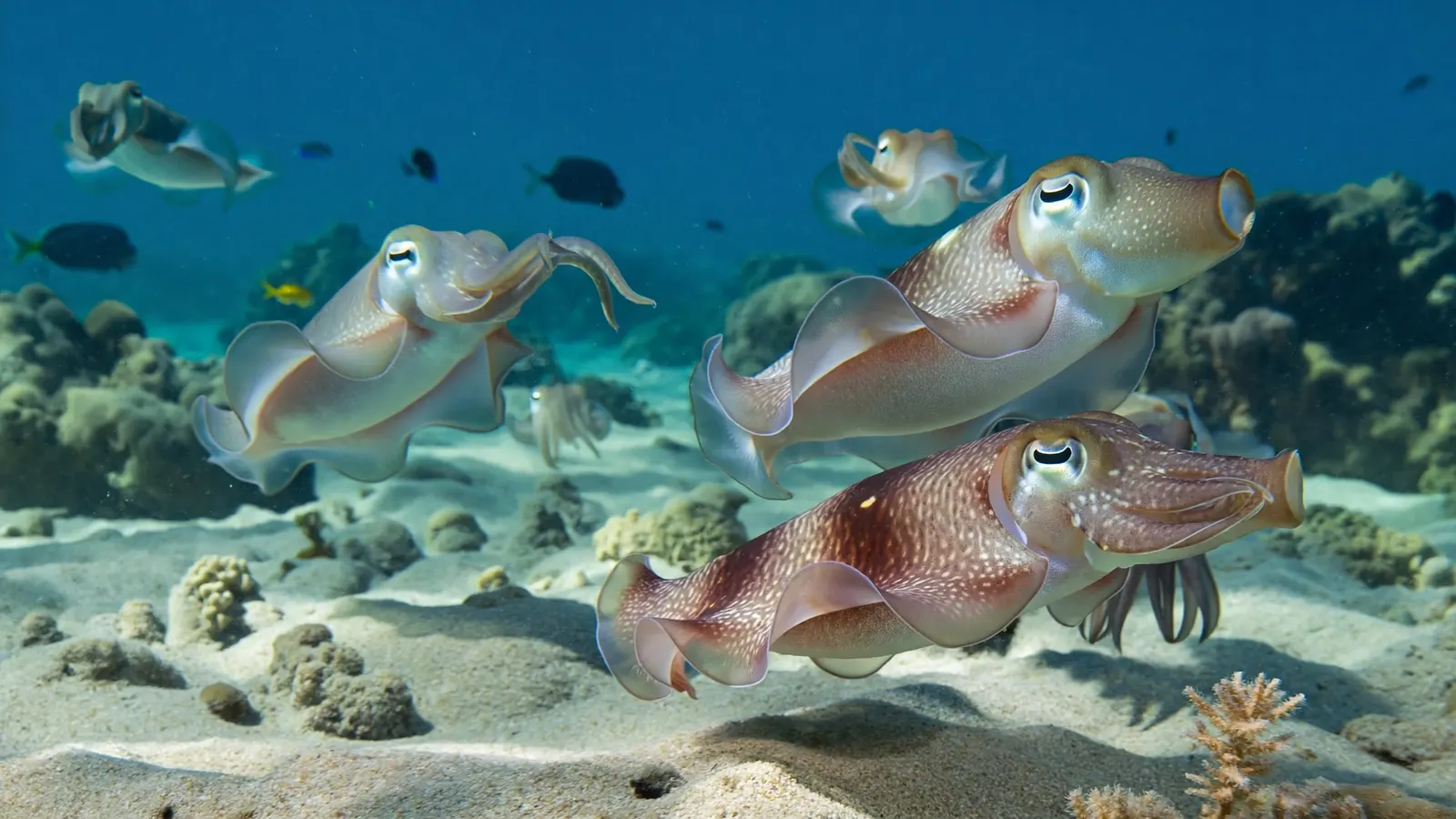
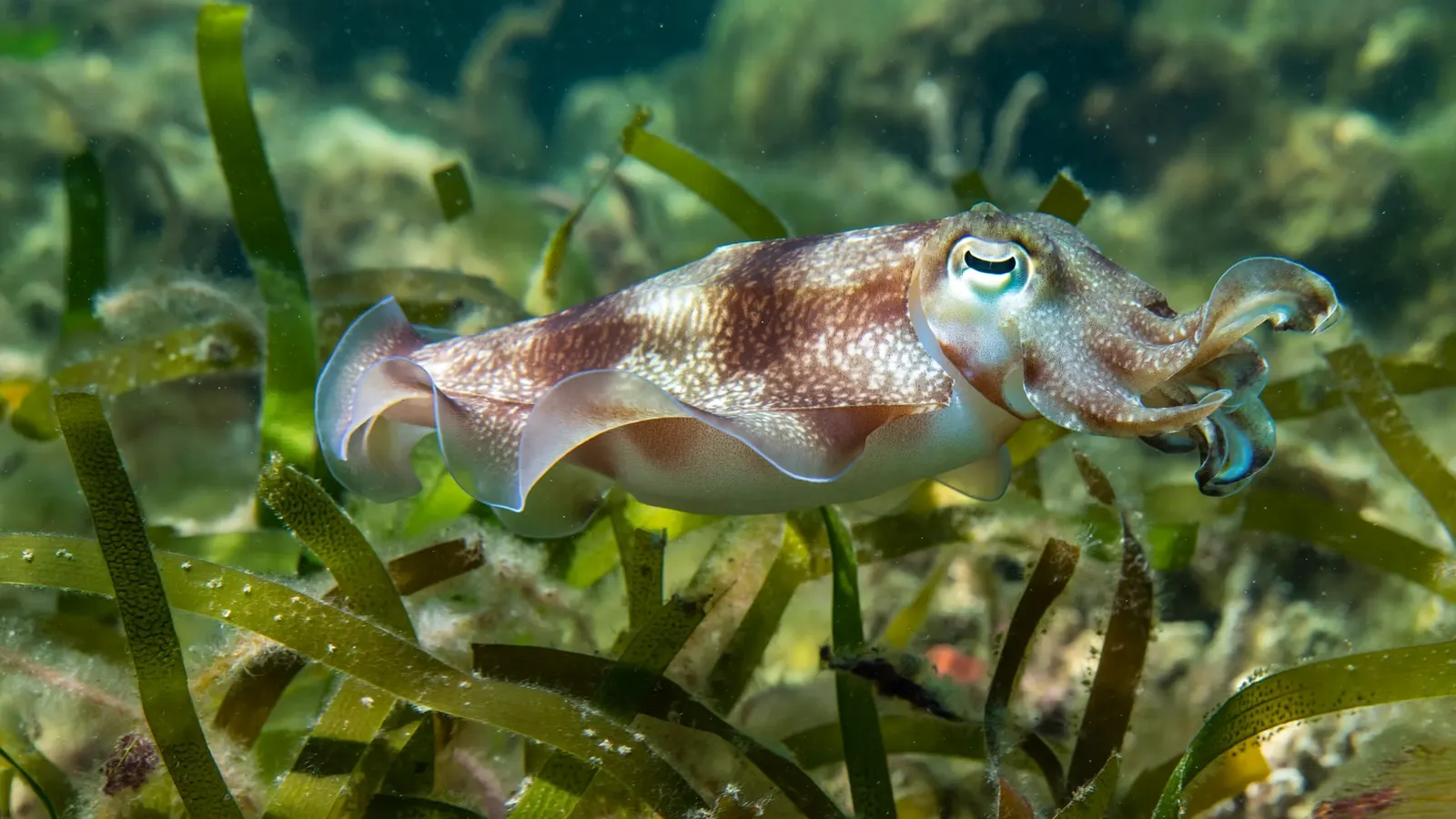
A cuttlefish is a ten-limbed cephalopod: eight arms plus two long feeding tentacles that shoot out to grab prey. Despite the name it is a mollusc, more closely related to snails and clams than to any fish. Cuttlefish sit between squid and octopuses in body plan. Like squid they have fins and two tentacles; unlike squid they have a broad, flattened mantle edged by a continuous skirt-like fin that lets them hover and reverse with precision. Close relatives on thesea.org include the squid, the octopus and the shelled nautilus.
How many species of cuttlefish are there?
Estimates range from about 116 to just over 120 species, depending on how recent revisions are counted. Most belong to the large genus Sepia. Well-known examples include the common cuttlefish (Sepia officinalis) of the northeast Atlantic and Mediterranean, the giant Australian cuttlefish (Sepia apama), the pharaoh cuttlefish of the Indo-Pacific and the small, toxic-fleshed flamboyant cuttlefish (Metasepia pfefferi).
| Species | Region | Notable trait |
|---|---|---|
| Common cuttlefish (Sepia officinalis) | NE Atlantic, Mediterranean | Best-studied species; IUCN Least Concern |
| Giant Australian cuttlefish (Sepia apama) | Southern Australia | Largest species; mass spawning aggregation |
| Pharaoh cuttlefish (Sepia pharaonis) | Indo-Pacific, Red Sea | Major fishery species |
| Flamboyant cuttlefish (Metasepia pfefferi) | Indo-Australian Archipelago | Walks on arms; toxic muscle tissue |
| Dwarf cuttlefish (Sepia bandensis) | Indo-West Pacific | Small; popular with researchers |
How big do cuttlefish get?
Most cuttlefish are 15–25 cm long. The giant Australian cuttlefish is the record holder, with a mantle length of about 50 cm and a weight above 10.5 kg (23 lb). At the other end, several dwarf species are only a few centimeters long as adults. Hatchlings emerge fully formed at around 6 mm and reach about 25 mm in their first two months.
What is a cuttlebone?
The cuttlebone is an internal shell made of aragonite, divided into thin chambers. The cuttlefish adjusts the ratio of gas to liquid in those chambers to rise or sink without swimming, much as a shelled cephalopod like the nautilus does with its external shell. Each species has a cuttlebone of distinct shape and texture, which helps taxonomists identify specimens. The bone also limits depth: it implodes under too much pressure, which is one reason most cuttlefish live on the continental shelf, though a few species are recorded to about 600 m. Washed-up cuttlebones are the white ovals sold for pet birds as a calcium source.
How do cuttlefish change color if they are color-blind?
The skin holds layers of color-changing cells. Chromatophores are tiny elastic sacs of pigment, each ringed by muscles under direct nerve control; when the muscles pull, a chromatophore can expand its surface area by about 500 percent in well under a second. Beneath them, iridophores and leucophores reflect and scatter light to produce sheens and whites. Up to 200 chromatophores can occur in a single square millimeter of skin. Muscles in the skin also raise papillae, bumps that change the texture to match rock or algae.
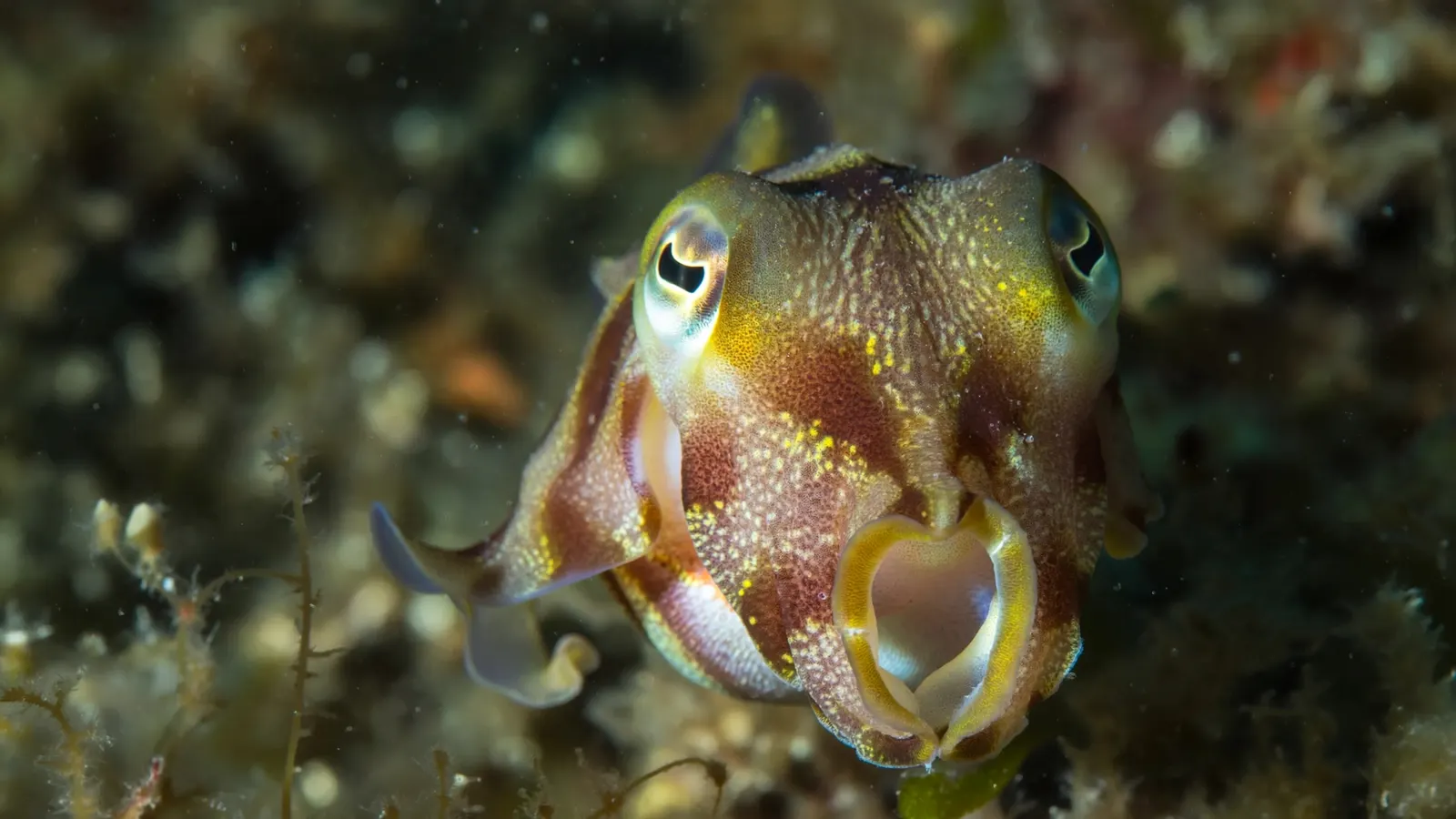
Laboratory studies show cuttlefish lack color vision, yet they still match their surroundings. They can perceive polarized light, which sharpens contrast, and one hypothesis is that their W-shaped pupil exploits chromatic aberration to infer color. The full mechanism is still unresolved. Researchers have catalogued 34 chromatic, six textural, eight postural and six locomotor elements in the common cuttlefish’s display repertoire. See cephalopod camouflage for how this compares with octopuses and squid.
What do cuttlefish eat?
Cuttlefish are active predators of crabs, shrimp, small fish and other molluscs. They stalk prey slowly, sometimes running bands of dark color across the body (the “passing cloud” display) that seem to freeze the prey, then fire their two tentacles to grab it and pull it to the beak. Venomous saliva helps subdue prey.
How is a cuttlefish different from a squid or an octopus?
All three are coleoid cephalopods with an ink sac, a beak and three hearts, but their bodies are built for different lives. Cuttlefish are hoverers and ambushers over the seabed; squid are open-water swimmers; octopuses are crawlers that hide in dens.
| Trait | Cuttlefish | Squid | Octopus |
|---|---|---|---|
| Limbs | 8 arms + 2 tentacles | 8 arms + 2 tentacles | 8 arms |
| Internal shell | Chambered cuttlebone | Thin chitin pen (gladius) | None or tiny remnants |
| Fins | Skirt along whole mantle | Paired fins at mantle tip | None in most species |
| Pupil | W-shaped | Round | Horizontal slit (most) |
| Lifestyle | Near the bottom, hovering | Open water, schooling | Bottom-dwelling, den-living |
| Species | ~120 | Several hundred | ~300 |
The cuttlebone is the giveaway. It gives cuttlefish fine control of buoyancy, so they can stay motionless in front of prey while their fins make tiny corrections. Squid trade that control for speed, and octopuses gave up the shell entirely, which lets them squeeze through any gap larger than their beak. For a deeper comparison see squid versus octopus.
How do cuttlefish defend themselves?
Camouflage is the first line of defense, but cuttlefish have more. Their ink, rich in melanin, can be released as a diffuse smoke screen or as a dense blob roughly the size of the animal, a decoy that draws a predator’s strike while the cuttlefish jets away. When camouflage fails, many species flash a deimatic display: sudden black-and-white coloring with dark eyespots and the body flattened to look larger. Researchers have found that cuttlefish tailor these responses to the predator, using startle displays on small fish, saving stronger displays for larger fish, and giving no display at all to predators that hunt by smell, such as crabs and dogfish. Predators include dolphins, seals, sharks, large fish and seabirds.
How long do cuttlefish live?
Most cuttlefish live only about one to two years. Like most cephalopods they grow fast, breed once or over a short season, and die soon after spawning. Females lay clusters of eggs that are often stained with ink, so they look like small bunches of black grapes.
Where do cuttlefish live?
Cuttlefish have an unusual distribution. They live along the coasts of East and South Asia, Western Europe, the Mediterranean, around Africa and around Australia, but no species lives naturally in the Americas. Most occur in shallow water over sand, seagrass and reef, from the low tide line to the edge of the continental shelf.
How smart are cuttlefish?
Cuttlefish have one of the largest brain-to-body ratios among invertebrates. In a 2021 study in Proceedings of the Royal Society B, led by Alexandra Schnell at the University of Cambridge, cuttlefish passed a version of the “marshmallow test,” waiting up to about 50–130 seconds for a preferred food instead of taking a less-liked one immediately. Common cuttlefish also show a sleep-like state with rapid eye movement, arm twitches and flickering color changes.
How do cuttlefish reproduce?
At spawning aggregations males can greatly outnumber females, by up to 11 to one in the giant Australian cuttlefish of Spencer Gulf, so competition is fierce. Large males guard females with intense zebra-striped displays. Smaller males sometimes win by deception, taking on female-like coloring to slip past a guarding male. The most spectacular example is the giant Australian cuttlefish aggregation near Whyalla and Point Lowly in South Australia’s upper Spencer Gulf, where hundreds of thousands gather from about May to August; it is the only known mass cuttlefish spawning aggregation in the world.
Are cuttlefish dangerous or endangered?
Cuttlefish are harmless to divers. The flamboyant cuttlefish has toxic muscle tissue, but it is poisonous to eat rather than venomous to touch. The common cuttlefish is assessed by the IUCN as Least Concern, while the giant Australian cuttlefish was listed as Near Threatened in 2009 after declines at its spawning site. Cuttlefish are heavily fished in Europe and Asia for food and for their ink, the original source of the brown pigment sepia.
Where the name and the animal come from
The “cuttle” in cuttlefish comes from cudele, the Old English name for the animal, which may be related to the Old Norse koddi, meaning cushion, and the Middle Low German Kudel, meaning rag. The Greek and Latin word for cuttlefish was sepia, which survives as the scientific genus name and as the English word for the reddish-brown color once made from its ink.
The group is younger than many people assume. The earliest cuttlefish fossils date from the very end of the Cretaceous period and are represented by Ceratisepia from the Late Maastrichtian Maastricht Formation of the Netherlands. The Jurassic fossil Trachyteuthis was once thought to be a possible relative, but later studies placed it closer to octopuses and the vampire squid. The odd geographic gap in the Americas may be a legacy of that history: cuttlefish appear to have evolved in the Old World, and by the time the family spread, the North Atlantic had probably become too cold and deep for these warm-water animals to cross.
Classification is still moving. Most species have long been placed in the giant genus Sepia, but recent work has split it, and the World Register of Marine Species now lists the giant Australian cuttlefish under the genus Ascarosepion, grouped with 13 other species including the broadclub, reaper and flamboyant cuttlefish. Many books and aquarium labels still use the older names.
Eyes built differently from ours
Cuttlefish eyes look superficially like vertebrate eyes, but the similarity is a case of convergent evolution: the eye forms in a different way in the embryo and is wired differently. The optic nerve runs behind the retina, so there is no blind spot. Instead of changing the shape of the lens to focus, as mammals do, a cuttlefish moves the whole lens toward or away from the retina. Cuttlefish can also use stereopsis, combining input from both eyes to judge depth and distance, which helps when they fire their tentacles at prey.
Vision starts before hatching. The eyes appear to be fully developed inside the egg, and embryos watch their surroundings through the clear egg membrane. In experiments with common cuttlefish, embryos shown crabs through the egg went on to prefer crabs after hatching, even though young common cuttlefish usually prefer shrimp. Embryos can also visibly operate their chromatophores before they hatch, so the camouflage system is working from the start.
How cuttlefish signal to each other
The same skin that hides a cuttlefish also carries messages. Researchers describe cephalopod displays as combinations of four types of element: color, skin texture, body posture and movement. The common cuttlefish can use 34 chromatic, six textural, eight postural and six locomotor elements, while the flamboyant cuttlefish uses between 42 and 75 chromatic, 14 postural and seven textural and locomotor elements. The colour comes from three types of chromatophore, yellow and orange in the top layer, red, and brown or black at the deepest level, each a sac holding hundreds of thousands of pigment granules and pulled open by many radiating muscles. Because each chromatophore is under direct nerve control from the brain, the change is close to instant.
Cuttlefish can also alter the polarization of light reflected from their skin. Many marine animals can detect polarization, and cuttlefish are sensitive to it themselves, so polarized patterns may act as a private channel between cuttlefish that predators and prey cannot read in the same way. In the giant Australian cuttlefish, the optic lobes are larger than any other part of the brain, which fits an animal that relies so heavily on visual communication.
Life cycle of the common cuttlefish
The common cuttlefish of Europe is migratory. It spends spring and summer inshore to breed and moves to depths of about 100 to 200 m in autumn and winter. It is one of the largest cuttlefish, with exceptional temperate-water animals reaching about 45 to 49 cm mantle length and 4 kg, while those in subtropical seas rarely exceed 30 cm. Males transfer packets of sperm, called spermatophores, with a modified arm, and a male can carry up to 1,400 of them. Females carry between 150 and 4,000 eggs, depending on body size.
The female attaches her eggs to seaweed, shells or other solid objects so they do not drift away, and the eggs incubate for 30 to 90 days depending on temperature. The young hatch as miniature adults rather than as larvae, ready to hunt. After breeding, adults decline quickly: their eyesight fails, they move and hunt less efficiently, and many die soon after spawning. The species is fished heavily in the Mediterranean, including by Greece and Spain, and some regional stocks are close to over-exploited, but the IUCN considers it Least Concern because its overall numbers are not declining.
The Spencer Gulf aggregation under pressure
The giant Australian cuttlefish normally breeds in pairs or small groups; loose aggregations rarely exceed 10 animals in any one spot. The exception is the upper Spencer Gulf, where hundreds of thousands gather on rocky reefs between Whyalla and Point Lowly from May to August. Outside the breeding season the sex ratio is about even, but in the aggregation males can outnumber females by up to 11 to one. Females lay eggs one at a time on the undersides of rocks at depths of 2 to 5 m, and the eggs hatch three to five months later. The species is semelparous, dying after a single breeding cycle.
That concentration made the population vulnerable. A survey in 2005 found a 34 percent drop in biomass since 2001, attributed to natural variability and illegal fishing during the peak spawning period. An application to list the population as threatened under Australian law was rejected in February 2011, when the government’s Threatened Species Scientific Committee found that it was not taxonomically distinct from the rest of the species. In 2014, after about 15 years of overall decline, surveys showed the first signs of recovery. Fishing closures around the spawning grounds have since been expanded and scaled back; by 2020 the closed area covered False Bay from Whyalla to Point Lowly. Some researchers think the Spencer Gulf animals may be a separate species, citing genetic separation and differences in shape and sexual dimorphism, but that has not been formally resolved. See our giant Australian cuttlefish page for more.
The cuttlebone as an engineering material
Cuttlebone is light but surprisingly strong. Thin walls divide it into chambers, held apart by pillars that are typically only a few microns thick. Engineers have measured its specific stiffness and found that, under compression, the cuttlebone of some species absorbs energy on a par with advanced foams made from metals and polymers. The trade-off is depth: depending on the species, cuttlebones implode at about 200 to 600 m, which is why cuttlefish keep mostly to the continental shelf. The giant Australian cuttlefish, which has the largest cuttlebone, lives from the surface to about 100 m.
Washed-up cuttlebones are collected and sold as a calcium supplement for cage birds, and some reptile keepers offer them to their animals too. Cuttlefish ink is used in cooking to blacken and flavor rice and pasta, and its pigment chemistry has been studied for making non-iridescent colors in new materials.
Is a cuttlefish a fish?
No. A cuttlefish is a cephalopod mollusc, related to squid, octopuses and nautiluses.
How many hearts does a cuttlefish have?
Three: two gill (branchial) hearts and one systemic heart. Their blood uses copper-based hemocyanin and looks blue-green.
How long do cuttlefish live?
Usually about one to two years.
What is the biggest cuttlefish?
The giant Australian cuttlefish, Sepia apama, at about 50 cm mantle length and over 10.5 kg.
Can cuttlefish see color?
Lab tests indicate they cannot, yet they camouflage effectively, possibly helped by polarization vision and their W-shaped pupil.
Are there cuttlefish in the Americas?
No. Cuttlefish occur in the eastern Atlantic, Mediterranean, Africa, Asia and Australia, but not in the Americas.
What is a cuttlebone used for?
It is a chambered internal shell the cuttlefish uses to control buoyancy.
Are cuttlefish intelligent?
Yes. They have a large brain for their size and have passed delayed-gratification tests similar to the marshmallow test.
- Encyclopaedic overview of Sepiida, species counts and size records (Wikipedia, 2023; PBS Nature cuttlefish fact sheet).
- Schnell A.K. et al. (2021). Cuttlefish exert self-control in a delay of gratification task. Proceedings of the Royal Society B 288: 20203161.
- Hanlon R.T. & Messenger J.B. Cephalopod Behaviour, 2nd ed. Cambridge University Press.
- IUCN Red List: Sepia officinalis (Least Concern); Sepia apama (Near Threatened, 2009).
- Wikipedia: Cuttlefish (etymology, fossil record, eyes, display elements, chromatophores); Common cuttlefish; Giant cuttlefish (Spencer Gulf aggregation, 2005 survey, 2011 listing decision); Cuttlebone (implosion depth, material properties).
- World Register of Marine Species: Ascarosepion apama (giant Australian cuttlefish).
Blane Perun has been exploring Earth’s oceans and marine life for over 25 years. Founder of TheSea.Org in 1999, underwater photographer, coral aquaculture pioneer, and explorer of 80+ countries.
About Blane Perun →