Crocodiles in Panama — Canal Crocs, Caimans and Mangrove Giants
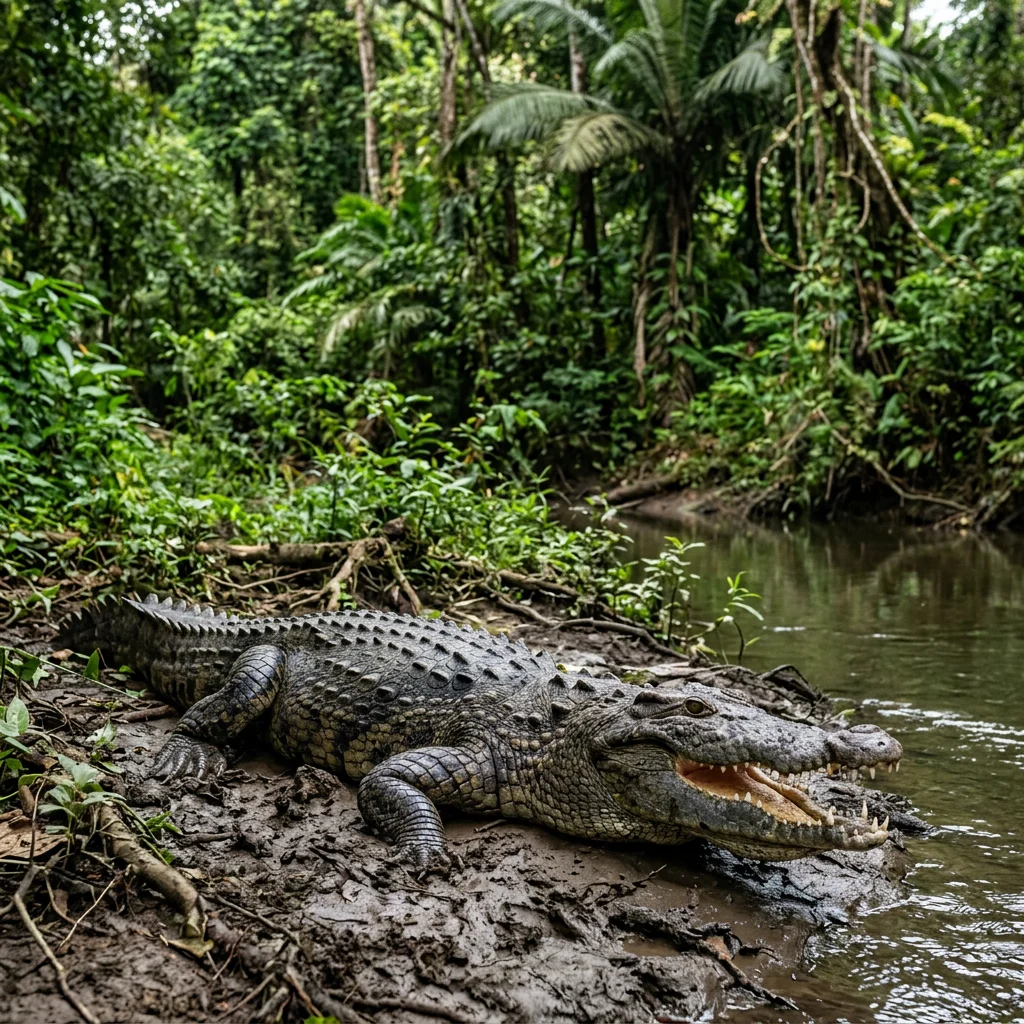
Panama has two crocodilians: the American crocodile and the spectacled caiman (the brown caiman subspecies). American crocodiles live in Gatun Lake and the Panama Canal, the Chagres River, and mangroves and river mouths on both the Pacific and Caribbean coasts, with big adults over 4 m. Caimans live in freshwater ponds, marshes and rivers. Both are commonly seen on canal and lake tours.
What crocodiles live in Panama?
| Species | Size | Habitat in Panama |
|---|---|---|
| American crocodile (Crocodylus acutus) | Males ~2.9–4 m; largest known in Panama ~4.2 m | Gatun Lake, Panama Canal, Chagres, coastal mangroves, Coiba |
| Spectacled caiman (Caiman crocodilus fuscus) | 1.5–2.5 m | Fresh water: ponds, marshes, rivers, lake margins |

How to tell Panama’s crocodile from its caiman
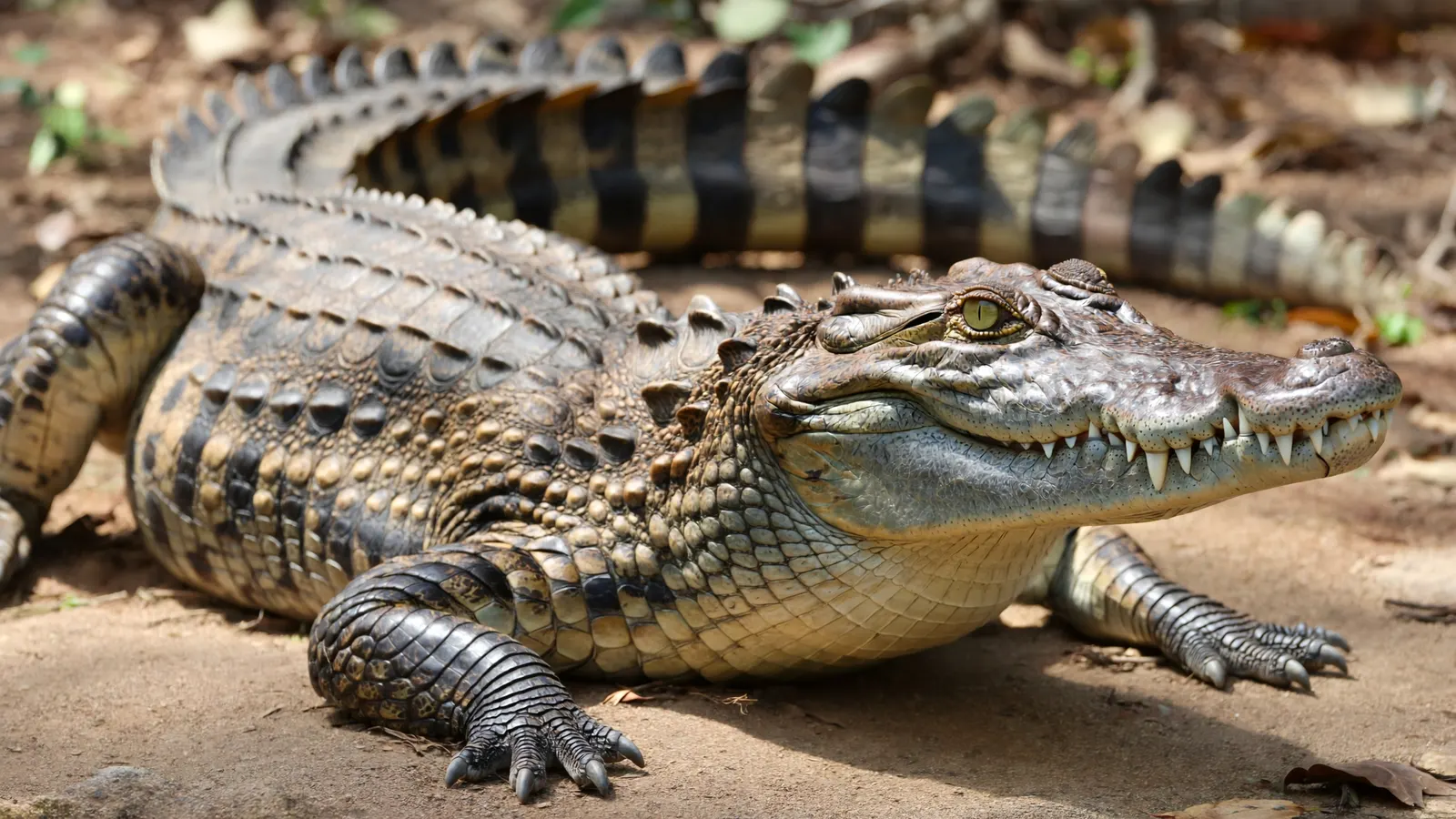
Panamanians often call the American crocodile cocodrilo aguja (needle crocodile) for its long, narrow snout, and the caiman babillo. The differences are easy to see at close range. The American crocodile has a long, tapering snout, a pale grey-olive to tan body, and, as in all true crocodiles, the large fourth tooth of the lower jaw stays visible when the mouth is closed. It is the bigger animal by far: mature males in mainland rivers typically measure about 2.9–4 m and females about 2.5–3 m. The largest crocodile known in Panama, a male nicknamed “Tito” on Coiba Island, measures about 4.2 m.
The caiman is smaller, stockier and darker, with a shorter, broader snout and a bony ridge between the eyes that looks like the bridge of a pair of spectacles, which gives the species its English name. Males usually reach 1.5–1.8 m and occasionally 2–2.5 m; females seldom exceed 1.4 m. Caimans prefer fresh water and tolerate salt water poorly, while the American crocodile is one of only two crocodiles, with the saltwater crocodile, that commonly live in the sea. So a large animal on a beach, in a mangrove estuary or swimming offshore near an island is almost certainly a crocodile, while a small one in a cattle pond or roadside ditch is probably a caiman.
How did crocodiles end up in the middle of the canal?
They were already in the Chagres River. When engineers flooded the valley, the crocodiles got a 470 km² lake.
Gatun Lake was created on 27 June 1913, when the spillway gates of Gatun Dam were closed across the Chagres River. The rising water drowned forest, farmland and villages, and when it was complete the lake covered about 470 km², then the largest artificial lake in the world. It sits about 26 m above sea level and carries ships for 33 km of their crossing. Crocodiles and caimans that had lived along the Chagres and its tributaries now had a vast, sheltered body of fresh water, full of bays, inlets and drowned trees, surrounded by forest that was kept largely intact to protect the canal’s watershed.
The lake also produced one of the most studied pieces of rainforest on Earth. Barro Colorado Island, a former hilltop cut off by the rising water, has been a research station since the 1920s and is now run by the Smithsonian Tropical Research Institute. A 2021 genetic study described its crocodiles as among the best-preserved populations in the region. Crocodiles regularly bask along the lake shore and on the island’s fringes, and transiting ships pass within sight of them.
The lake has changed beneath them. Peacock bass from South America were released into Gatun Lake around 1967 and spread rapidly. In a well-known 1973 paper in Science, Thomas Zaret and Robert Paine showed how this predator wiped out several native fish species and changed the lake’s food web. A Smithsonian sampling in 2016 found only about a quarter of the native fish species still present. Crocodiles are opportunistic feeders, and the lake still supports plenty of large fish, but the Gatun of today is a very different ecosystem from the river they originally lived in.
Are there crocodiles in the Panama Canal?

Yes. American crocodiles are a common sight in Gatun Lake and along the canal, and ship transit passengers often spot them basking on banks.
Gatun Lake was created in 1913 by damming the Chagres River to form the canal’s central section. Its sheltered bays, flooded forest and abundant fish (including introduced peacock bass) suit crocodiles well. Canal workers and fishermen in small boats see them regularly.
Where can you see crocodiles in Panama?
- Gatun Lake and Monkey Island tours — crocodiles and caimans plus monkeys and sloths.
- Chagres River and Soberanía National Park — crocodiles basking along the banks.
- Pacific coast river mouths and mangroves — e.g. around the Gulf of Chiriquí and Coiba National Park.
- Caribbean coast — mangroves near Colón and Bocas del Toro lagoons.
- Panama City’s coastal mangroves — Juan Díaz and Panama Bay wetlands.
Are crocodiles in Panama dangerous?
American crocodiles are relatively shy, but large adults can attack people, and incidents have occurred in Panama involving fishermen and people swimming in rivers and lakes. Crocodiles that are fed by people or that live near fish-cleaning sites can lose their fear. Caimans are small and pose little risk.
Are crocodiles protected in Panama?
Yes. The American crocodile is listed as Vulnerable by the IUCN and protected in Panama. Both species were heavily hunted for skins in the 20th century. Hunting bans since the 1970s have allowed a recovery. Today the main threats are habitat loss in coastal mangroves, conflict with fishermen, feeding by people and illegal killing.
Is the spectacled caiman in Panama the same as in the Amazon?
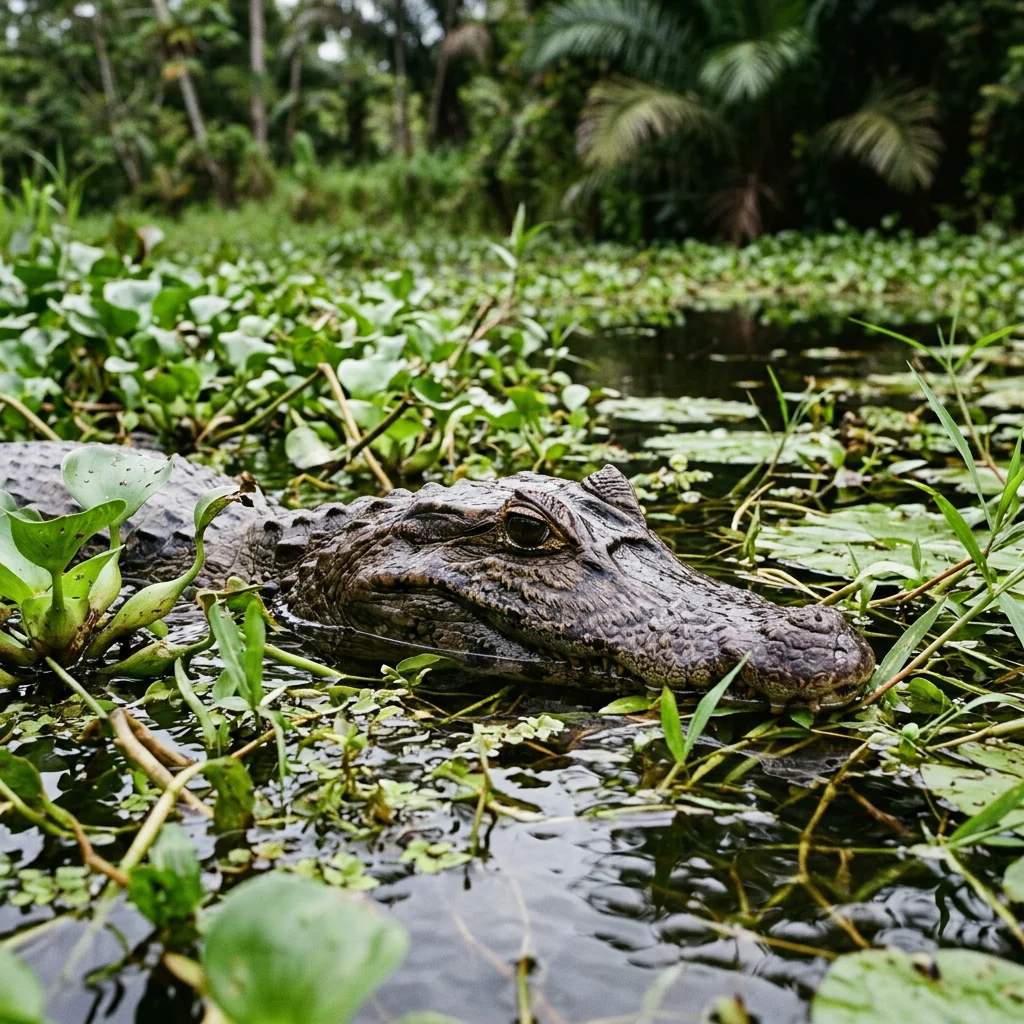
It is the same species, but Central American populations are usually treated as the subspecies Caiman crocodilus fuscus, the brown caiman. It is brownish-olive and often found in very small water bodies, including cattle ponds and roadside ditches.
Are Pacific and Caribbean crocodiles different?
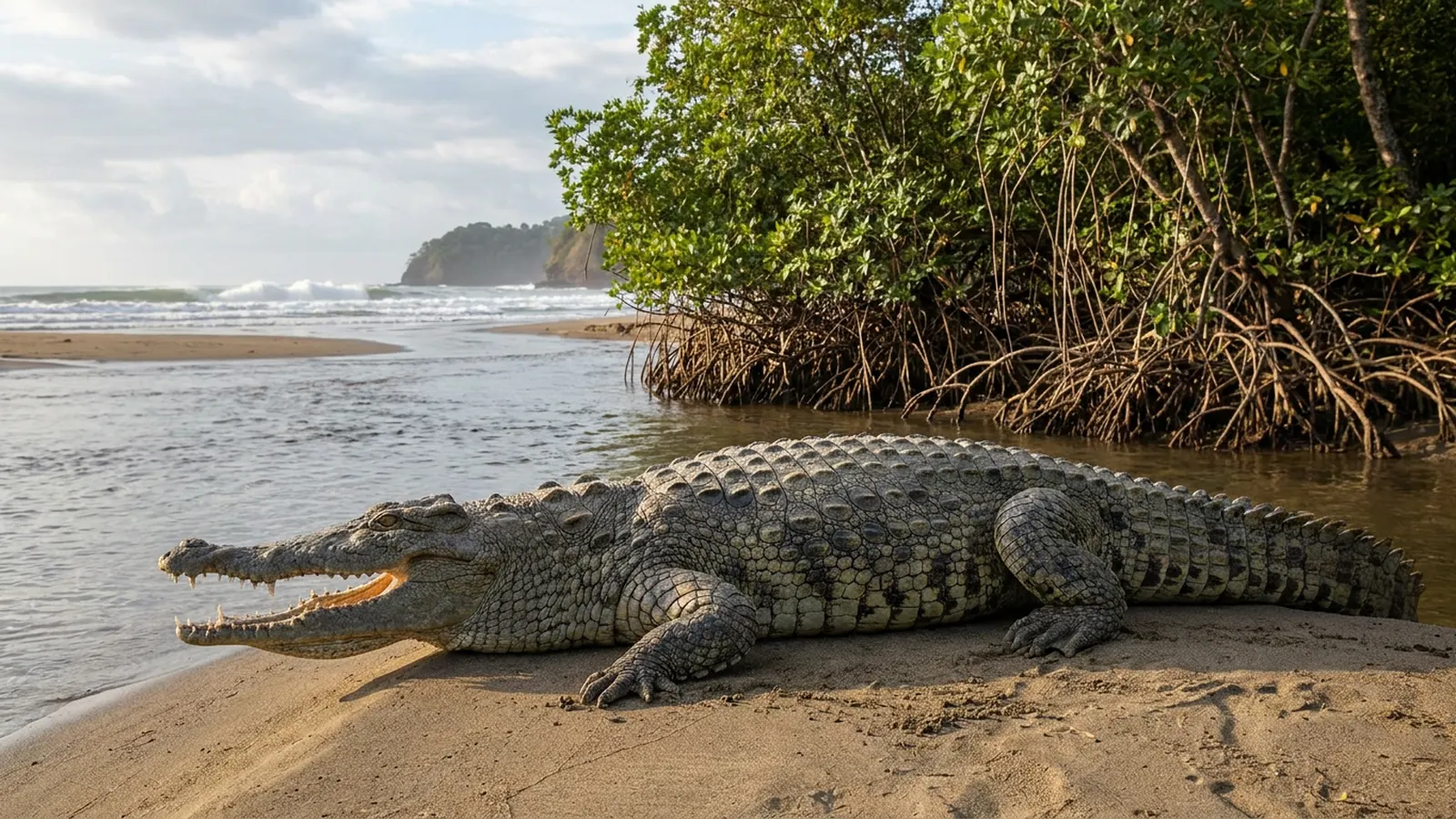
Panama is one of the few places where you can see the same crocodile species in two oceans on the same day. Biologists expected that the rise of the Isthmus of Panama, which closed the seaway between the Pacific and Caribbean over 3 million years ago, would have split the crocodiles into two long-separated populations. A genetic study published in Evolution in 2021 by Jose Avila-Cervantes of McGill University, Miryam Venegas-Anaya and colleagues found otherwise. After sampling crocodiles on both coasts, they estimated that the two populations separated only about 100,000 years ago, with a second, younger signal of separation around 20,000 years ago.
Their explanation lies in the Ice Age. During warm interglacial periods, sea levels were high enough to flood much of lowland Panama, linking the two coasts through brackish lagoons, small rivers and narrow strips of land that a salt-tolerant crocodile could cross. During cold glacial periods, sea levels dropped by more than 100 m and Panama was roughly twice as wide as today, which kept the populations apart. Some genetic differences between the coasts remain, and the authors warned that coastal development threatens that diversity. They found Pacific-coast crocodiles near the canal hard to locate, and singled out the Barro Colorado Island population as one worth protecting.
What has research on Coiba found?
Coiba National Park, a former penal colony island off the Pacific coast and a UNESCO World Heritage Site, holds one of Panama’s most closely studied crocodile populations. Between 2009 and 2012, Miryam Venegas-Anaya and colleagues carried out 99 nights of spotlight surveys covering more than 147 km of shoreline and rivers, and captured 185 crocodiles. They encountered between about 1 and 1.8 crocodiles per kilometre, depending on the year. The sex ratio was almost exactly equal, and most captured animals were young: average total length was about 1.15 m for females and 1.05 m for males. Animals were found across roughly 581 km² on the island and adjacent mainland, mostly in mangroves and on beaches, and their numbers were linked to protected areas. The researchers concluded that long-term monitoring is needed to tell natural ups and downs from human-caused change.
Why are crocodiles turning up in Panama City?
Experts describe the rise in sightings as a recovery, not an invasion.
From the Second World War to the mid-1970s, crocodile skins were in heavy demand, and most of Panama’s populations were badly depleted. Hunting bans since then have allowed survivors to grow and breed, and crocodiles in Panama mature at about seven years and can live 50–80 years. The result, according to researchers quoted by La Prensa in June 2026, is more crocodiles and larger ones, in places where people had forgotten they lived. Social media adds to the impression, since every sighting is filmed and shared, and some viral clips are not from Panama at all.
No national census has ever been carried out, but local surveys give a sense of numbers. Researchers have counted up to 46 adults within less than a kilometre of the Río Grande estuary in Coclé, about 11 animals along 3 km of the Juan Díaz River in the capital, and about 30 per kilometre at the Coquira River near Chepo and the port of Mensabé in Los Santos, where fishing waste attracts them. In 2026 the environment ministry, MiAmbiente, stepped up patrols, warning signs and community education around Clayton, Diablo and Albrook in the former Canal Zone, where crocodiles and people meet often, and began capturing, measuring and marking animals to follow their movements. A human–crocodile conflict management plan for Panama Bay, prepared with the Technological University of Panama, is due at the end of 2026.
Nesting season and when crocodiles are most defensive
American crocodiles nest in sand or loose soil above the high-water line, often on beaches and riverbanks, and clutches average around 38 eggs. In Panama the hatchlings emerge in April and May, and researchers warn that this is when adults are most territorial and quick to defend nests and young. Hatchlings are about 27 cm long and weigh around 60 g, and most are eaten by birds, fish, crabs and other predators in their first year. Caimans nest differently, piling mounds of vegetation near water, and lay smaller clutches, usually 14–40 eggs and about 22 on average. Heat from rotting plants helps incubate the eggs for about 90 days, and the temperature in the nest decides whether the young are male or female. Caiman mothers often guard young in groups, or crèches, that can include the offspring of several females.
How often do crocodiles attack people in Panama?
Serious attacks are uncommon, but they do happen. In August 2021 a 12-year-old girl was killed by a crocodile while bathing in a river in the Gangandí area of Guna Yala, on the Caribbean side. Residents near Gatun Lake and Colón also report crocodiles in drainage channels and occasional bites. Researchers such as Miryam Venegas-Anaya stress that Panama’s crocodiles do not treat people as normal prey and that most incidents involve animals defending nests or crocodiles that have learned to associate people with food.
That last point is the one people can control. Fishermen who throw fish scraps into rivers, and residents who feed crocodiles for photos, teach them to approach people. MiAmbiente has publicly criticised fishermen at the Coquira River for feeding crocodiles, and its advice is consistent: keep your distance, never feed crocodiles, do not leave fish waste near rivers, lagoons or mangroves, and report sightings through the government’s 311 line or the ministry’s social media.
Why crocodiles matter to Panama’s coasts
Panamanian researchers describe crocodiles as indicators of healthy mangroves and estuaries: where they are scarce, overfishing or pollution is often to blame. As predators and scavengers they remove carrion and take animals that compete with or prey on commercially important fish and shrimp. The brown caiman, meanwhile, is listed on CITES Appendix II, and although the spectacled caiman as a whole is rated Least Concern, the brown caiman subspecies has been heavily hunted for skins in neighbouring Colombia. Protecting Panama’s crocodilians therefore depends on the same things that protect its fisheries: intact mangroves, clean rivers and fewer fish scraps thrown to the water’s edge.
Tips for watching crocodiles in Panama
The easiest place to see crocodiles is from a boat on Gatun Lake, where tour operators visit the lake’s islands and quiet inlets; look along muddy banks and on logs, especially in the morning when crocodiles bask to warm up. River trips on the Chagres, trips into Coiba National Park and boat rides through Pacific mangroves also give good chances. At night, a torch reveals both species by the red-orange eyeshine reflected from the water. Keep to the boat, keep hands inside, and ask operators not to feed the animals. A crocodile that has learned to approach boats for food becomes a risk to the next swimmer or fisherman and is often the one that ends up being removed.
For more on Panama’s waters, see the Panama Canal and Panama coral reef maps.
Are there crocodiles in Panama?
Yes, American crocodiles and spectacled (brown) caimans.
Are there crocodiles in the Panama Canal?
Yes. American crocodiles are common in Gatun Lake and along the canal.
Is it safe to swim in Gatun Lake?
No. Crocodiles live there and swimming is not recommended.
How big are crocodiles in Panama?
Adult male American crocodiles usually reach about 2.9–4 m; the largest known in Panama, on Coiba, is about 4.2 m. Caimans rarely exceed 2–2.5 m.
Where can I see crocodiles in Panama?
Gatun Lake tours, the Chagres River, Pacific coast river mouths and mangroves near Colón and Bocas del Toro.
- IUCN SSC Crocodile Specialist Group. Crocodiles: Status Survey and Conservation Action Plan, 3rd ed.
- Ponce-Campos, P. et al. (2012). Crocodylus acutus. IUCN Red List.
- Smithsonian Tropical Research Institute. Fauna of Barro Colorado Island and Gatun Lake.
- Avila-Cervantes, J. et al. (2021). Effect of the Central American Isthmus on gene flow and divergence of the American crocodile (Crocodylus acutus). Evolution.
- Venegas-Anaya, M. et al. (2015). Population ecology of American crocodile (Crocodylus acutus) in Coiba National Park, Panama. Journal of Herpetology 49(3): 349–357.
- Zaret, T.M. & Paine, R.T. (1973). Species introduction in a tropical lake. Science 182: 449–455.
- La Prensa (Panamá), 14 June 2026. ¿Cocodrilos en la ciudad de Panamá?: una historia de recuperación.
- Telemetro, 18 July 2026. MiAmbiente refuerza medidas de prevención ante presencia de cocodrilos en la ciudad.
- Panamá América, 20 August 2021. Report of a fatal crocodile attack in Guna Yala.
Blane Perun has been exploring Earth’s oceans and marine life for over 25 years. Founder of TheSea.Org in 1999, underwater photographer, coral aquaculture pioneer, and explorer of 80+ countries.
About Blane Perun →More on Crocodiles →Why are there more crocodiles in Panama City now?
Experts say populations are recovering after decades of skin hunting ended in the 1970s. Fish waste and feeding draw crocodiles to ports and rivers, and social media makes sightings more visible.
When are crocodiles in Panama most aggressive?
Around nesting: hatchlings emerge in April and May, when adults defend nests and young most strongly.
Do Pacific and Caribbean crocodiles in Panama differ?
Slightly. A 2021 genetic study found the two coastal populations separated only about 100,000 years ago, because Ice Age sea-level highs repeatedly linked the coasts.
