Cephalopods — The Ocean’s Big-Brained Molluscs
Cephalopods are marine molluscs whose arms grow directly from the head: octopuses, squid, cuttlefish and nautiluses. More than 800 living species are known, and new ones are still being described. Most have three hearts, copper-based blue blood, an ink sac, a parrot-like beak and the ability to jet by squirting water through a funnel. They range from thumb-sized pygmy species to the colossal squid, the heaviest invertebrate on record at about 495 kg. Most live fast and die young, typically within one to two years.
Cephalopods are the molluscs that took a different path from snails and clams: big brains, camera eyes, jet propulsion and skin that changes colour in a blink. This guide covers how they work, how they evolved and what research is still revealing about them.
What is a cephalopod?
The name means “head-foot” in Greek, because the muscular foot of the ancestral mollusc became a ring of arms and tentacles around the mouth. Cephalopods are molluscs, so their closest relatives are snails, clams and chitons, yet they evolved large brains, camera-like eyes and fast, flexible bodies that let them compete with fish. Fishers have long called them “inkfish” for the ink cloud nearly all of them can release.

What are the main groups of cephalopods?
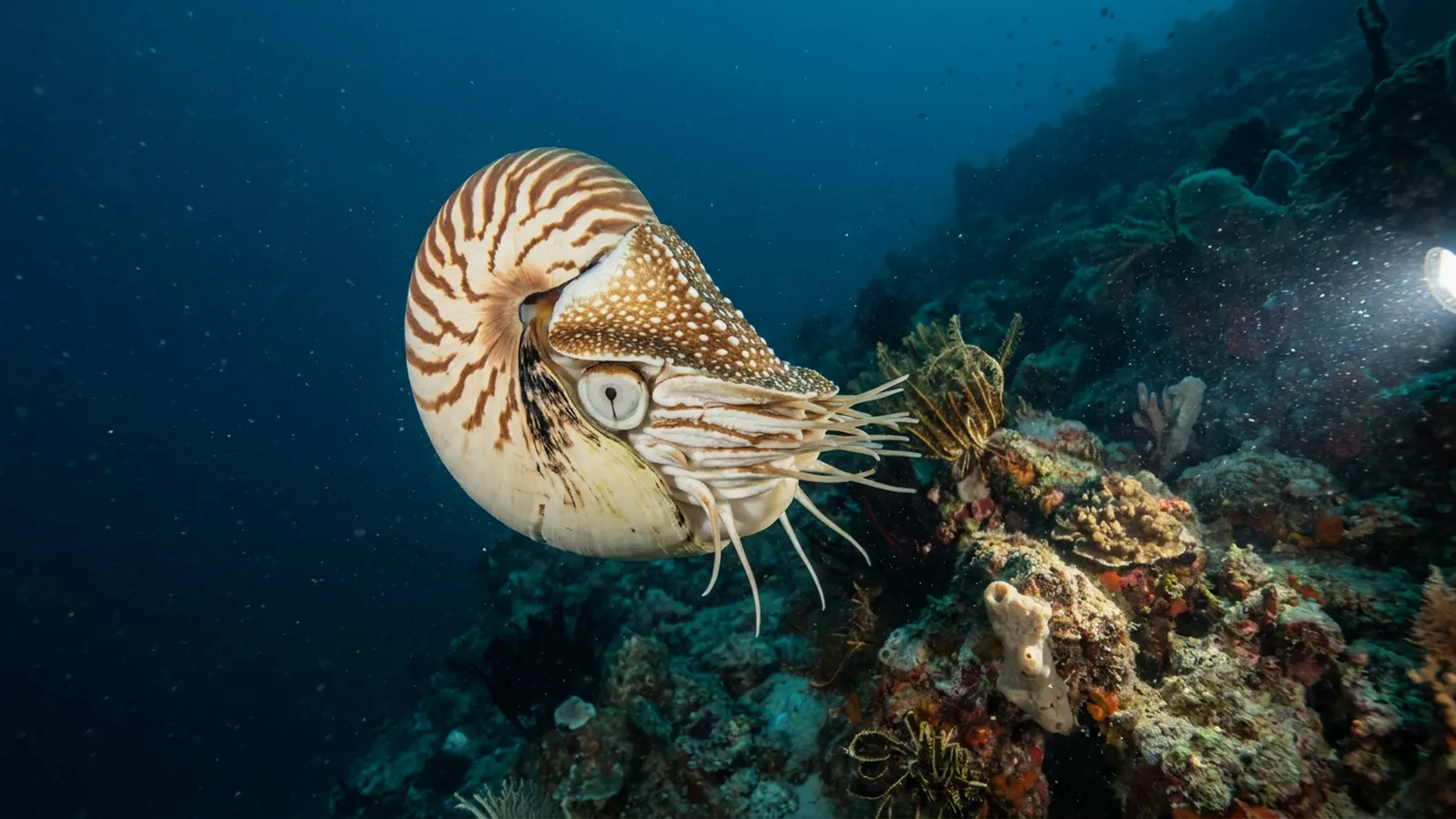
Living cephalopods fall into two lineages that split more than 470 million years ago. The nautiloids keep an external chambered shell; somewhere between six and nine species survive, depending on the authority, in the genera Nautilus and Allonautilus. Everything else is a coleoid, with the shell internal, reduced or lost.
| Group | Approx. species | Limbs | Shell | Thesea.org guide |
|---|---|---|---|---|
| Octopuses (Octopoda) | ~300 | 8 arms | Absent or vestigial | Octopus |
| Squid (several orders) | Several hundred | 8 arms + 2 tentacles | Internal gladius (pen) | Squid |
| Cuttlefish (Sepiida) | ~116–120 | 8 arms + 2 tentacles | Internal cuttlebone | Cuttlefish |
| Nautiluses (Nautilidae) | ~9 | Up to ~90 cirri | External chambered shell | Nautilus |
| Vampire squid (Vampyromorphida) | 1 | 8 webbed arms + 2 filaments | Internal pen | Vampire squid |
How do cephalopods breathe and circulate blood?
Coleoids have two branchial (gill) hearts that push blood through the gills and one systemic heart that sends it around the body. The blood carries oxygen with hemocyanin, a copper-containing protein, which turns blue when oxygenated. Hemocyanin works better than hemoglobin in cold, low-oxygen water, but it floats free in the blood rather than being packed into cells, which limits how much oxygen the blood can carry. That is one reason cephalopods tire quickly despite their bursts of speed.
How do cephalopods move?
Water drawn into the mantle cavity is squeezed out through a funnel, producing jet propulsion; squid can expel up to 94 percent of the water in the cavity in one thrust. Jetting is energy-expensive, so most species cruise with fins or crawl on their arms and save the jet for escapes and strikes. Some squid even launch themselves out of the water and glide. Octopuses walk on the seabed, and the nautilus jets slowly while using its shell for buoyancy.
How do cephalopods change color?
Coleoids carry chromatophores, elastic sacs of pigment opened by muscles under direct nerve control, over layers of reflective iridophores and leucophores. They can change color and pattern in milliseconds, for camouflage, warning or courtship, and many can also change skin texture. Deep-sea species add bioluminescent photophores. Remarkably, most cephalopods appear to be color-blind. Read more in cephalopod camouflage.
How intelligent are cephalopods?
Octopuses, cuttlefish and squid have the largest nervous systems of any invertebrates. In octopuses, about two-thirds of the neurons sit in the arms, which can carry out complex reflexes without input from the brain. Octopuses solve puzzles and use tools; cuttlefish have passed delayed-gratification tests. Their giant nerve fibers, which lack myelin and are unusually wide, made squid a workhorse of 20th-century neuroscience.
How big and how small do cephalopods get?
The colossal squid (Mesonychoteuthis hamiltoni) is the heaviest: a male caught in the Ross Sea in February 2007 weighed about 495 kg (1,091 lb). The giant squid (Architeuthis dux) is the longest, reaching about 13 m with tentacles, though most of that length is tentacle. At the small end, pygmy squid and some octopuses are adult at a centimeter or two. See colossal squid and giant squid for the details.
How long do cephalopods live?
Most coleoids grow fast and live one to two years; many octopus and squid females brood or lay eggs once and die soon after (they are semelparous). Large or cold-water species can live longer, and nautiluses are the exception, living for many years and breeding repeatedly.
Where do cephalopods live?
Every ocean, from tide pools to the deep sea, but never in fresh water. Diversity is highest near the equator and falls toward the poles. Cuttlefish are absent from the Americas, while octopuses and squid are found nearly everywhere. Nautiluses are restricted to the Indo-Pacific.

How do cephalopods catch and eat their food?
All cephalopods are predators. Squid and cuttlefish carry two long feeding tentacles in addition to their eight arms, and in many species these can shoot out and grab prey in as little as 15 milliseconds before the arms pull it toward the mouth. Octopuses have no tentacles; they pounce, wrap prey in the web between their arms, or probe crevices with single arms. The nautilus uses dozens of sucker-less cirri to grip food and relies far more on smell than sight.
At the centre of the arm crown sits a two-part beak, the only hard part of many cephalopods’ bodies. Every living cephalopod has one. Behind it, most species also have a radula, the toothed ribbon that molluscs use to rasp food, with rows of up to nine teeth; it is reduced in most octopuses and absent altogether in the ram’s horn squid, Spirula. Salivary glands add toxic secretions that help subdue prey and loosen flesh from shell, which is why octopuses can drill into and open snails and clams. Crustaceans, fish and other molluscs, including other cephalopods, make up most diets, and cannibalism is common in many squid.
Beaks resist digestion, so they pile up in the stomachs of the animals that eat cephalopods. Researchers identify and measure beaks from sperm whales, seals, albatrosses and penguins to work out which species were eaten and how big they were, and much of what is known about deep-sea squid populations comes from that indirect evidence. Cephalopods are a central link in ocean food webs: they turn small prey into large, protein-rich bodies that feed whales, dolphins, seals, seabirds, sharks, tuna and billfish.
What can cephalopods see, feel and hear?
The coleoid eye is a camera eye with a lens, iris and retina, built remarkably like a vertebrate eye even though the two evolved separately. One difference favours the cephalopod: its retinal nerve fibres leave from behind the photoreceptors, so it has no blind spot. Many squid and octopuses, and probably cuttlefish, can also detect the plane of polarized light, which helps them spot transparent prey and may carry hidden signals between individuals. The nautilus is the odd one out, with a pinhole eye that has no lens.
Colour vision is the great puzzle. Most cephalopods have only one type of visual pigment, which should make them colour-blind, yet they match the colours of their backgrounds with uncanny accuracy. Two partial explanations have been proposed. One is that the strangely shaped pupils of squid, cuttlefish and octopuses could exploit chromatic aberration, extracting colour information from how sharply different wavelengths focus; this is supported by modelling but remains a hypothesis. The other is that the skin itself may sense light: a 2015 study found transcripts of light-sensitive opsin proteins in the skin of the longfin inshore squid and two cuttlefish species. A known exception is the firefly squid (Watasenia scintillans) of Japan, which has three types of photoreceptor and shows evidence of colour vision.
Balance and acceleration are sensed by statocysts, fluid-filled chambers beside the brain. Some squid can detect low-frequency sound through them, but in general cephalopods are thought to be close to deaf. Chemical senses are strong, especially in the suckers of octopuses, which can taste what they touch.
Why do cephalopods squirt ink?
With the exception of the nautiluses and the finned cirrate octopuses, every known cephalopod has an ink sac. It opens into the gut near the base of the funnel, so ink can be blown out with a jet of water. The ink is almost pure melanin mixed with mucus. Released as a diffuse cloud it acts as a smokescreen. Released with extra mucus it can hold together as a blob roughly the size and shape of the animal, a decoy called a pseudomorph that predators sometimes attack while the cephalopod changes colour and leaves. Ink may also interfere with a predator’s sense of smell. Some females coat their egg capsules with ink, which may help camouflage the eggs. Humans have used it as a writing and drawing pigment (sepia is named after the cuttlefish genus) and in dishes such as squid-ink pasta and rice.
How do cephalopods reproduce?
Mating usually involves packets of sperm called spermatophores. In most species the male uses a modified arm, the hectocotylus, to place them in the female’s mantle cavity or near her mouth; nautiluses use a different organ called a spadix. In the argonauts, or paper nautiluses, the hectocotylus detaches and stays with the female; when first found it was mistaken for a parasitic worm. Females of several species store sperm from more than one male, and DNA studies have confirmed mixed paternity.
Most coleoids breed once and then die, a strategy called semelparity. Squid often spawn in large gatherings and attach finger-like egg capsules to the seabed or release floating egg masses. Octopus females guard their eggs in a den, cleaning and ventilating them, and stop feeding until they hatch. In shallow-water octopuses brooding lasts around one to three months. In the deep sea it can last far longer: a female Graneledone boreopacifica watched by researchers from the Monterey Bay Aquarium Research Institute at 1,397 m in Monterey Canyon, California, guarded a single clutch of 155 to 165 eggs for 53 months, from May 2007 to September 2011, in water of about 3 °C. That is the longest egg-brooding period known for any animal.
Cephalopods have no true larval stage. Eggs hatch into miniature versions of the adult, although the young of many squid and some octopuses drift in the plankton for a time and are called paralarvae. Egg development is strongly affected by temperature, so warm water speeds up the whole life cycle, a point that matters for how cephalopods respond to warming oceans.
How did cephalopods evolve?
The oldest widely accepted cephalopods are small shelled animals such as Plectronoceras from the Late Cambrian, about 500 million years ago. They are thought to have evolved from snail-like molluscs with a cap-shaped shell, and the key innovation was the siphuncle, a tube that let the animal control gas and liquid in the shell chambers and so float. In the Ordovician, shelled nautiloids diversified rapidly and were among the top predators of their time, some with straight shells over two metres long. The lineages leading to the modern nautilus and to the coleoids had separated by the Early Ordovician, more than 470 million years ago.
Two famous extinct groups followed. The ammonites appeared in the Devonian, became extremely diverse, and are so widespread and fast-changing that geologists use them to date rocks; the last of them vanished during or soon after the mass extinction that ended the Cretaceous. See cephalopod fossils and cephalopods with shells. The belemnites were squid-like animals with a heavy internal guard, often found as bullet-shaped fossils. Living squid and cuttlefish belong to the same broad internal-shelled coleoid branch, while octopuses lost the shell almost entirely. A 12 cm fossil from the Bear Gulch Limestone of Montana, described in 2022 as Syllipsimopodi bideni and dated to roughly 330 million years ago, was interpreted by its authors as the oldest known relative of octopuses and vampire squid; it had ten arms, suggesting that the eight-armed body plan came later.
What do cephalopod genomes reveal?
The first cephalopod genome, from the California two-spot octopus (Octopus bimaculoides), was published in 2015. It showed no evidence of a whole-genome duplication, contrary to an earlier idea, but it did reveal large expansions of a few gene families. The most striking are the protocadherins, genes involved in wiring neurons together, which are greatly multiplied in octopuses as they are in vertebrates. The genome is also rich in transposable elements, so-called jumping genes, some of them active in nervous tissue. Later long-read studies found that cephalopod genomes have been extensively shuffled, with chromosome segments rearranged compared with other molluscs.
Squid, octopuses and cuttlefish also edit their genetic messages on a scale not seen in most animals. A 2017 study in the journal Cell reported that coleoid cephalopods recode a large share of the RNA made in their nervous systems, changing the proteins produced without changing the DNA. Many of these editing sites are conserved across species, and the authors argued that keeping them in place has slowed the evolution of the surrounding DNA. Nautiluses do not show the same pattern, which suggests the trait arose in the coleoid line.
Are cephalopod numbers increasing?
Fish stocks have declined in many regions, but cephalopods appear to have done the opposite. A 2016 study led by Zoë Doubleday of the University of Adelaide, published in Current Biology, compiled catch rates for 35 cephalopod species or genera from six families between 1953 and 2013 and found that abundance had increased, with the trend remarkably consistent across octopuses, bottom-dwelling squid and cuttlefish, and open-ocean squid. The authors did not identify a single cause. Suggested factors include warmer water speeding up cephalopod life cycles and the removal of fish that compete with or eat cephalopods. Because most species live only a year or two, cephalopod populations can respond quickly to changing conditions, in either direction.
Squid and octopus are also a major fishery. Large open-ocean squids such as the jumbo or Humboldt squid, the Argentine shortfin squid and the Japanese flying squid support some of the biggest invertebrate fisheries in the world, and catches swing sharply from year to year with ocean conditions. Nautiluses are the opposite case: they mature slowly and lay few eggs, so shell collecting can deplete local populations, and all species were listed on CITES Appendix II in 2016.
How are cephalopods protected by law?
Cephalopods are increasingly treated as animals that can suffer. They are the only invertebrates covered by the European Union’s 2010 directive on animals used for scientific purposes. In the United Kingdom, a government-commissioned review led by researchers at the London School of Economics concluded in 2021 that there is strong scientific evidence that cephalopods and decapod crustaceans are sentient, and the Animal Welfare (Sentience) Act 2022 recognised both groups alongside vertebrates. Plans for commercial octopus farming have met strong opposition from scientists and welfare groups, and in 2024 Washington became the first US state to ban octopus farming, followed by California later the same year.
How much is still unknown?
Cephalopods remain among the least-explored large animals in the sea. The giant squid was not photographed alive in its natural habitat until 2004, and the colossal squid, described in 1925, was filmed alive in the wild for the first time only in March 2025, when the Schmidt Ocean Institute’s remotely operated vehicle SuBastian recorded a juvenile about 30 cm long at roughly 600 m near the South Sandwich Islands. New species of octopus, squid and even nautilus continue to be named; three new Nautilus species were described in 2023. Many deep-sea species are known from only a handful of specimens, and the life spans, population sizes and breeding sites of most remain unknown.
What animals are cephalopods?
Octopuses, squid, cuttlefish, nautiluses and the vampire squid.
How many species of cephalopods are there?
More than 800 living species, with new species still described.
Why do cephalopods have three hearts?
Two hearts pump blood through the gills and one pumps it around the body, compensating for less efficient copper-based blood.
Why is cephalopod blood blue?
It uses hemocyanin, a copper-containing protein, instead of iron-based hemoglobin.
What is the largest cephalopod?
By weight the colossal squid (~495 kg); by length the giant squid (~13 m).
Are cephalopods intelligent?
Yes. They have the largest invertebrate nervous systems and show problem-solving and learning.
How long do cephalopods live?
Most one to two years; nautiluses live much longer.
Do all cephalopods have ink?
Nearly all; nautiluses and the finned cirrate octopuses lack an ink sac.
- FAO Species Catalogue: Cephalopods of the World (Jereb & Roper, eds.).
- Guinness World Records: Largest cephalopods (colossal squid 495 kg; giant squid ~13 m).
- Smithsonian Magazine: Fourteen fun facts about squid, octopuses and other cephalopods.
- Barord G.J. et al. (2023). Three new species of Nautilus. ZooKeys 1143: 51–69.
- Robison B., Seibel B. & Drazen J. (2014). Deep-sea octopus (Graneledone boreopacifica) conducts the longest-known egg-brooding period of any animal. PLOS ONE 9(7): e103437.
- Doubleday Z.A. et al. (2016). Global proliferation of cephalopods. Current Biology 26(10): R406–R407.
- Albertin C.B. et al. (2015). The octopus genome and the evolution of cephalopod neural and morphological novelties. Nature 524: 220–224.
- Liscovitch-Brauer N. et al. (2017). Trade-off between transcriptome plasticity and genome evolution in cephalopods. Cell 169(2): 191–202.
- Whalen C.D. & Landman N.H. (2022). Fossil coleoid cephalopod from the Mississippian Bear Gulch Lagerstätte sheds light on early vampyropod evolution. Nature Communications 13: 1107.
- Kingston A.C.N. et al. (2015). Visual phototransduction components in cephalopod chromatophores suggest dermal photoreception. Journal of Experimental Biology 218: 1596–1602.
- Stubbs A.L. & Stubbs C.W. (2016). Spectral discrimination in color blind animals via chromatic aberration and pupil shape. PNAS 113(29): 8206–8211 (a modelling hypothesis).
- Birch J. et al. (2021). Review of the Evidence of Sentience in Cephalopod Molluscs and Decapod Crustaceans. London School of Economics; UK Animal Welfare (Sentience) Act 2022.
- Schmidt Ocean Institute / Ocean Census (April 2025). First footage of a live juvenile colossal squid, South Sandwich Islands.
Blane Perun has been exploring Earth’s oceans and marine life for over 25 years. Founder of TheSea.Org in 1999, underwater photographer, coral aquaculture pioneer, and explorer of 80+ countries.
About Blane Perun →