Carukia barnesi — The Jelly a Doctor Found by Stinging Himself
Carukia barnesi is a tiny box jellyfish from tropical northern Australia and the first species proven to cause Irukandji syndrome. Its bell is usually about 1–2 cm across, with four thin tentacles that can stretch to roughly 75 cm. It is named after the Cairns doctor Jack Barnes, who caught it in December 1961 and proved its role by letting it sting himself, his nine-year-old son and a young lifesaver; all three became ill and recovered, and he published the results in 1964.
For years, doctors in North Queensland saw swimmers with mysterious, agonising illnesses after barely noticeable stings. Hugo Flecker named the condition “Irukandji syndrome” in 1952, but no one knew which animal caused it. The answer came from one of the boldest self-experiments in medical history. This article covers the species and its discovery; for the wider group and the syndrome itself, see Irukandji jellyfish.
How was Carukia barnesi discovered?
In December 1961 the Cairns doctor Jack Barnes caught a tiny transparent box jelly off the northern beaches and, to prove it caused Irukandji syndrome, let it sting himself, his nine-year-old son and a local lifesaver.
All three developed the classic syndrome — severe pain, vomiting and distress — and all three survived. Barnes published his findings in the Medical Journal of Australia in 1964, and in 1967 the Adelaide zoologist Ronald Southcott formally described the species as Carukia barnesi in his honour. Today such an experiment would never pass an ethics committee, but it solved a decades-old mystery.
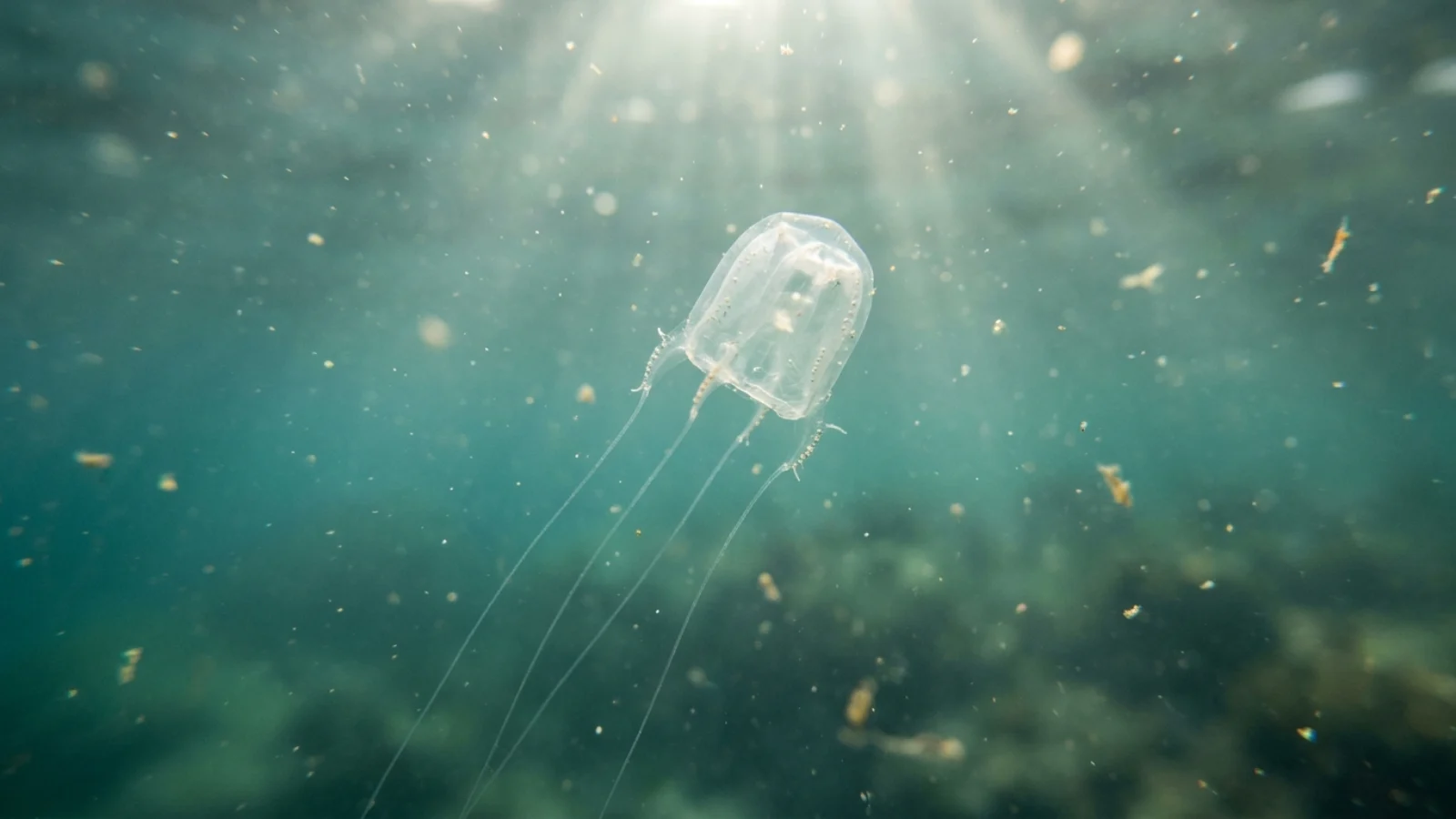
What does Carukia barnesi look like?
A transparent, cube-shaped bell about 1–2 cm across with four long, thin tentacles, each dotted with clusters of stinging cells that look like tiny beads.
Its bell carries stinging capsules too, not just its tentacles, which means a swimmer can be stung simply by touching the body. Fully extended, the tentacles of large adults reach about 75 cm, though they are often contracted to a fraction of that. Its small size and transparency make it nearly impossible to see in the water.
How does Carukia barnesi venom work?
The venom causes a massive release of stress hormones (catecholamines), driving the pain, racing heart and dangerous blood-pressure spikes of Irukandji syndrome.
Symptoms usually start somewhere between 5 and 120 minutes after the sting, most often around half an hour. Most patients recover with hospital treatment, but severe cases can lead to heart failure or bleeding in the brain. Two tourists died of Irukandji syndrome in Queensland in 2002; the species responsible was not identified in either case. The full list of symptoms and first aid is in Irukandji jellyfish.
What does Carukia barnesi eat?
Small fish and zooplankton. Young jellies feed on tiny crustaceans, while adults switch to larval fish.
Laboratory filming has shown that adults twitch their beaded tentacles in the light, apparently using the stinging-cell clusters as lures for larval fish (see below). See how do jellyfish eat?
Where does Carukia barnesi live?
In tropical waters of northern Australia, especially along the Queensland coast and around the Great Barrier Reef.
It can occur near beaches and on offshore reefs. Stings peak in the warmer months. Like other box jellyfish, it has a polyp stage, but no one has yet found its polyps in the wild. Compare it with the box jellyfish that shares its range.
Why did the cause stay hidden for so long?
Swimmers on the beaches north of Cairns were linking a strange illness to sea stings as early as the 1920s. The pattern puzzled doctors: the sting itself was often so slight that people barely noticed it, yet half an hour later they could be doubled over with back and stomach pain, sweating, vomiting and gasping for breath. Nothing visible was left on the skin to point to a culprit, and no one in the water had seen what touched them.
The radiologist and naturalist Hugo Flecker began collecting cases in the 1930s and described the condition in 1945. In 1952 he gave it a name, choosing “Irukandji” after the Aboriginal people who had lived along the coast between the Mowbray River and Trinity Inlet, the stretch where most cases occurred. He was frank about the choice: the label was needed precisely because the animal responsible was still unknown. Flecker died in 1957, and the investigation passed to a Cairns general practitioner and former wartime commando, Jack Handyside Barnes.
Barnes approached it as a detective would. He gathered sting records from the ambulance service and Cairns Base Hospital and found that most cases happened in December and January, with the great majority on the adjoining Palm Cove and Ellis beaches, and that they clustered on days when steady northerly winds pushed water onshore. From that he reasoned that the culprit must be small, colourless, transparent and mobile, and probably present near the surface in numbers. He even suggested the best way to see it: looking through a diving mask with light coming in at an angle.
What happened on 10 December 1961?
Using that method, Barnes and his helpers found two specimens of a small box jelly. He later wrote that he saw the first one only when it bumped against the glass of his face mask. The second was caught by a lifesaver, Don Ludbey, who spotted it hanging by one tentacle from a fish that was swimming erratically.
The first jellyfish was applied to Barnes himself and to his nine-year-old son; the second to a fit young lifesaver. The boy reported mild abdominal pain about twelve minutes after the sting. Over the next half hour all three developed the full picture that Flecker had described: restlessness, pain in the back, chest and abdomen, aching muscles and joints, difficulty breathing and vomiting. Forty minutes in, their abdominal muscles had gone rigid. The adults were treated with 50 mg of pethidine, an opioid painkiller, which brought relief within minutes, though the symptoms returned when the drug wore off. All three recovered without lasting harm.
Barnes published the cases in 1964 under the title “Cause and effect in Irukandji stingings”. The jellyfish itself still needed a scientific name, and that came in 1967, when Ronald Southcott described it in the Australian Journal of Zoology as a new genus and species, Carukia barnesi, honouring the man who had caught it. Today it is placed in its own family, Carukiidae, a grouping supported by molecular studies of box jellyfish relationships published around 2010.
How do you tell Carukia barnesi from other box jellies?
In the hand, size is the first clue. Field studies off Cairns have measured adults at roughly 20 mm across the bell, and in six seasons of night sampling around Double and Haycock islands the bell widths of captured medusae ranged from 3 to 24 mm, with nine out of ten between 6 and 16 mm. The bell is a clear, slightly taller-than-wide box with a single tentacle trailing from each of its four lower corners. Small raised warts on the bell carry stinging cells, and their number differs between young and mature animals.
The tentacles are the best field mark. Along each one, clusters of stinging capsules alternate large and small, so that a stretched tentacle looks like a fine thread strung with beads or crescents. The spacing of these clusters stays much the same however large the jellyfish grows; only the tentacle gets longer. In the largest adults a fully relaxed tentacle can reach about 75 cm, although figures as short as 5 cm are quoted for contracted or younger animals.
Like all box jellyfish, Carukia barnesi has four sensory structures called rhopalia, each carrying six eyes: two simple pigment cups, two slit-shaped eyes and two complex eyes with a cornea, lens and retina. That gives it 24 eyes in all. By contrast the much larger Chironex fleckeri, the dangerous box jelly of the same coastline, has a bell that can exceed 20 cm and bunches of up to 15 tentacles on each corner. Other small Irukandji species, such as Malo kingi, can be separated reliably only by specialists looking at details of the tentacle bases and stinging capsules.
Does it really fish with its tentacles?
Yes, and it is one of the better-documented examples of luring in jellyfish. In a 2015 study, Courtney and colleagues at James Cook University filmed wild-caught adults in a circular plankton tank under a day–night light cycle, with infrared lighting so they could film in the dark. In the light, the medusae spread their tentacles and twitched them frequently, making the bead-like stinging clusters jerk through the water. Larval fish, which hunt by sight, were drawn to these moving “baits” and were stung and eaten.
In darkness the twitching stopped. The researchers suggested that this saves energy at times when visual predators like fish larvae cannot see the lures anyway. Larger medusae twitched more often than smaller ones and had longer tentacles, which fits the idea that the behaviour develops as the jellyfish moves from feeding on plankton to targeting fish. The authors concluded that adults are not simply drifting and grazing on whatever touches them, but using a deliberate fishing strategy aimed at larval fish.
Once prey is stung, muscles in the tentacle contract to draw it up towards the mouth, which opens into a central stomach under the bell where digestion takes place.
Does its venom change as it grows?
It does. In 2007 Underwood and Jamie Seymour compared tentacle venom from immature and mature Carukia barnesi using protein electrophoresis and found different banding patterns between the two age groups. The shift lined up with a change in diet: younger medusae mostly took small invertebrates such as crustaceans, while mature ones took fish. Unusually for a box jellyfish, the change in venom was not accompanied by any change in the types of stinging capsule or their relative numbers, so the difference lies in what the capsules contain rather than in the capsules themselves.
More recent work has looked at temperature. A 2026 study by O’Hara and colleagues used high-resolution mass spectrometry to compare venom from polyps and from newly released medusae raised at 27, 29 and 31 °C. Venom composition varied with both temperature and life stage. The authors raised the possibility that warmer seas could alter how severe stings are, and that the variation might help explain why the delay before symptoms differs so much between patients, though both ideas still need testing.
The clinical effect of the venom is well established even if its full chemistry is not. It triggers a surge of catecholamines, the body’s stress hormones, which accounts for the severe pain, sweating, racing heart and dangerously high blood pressure that define Irukandji syndrome.
What does its life cycle look like?
For decades the early life of Carukia barnesi was a blank. That changed in 2016, when Courtney, Browning and Seymour described the full sequence in the laboratory. Medusae caught at night near Double Island, north of Cairns, spawned in their holding containers about nine hours after capture; 23 of the 73 animals released eggs or sperm. Mixed together, around 90% of the eggs were fertilised, and most reached the blastula stage within two days.
What followed was unexpected. Most embryos developed into planula larvae that stayed inside their egg capsules and paused there, sticking to the bottom of the container, for anything from six days to more than six months before hatching. Once free, the planulae barely moved for a couple of days before turning into tiny polyps. The polyps multiplied by budding off small swimming polyps, which settled and grew into new polyps in turn. Eventually each polyp turned into a single medusa by a process called monodisc strobilation, leaving behind a remnant that could carry on budding.
Where do the polyps live?
Nobody has yet found Carukia barnesi polyps in the wild, so the evidence is indirect. In a second 2016 study the same team tested laboratory polyps across a range of temperatures and salinities. All survived salinities between 19 and 46 parts per thousand, but they multiplied fastest at 26 parts per thousand, a salinity that does not occur in the open waters of the Great Barrier Reef or Coral Sea. The polyp populations stayed stable between 18 and 31 °C, with an optimum near 23 °C. The researchers concluded that the polyps probably live in warm estuaries, while the medusae are oceanic.
None of the cues they tried (temperature, salinity or feeding frequency) made the polyps produce jellyfish, which suggests that something else, possibly day length, starts the season. In 2022 O’Hara and Seymour found a chemical shortcut: exposing polyps for 24 hours to a low concentration of an indole compound, 5-methoxy-2-methylindole, turned about 90% of them into healthy medusae. That made it possible for the first time to rear the species in numbers in aquaria, which matters because venom research has always been limited by how hard the animals are to catch.
When and where are you most likely to meet one?
Off north-eastern Australia the medusae turn up during the warm monsoon months, roughly November to May, the period locals call stinger season. They are oceanic animals that live around coral reefs and islands, and only under certain conditions are they found close to beaches. The practical problem is that they are very hard to survey: researchers catch them at night by hanging bright lights over the side of a small boat and scooping up the medusae that swim towards them.
Using exactly that method, a James Cook University team led by Rowley recorded catches on 153 trips over six stinger seasons, from November 2013 to January 2019, at Double and Haycock islands off Cairns. Numbers varied enormously from year to year, from a season total of 44 medusae in 2016/17 to 602 in 2015/16. Most nights produced small catches, but tallies of more than 100 animals on a single trip showed that large aggregations do happen. Rainfall and wind direction explained only a small part of the pattern, with the best models accounting for about 16 to 20% of the variation.
Wind has long been part of local knowledge about Irukandji. A 2014 analysis of medical sting records by Lisa-ann Gershwin and colleagues at CSIRO found that on the Great Barrier Reef, stings tended to follow a relaxation of the usual south-easterly trade winds, with almost no alongshore wind on the day before a sting. That gives managers a basis for forecasts, even though, as the later field data showed, wind alone cannot predict every outbreak. The cost of the problem is substantial: Rowley’s paper cites an estimate that Irukandji jellyfish cost Australia some A$3 billion a year in medical costs and lost tourism.
How can swimmers protect themselves?
Because Carukia barnesi is so small, the stinger nets set up on many tropical Queensland beaches cannot be relied on to keep it out; they are designed with the much larger Chironex in mind. Lifesaving organisations advise swimming only at patrolled beaches between the red and yellow flags, wearing a full-length stinger suit (Lycra or similar) in season, and checking local warnings, which are often posted after stings or when surveys find jellyfish nearby.
For a sting in tropical Australian waters, the resuscitation council guideline (ANZCOR) used by lifesavers is the one summarised in the box above: out of the water, 000, CPR if breathing is not normal, then vinegar for half a minute before the tentacles are lifted off. Where no vinegar is at hand, the tentacles are removed and the skin is rinsed thoroughly with seawater; fresh water should not be used. Anyone who begins to feel the pain, sweating, nausea or chest discomfort of Irukandji syndrome needs hospital care. In one of the two fatal cases of 2002, reported by Fenner and Hadok in the Medical Journal of Australia, a 58-year-old tourist stung on the face and chest in shallow water off the Whitsunday Islands developed high blood pressure and died about 30 hours later from bleeding in the brain, a reminder that a sting that looks trivial can still be life-threatening.
What is Carukia barnesi?
The first Irukandji jellyfish identified — a tiny box jelly that causes Irukandji syndrome.
Who discovered Carukia barnesi?
Dr Jack Barnes of Cairns caught it in December 1961 and proved it caused Irukandji syndrome by letting it sting himself, his son and a lifesaver; he published in 1964.
How big is Carukia barnesi?
Its bell is usually about 1–2 cm across, with tentacles up to about 75 cm.
Is Carukia barnesi deadly?
It can be. Most victims recover, but severe Irukandji syndrome has caused deaths.
Where is Carukia barnesi found?
Tropical northern Australia, especially Queensland and the Great Barrier Reef.
Is Carukia barnesi the same as Irukandji?
It is one of several small box jellyfish that cause Irukandji syndrome, and the first to be identified.
- Barnes, J. H. (1964). Cause and effect in Irukandji stingings. Medical Journal of Australia.
- Fenner, P. J. & Hadok, J. C. (2002). Fatal envenomation by jellyfish causing Irukandji syndrome. Medical Journal of Australia.
- Gershwin, L. (2007). Malo kingi: a new species of Irukandji jellyfish. Zootaxa.
- Southcott, R. V. (1967). Revision of some Carybdeidae (Scyphozoa: Cubomedusae), including a description of the jellyfish responsible for the ‘Irukandji syndrome’. Australian Journal of Zoology 15: 651–657.
- Underwood, A. H. & Seymour, J. E. (2007). Venom ontogeny, diet and morphology in Carukia barnesi. Toxicon.
- Courtney, R., Sachlikidis, N., Jones, R. & Seymour, J. (2015). Prey capture ecology of the cubozoan Carukia barnesi. PLoS ONE 10: e0124256.
- Courtney, R., Browning, S. & Seymour, J. (2016). Early life history of the ‘Irukandji’ jellyfish Carukia barnesi. PLoS ONE 11: e0151197.
- Courtney, R., Browning, S., Northfield, T. & Seymour, J. (2016). Thermal and osmotic tolerance of ‘Irukandji’ polyps. PLoS ONE 11: e0159380.
- O’Hara, E. & Seymour, J. (2022). Inducing metamorphosis in the Irukandji jellyfish Carukia barnesi. Scientific Reports.
- Rowley, O. C. et al. (2022). Environmental drivers of the occurrence and abundance of the Irukandji jellyfish (Carukia barnesi). PLoS ONE 17: e0272359.
- Gershwin, L. et al. (2014). Dangerous jellyfish blooms are predictable. Journal of the Royal Society Interface.
- O’Hara, E. et al. (2026). The influence of environmental temperature on the venom of the Irukandji jellyfish Carukia barnesi across two life stages. Toxicon.
- ANZCOR — Guideline 9.4.5, Envenomation: jellyfish stings.
- Life in the Fast Lane — “Jack Barnes and the Irukandji enigma” (history of the 1961 stings).
Blane Perun has been exploring Earth’s oceans and marine life for over 25 years. Founder of TheSea.Org in 1999, underwater photographer, coral aquaculture pioneer, and explorer of 80+ countries.
About Blane Perun → More on Jellyfish →