How Do Flatworms Respire? — Two Ways to Burn Fuel
Respiration is the chemistry cells use to release energy from food. Free-living flatworms, such as planarians and marine polyclads, use aerobic respiration: oxygen that diffuses in through the skin is used in the mitochondria to break down sugars and fats into carbon dioxide and water, yielding ATP. Parasitic flatworms in low-oxygen places, especially tapeworms and gut-dwelling flukes, rely largely on anaerobic pathways that make less energy per sugar molecule and release acids such as succinate and acetate instead of CO2 alone. Gas exchange itself is simple diffusion across the body surface.
“Respire” and “breathe” are often used as synonyms, but biologists separate them. Breathing moves gases in and out of the body. Respiration is the chemistry inside cells that turns food into usable energy. Flatworms are a striking group in which to study the difference, because some of them respire much as we do while others have largely given up on oxygen.
What is the difference between breathing and respiration?
Breathing, or gas exchange, is a matter of physics. In a flatworm it happens by diffusion across the skin, with no lungs, gills or blood vessels, and it is covered in detail on our page about how flatworms breathe. Cellular respiration is a matter of chemistry. It is the series of reactions by which cells break down sugars, fats and sometimes proteins and capture part of the energy released in a molecule called ATP, the energy currency that powers muscle contraction, nerve signals, cilia and the building of new cells.
| Term | Meaning | In flatworms |
|---|---|---|
| Breathing (gas exchange) | Moving O2 in and CO2 out | Diffusion across the body surface |
| Aerobic respiration | Breaking down food with oxygen to make ATP | Free-living flatworms, free-swimming larvae |
| Anaerobic pathways | Making ATP without using oxygen | Adult tapeworms and many adult flukes |
The two are linked because aerobic respiration consumes oxygen and produces carbon dioxide, and gas exchange has to keep pace. A flatworm that respires aerobically needs a steady supply of oxygen through its skin, and that requirement shapes its body. A flatworm that respires mostly without oxygen is freed from that constraint, which is one reason the parasitic flatworms have been able to evolve into such different forms.
How do free-living flatworms respire?
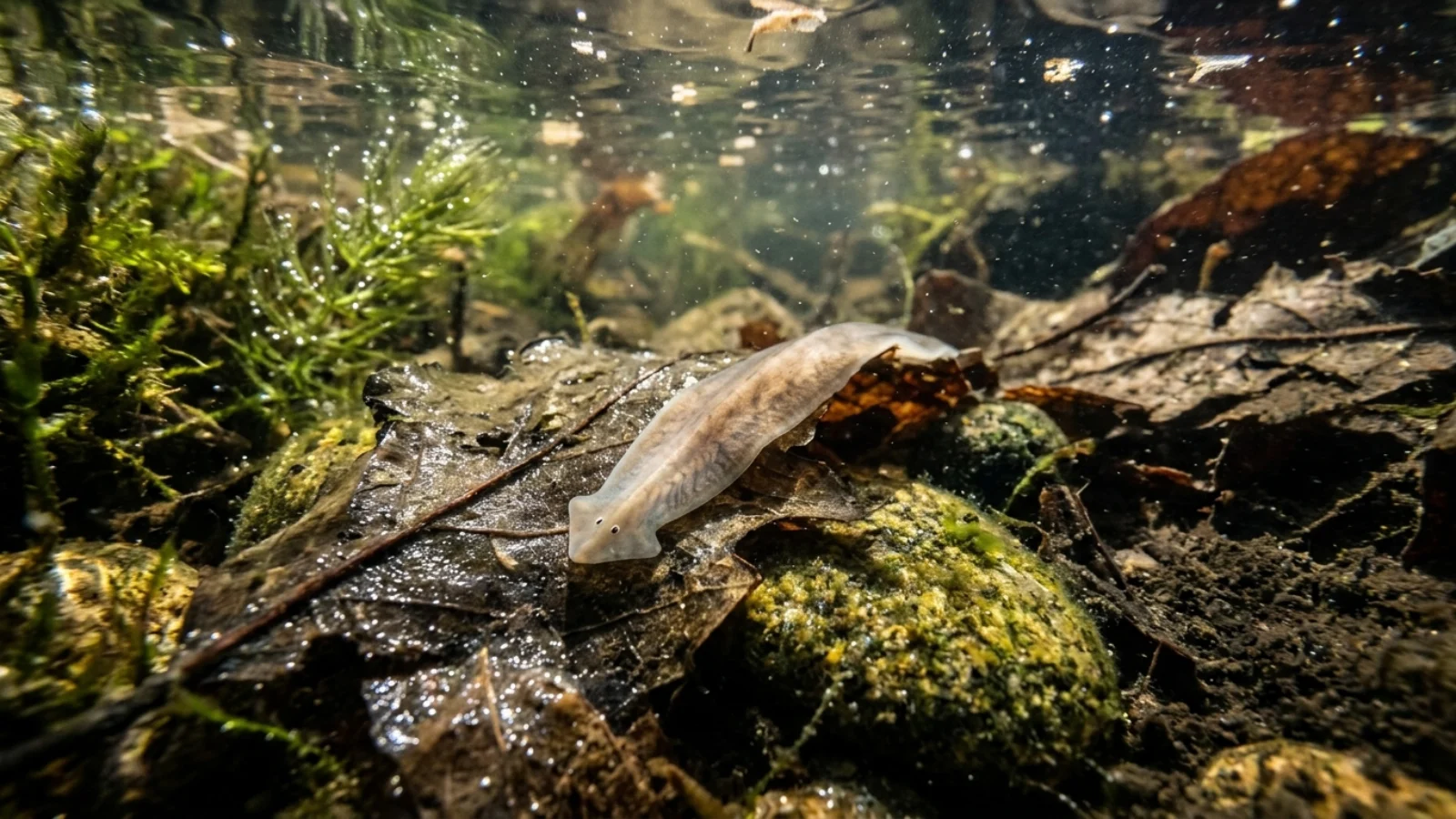
In essentially the same way as most animals. Planarians in ponds and streams, polyclads on coral reefs and the small flatworms that live between sand grains all depend on aerobic respiration. Oxygen diffuses in through the skin and from cell to cell. Inside each cell, glucose is first split into two molecules of pyruvate by glycolysis, a process that releases a little energy without needing oxygen. The pyruvate then enters the mitochondria, where the Krebs cycle strips it down to carbon dioxide and passes high-energy electrons to the electron transport chain. At the end of that chain the electrons are handed to oxygen, which combines with hydrogen to form water. The flow of electrons drives the production of most of the cell’s ATP.
The payoff is large. Full aerobic breakdown of a glucose molecule yields roughly 30 to 38 ATP, depending on how the calculation is done, compared with just two from glycolysis alone. Free-living flatworms are active animals. Planarians glide continuously on beating cilia, hunt worms, insect larvae and snails, and maintain large populations of stem cells, while many polyclads swim by rippling their body margins. All of this needs the high energy yield that only oxygen can provide.
The waste carbon dioxide leaves the way oxygen came in, by diffusion out through the skin. The water produced by respiration simply joins the body fluids. Because there is no circulatory system, everything depends on short distances, and that is why free-living flatworms stay thin, with every cell close to the surface or to the branches of the gut.
How does body size affect a planarian’s metabolism?
Planarians are unusual in that adults can shrink and grow again. Well-fed worms grow, while starving worms gradually get smaller as they use their own tissues for energy, then grow back when food returns. This makes them a useful animal in which to study how metabolism changes with size, because the same individual can be measured at very different body masses.
A 2019 study in eLife by Albert Thommen, Frank Jülicher and colleagues did exactly that with Schmidtea mediterranea, whose adult body mass changes reversibly over about three orders of magnitude. They found that the worms’ metabolic rate scales with body mass to the three-quarter power, the same relationship, known as Kleiber’s law, that holds roughly across many animals from mice to elephants. In other words, a planarian a thousand times heavier than another uses far less than a thousand times as much energy.
The explanation was unexpected. The team concluded that the scaling did not arise from individual cells slowing their metabolism as the worm grew. Instead, larger worms carried more stored energy per cell, so a bigger animal contained proportionally more storage material and relatively less actively respiring tissue. This links the old question of why big animals use energy more economically to something as simple as how much fuel each cell keeps in reserve.
How do tapeworms respire without oxygen?
Adult tapeworms live in the intestine of a vertebrate host. There, oxygen is scarce, especially away from the gut wall, but sugar is plentiful because the host is constantly digesting food. A tapeworm has no mouth or gut and absorbs nutrients directly through its outer covering, the tegument. With abundant fuel and little oxygen, adult tapeworms rely largely on pathways that make ATP without passing electrons to oxygen.
The main route is often called malate dismutation. In the cytoplasm, glycolysis runs as normal until it reaches a molecule called phosphoenolpyruvate. In most animals that is turned into pyruvate. Many tapeworms and flukes instead use an enzyme, phosphoenolpyruvate carboxykinase, to add carbon dioxide and produce oxaloacetate, which is then converted to malate and carried into the mitochondria. There some malate is oxidised to acetate, generating electrons, while the rest is reduced to succinate. The final step uses an enzyme called fumarate reductase, which runs part of the Krebs cycle backwards and passes electrons to fumarate instead of oxygen. In many species the succinate is then converted further to propionate.
The result is a mixture of organic acids, chiefly succinate, acetate and propionate, sometimes with lactate, that the worm excretes into the host’s gut. The pathway yields a few more ATP per glucose than simple fermentation to lactate, but still far less than full aerobic respiration. The worm compensates by consuming large amounts of sugar and storing plenty of glycogen. The rat tapeworm Hymenolepis diminuta, which is easy to keep in the laboratory, has been one of the main models for working out these pathways.
Why are the electron carriers different in parasitic flatworms?
The electron transport chain needs a small molecule called a quinone to shuttle electrons between its components. In aerobic respiration that role is played by ubiquinone. Fumarate reductase works best with a different quinone, rhodoquinone, which has a lower energy level suited to passing electrons to fumarate. Parasitic flatworms that rely on fumarate reduction contain rhodoquinone, and its presence is a biochemical signature of this kind of anaerobic metabolism across many animals, from tapeworms and flukes to roundworms and some molluscs.
Many of these parasites keep the machinery for both ways of living. Their mitochondria retain ubiquinone-based aerobic respiration, which is used by stages that live in oxygen-rich water, while the rhodoquinone-based pathway takes over in the host. Switching between the two is one of the key changes that happens when a parasite moves from the outside world into an animal.
Do flukes switch from aerobic to anaerobic respiration?
Many of them do, and the liver fluke Fasciola hepatica is the best-studied example. Its eggs pass out of the host and hatch in water into a swimming larva that respires aerobically. After developing in a snail and encysting on vegetation, the young fluke excysts in the gut of a sheep, cow or person, bores through the gut wall, and migrates through the liver to the bile ducts. A 1987 study by Aloysius Tielens and colleagues in Molecular and Biochemical Parasitology compared the energy metabolism of freshly excysted juveniles with that of adults.
They found that both stages use a mix of pathways but in very different proportions. In juveniles, a large share of glucose still went through pyruvate kinase, the conventional route toward aerobic respiration. In adults, the phosphoenolpyruvate carboxykinase route leading to malate dominated, and pyruvate kinase activity almost disappeared. As the fluke matures it becomes steadily more anaerobic, producing acetate and propionate as its main end products. That gradual shift matches the change in its surroundings, from oxygenated water and tissues to the oxygen-poor bile ducts.
How do blood flukes respire?
Blood flukes of the genus Schistosoma are a paradox. The adults live in the veins of their host, surrounded by blood that is well supplied with oxygen, yet they rely mostly on glycolysis to lactate, the least efficient way of making ATP from sugar. In a classic 1950 study, Ernest Bueding found that adult Schistosoma mansoni used an amount of glucose equal to one-sixth to one-fifth of their dry weight every hour, and that more than 80 percent of it was converted to lactic acid. The rates were the same whether oxygen was present or not, and the worms showed no surge in oxygen use after a period without it, unlike most other parasitic worms studied.
The switch happens at the moment of infection. A free-swimming schistosome larva, the cercaria, respires aerobically, oxidising glucose to carbon dioxide to power its beating tail. Research by Tielens’s group in 1991 showed that when cercariae were transferred from water to a glucose-containing salt medium mimicking the conditions of skin penetration, the body of the larva switched very rapidly to producing lactate, while the tail, which is shed during penetration, continued to burn glucose aerobically. Why adults living in oxygen-rich blood favour such a wasteful pathway is still debated. One idea is that with a constant supply of glucose from the host, speed of ATP production matters more than efficiency.
Do all parasitic flatworms respire anaerobically?
No. The pathway depends on where the worm lives and at what stage of life. Free-swimming larvae, such as fluke miracidia and cercariae and the swimming larvae of some tapeworms, live in water and respire aerobically. Monogeneans clinging to the gills and skin of fish have plenty of oxygen and are thought to depend mainly on aerobic metabolism. Larval tapeworms living in well-oxygenated host tissues may also use oxygen more than the adults in the gut.
| Flatworm | Habitat | Main energy pathway |
|---|---|---|
| Planarian | Freshwater | Aerobic |
| Marine polyclad | Reef, rocky shore | Aerobic |
| Monogenean | Fish gills and skin | Mainly aerobic |
| Tapeworm (adult) | Host intestine | Largely anaerobic, malate dismutation |
| Liver fluke (adult) | Bile ducts | Largely anaerobic; acetate and propionate |
| Blood fluke (adult) | Blood vessels | Mostly glycolysis to lactate |
| Fluke larvae | Water | Aerobic |
The pattern is clear when the table is read as a life cycle. A typical fluke or tapeworm alternates between aerobic stages in the open environment and anaerobic or semi-anaerobic stages inside a host. Its metabolism follows its surroundings, and much of its biochemistry is about switching smoothly between the two.
What fuels do flatworms burn?
Free-living flatworms use a mixture of carbohydrates, fats and proteins from their prey, much like other carnivorous animals, and store energy as glycogen and fat in their tissues. During starvation they draw on these reserves and then on their own body tissue, which is why a starving planarian shrinks rather than simply getting thinner. Their respiration therefore reflects their diet and their nutritional state, burning stored fats and proteins when sugar is scarce.
Parasitic flatworms depend heavily on carbohydrates. Adult tapeworms and flukes absorb glucose from the host and store large amounts of glycogen, which acts as a buffer between meals of the host. Genome sequencing has shown how dependent some of them are. A 2013 analysis of four tapeworm genomes, published in Nature, found that tapeworms have lost the ability to make fatty acids and cholesterol from scratch and must take them from their host. Their metabolism is built around a reliable supply of sugar and ready-made building blocks, which suits an animal permanently bathed in a host’s nutrients.
Why does flatworm respiration matter for medicine?
Because the enzymes of anaerobic metabolism in parasitic worms differ from those in human cells, they are attractive targets for drugs. Fumarate reductase and rhodoquinone have no direct equivalent in human energy metabolism, so a compound that blocks them could in principle harm the worm while sparing the patient, and they have been studied for exactly that reason. The same logic applies to roundworms, which share much of this chemistry.
Some existing drugs already act on parasite energy production. Niclosamide, long used against tapeworms, is thought to work mainly by uncoupling oxidative phosphorylation in the worm’s mitochondria, so that the energy from respiration is wasted rather than captured as ATP. Understanding respiration also helps explain why many anti-worm drugs harm the parasite far more than the host, and why parasites in different parts of the body can respond differently to the same treatment.
Does respiration limit flatworm size?
Indirectly. Aerobic flatworms depend on oxygen reaching every cell by diffusion, so they must stay thin, though they can still be long and broad. Some land planarians grow to tens of centimetres long but remain flat and narrow. Anaerobic tapeworms are partly freed from that limit because they need little oxygen, and they can grow extraordinarily long; chains of the beef tapeworm over 20 metres have been reported, though about 4 metres is more typical. They still stay flat, because their flattened shape gives a large surface for absorbing food through the tegument. For more on these and other parasitic flatworms, see are flatworms parasites?
What are the common misconceptions?
The first misconception is that respiration means breathing. In biology, respiration is cellular chemistry; breathing is only the delivery service. The second is that anaerobic animals need no oxygen at all. Most anaerobic flatworms are better described as facultative: they can use oxygen when it is available and keep aerobic machinery for their free-living stages. The third is that parasites are simply lazy versions of free-living animals. Their energy metabolism is in some ways more complex, with extra enzymes, an alternative quinone and the ability to switch between pathways during a life cycle.
The fourth misconception is that flatworms are too simple to tell us anything about human metabolism. Planarians have become a model for how metabolism scales with body size, and the anaerobic pathways of parasitic flatworms have shed light on how mitochondria evolved to work in low-oxygen environments. For the wider anatomy behind all this, see our pages on whether flatworms have a circulatory system and a complete digestive system.
How do flatworms respire?
Free-living flatworms use aerobic respiration in their mitochondria. Many adult gut parasites rely largely on anaerobic pathways that produce organic acids.
Do flatworms need oxygen?
Free-living flatworms and free-swimming larvae do. Adult gut tapeworms and liver flukes need very little.
What is malate dismutation?
A pathway in which malate is split in the mitochondria into acetate and succinate, using fumarate instead of oxygen to accept electrons.
What do tapeworms excrete as waste from respiration?
Mainly organic acids such as succinate, acetate and propionate, sometimes with lactate.
Why do blood flukes make lactate even in oxygen-rich blood?
They rely mostly on glycolysis to lactate, apparently favouring fast ATP production from the host’s plentiful glucose over efficiency.
Is respiration the same as breathing?
No. Breathing moves gases; respiration is the chemistry cells use to make ATP from food.
How does planarian metabolism change with size?
It scales with body mass to the three-quarter power, because larger worms store more energy per cell.
Can anti-worm drugs target respiration?
Yes. Parasite-specific enzymes such as fumarate reductase are studied as targets, and niclosamide disrupts energy production in tapeworms.
- Thommen, A. et al. (2019). Body size-dependent energy storage causes Kleiber’s law scaling of the metabolic rate in planarians. eLife 8: e38187.
- Tielens, A.G.M., van den Heuvel, J.M. & van den Bergh, S.G. (1987). Differences in intermediary energy metabolism between juvenile and adult Fasciola hepatica. Molecular and Biochemical Parasitology 24: 273–281.
- Horemans, A.M., Tielens, A.G.M. & van den Bergh, S.G. (1991). The transition from an aerobic to an anaerobic energy metabolism in transforming Schistosoma mansoni cercariae. Parasitology 102: 259–265.
- Bueding, E. (1950). Carbohydrate metabolism of Schistosoma mansoni. Journal of General Physiology 33: 475.
- Tsai, I.J. et al. (2013). The genomes of four tapeworm species reveal adaptations to parasitism. Nature 496: 57–63.
- Wikipedia: Flatworm; Cellular respiration; Tapeworm.
Blane Perun has been exploring Earth’s oceans and marine life for over 25 years. Founder of TheSea.Org in 1999, underwater photographer, coral aquaculture pioneer, and explorer of 80+ countries.
About Blane Perun →