Belcher’s Sea Snake — The Faint-Banded Snake Behind a Famous Myth
Belcher’s sea snake (Hydrophis belcheri), also called the faint-banded sea snake, is a small-to-medium sea snake of tropical Indo-Pacific waters, typically 0.5–1 m long and pale yellowish with dark greenish crossbands. It is venomous but timid, and bites are rare and usually involve fishers handling nets. It is widely but wrongly described online as “the most venomous snake in the world”; that claim traces to a 1996 book that mixed incompatible toxicity tests. Its measured LD50 is 0.24 mg/kg by intramuscular injection in mice, and the most venomous sea snake is actually Dubois’ sea snake.
Search “most venomous snake in the world” and Belcher’s sea snake still turns up near the top, often with claims that a few milligrams could kill a thousand people. It is a classic internet myth. Belcher’s sea snake is a real and venomous sea snake, but it is not the world’s most toxic snake, not even the most toxic sea snake, and it is one of the least likely to bite. Here is what is actually known.
Is Belcher’s sea snake the most venomous snake in the world?
No. That claim comes from an error in a 1996 popular book, and the best toxicity data put several snakes, land and sea, ahead of it.
The myth spread after Snakes in Question: The Smithsonian Answer Book (Ernst and Zug, 1996) compared venom toxicities that had been measured by different methods — subcutaneous, intramuscular, intravenous and intraperitoneal injection — as if they were interchangeable. Venom expert Bryan Grieg Fry has explained that values can only be compared within the same test method; mixing them is, in his words, “apples and rocks.” The confusion was compounded because Belcher’s sea snake was often mixed up with the hook-nosed or beaked sea snake. Measured consistently, the inland taipan has the most toxic venom of any snake, and among sea snakes Dubois’ sea snake ranks highest.
| Species | LD50 (mg/kg) | Test route |
|---|---|---|
| Inland taipan | ~0.025 | Subcutaneous |
| Dubois’ sea snake | 0.044 | Subcutaneous |
| Yellow-bellied sea snake | ~0.067 | Subcutaneous |
| Beaked sea snake | ~0.11 | Subcutaneous |
| Belcher’s sea snake | 0.24 | Intramuscular (not directly comparable) |
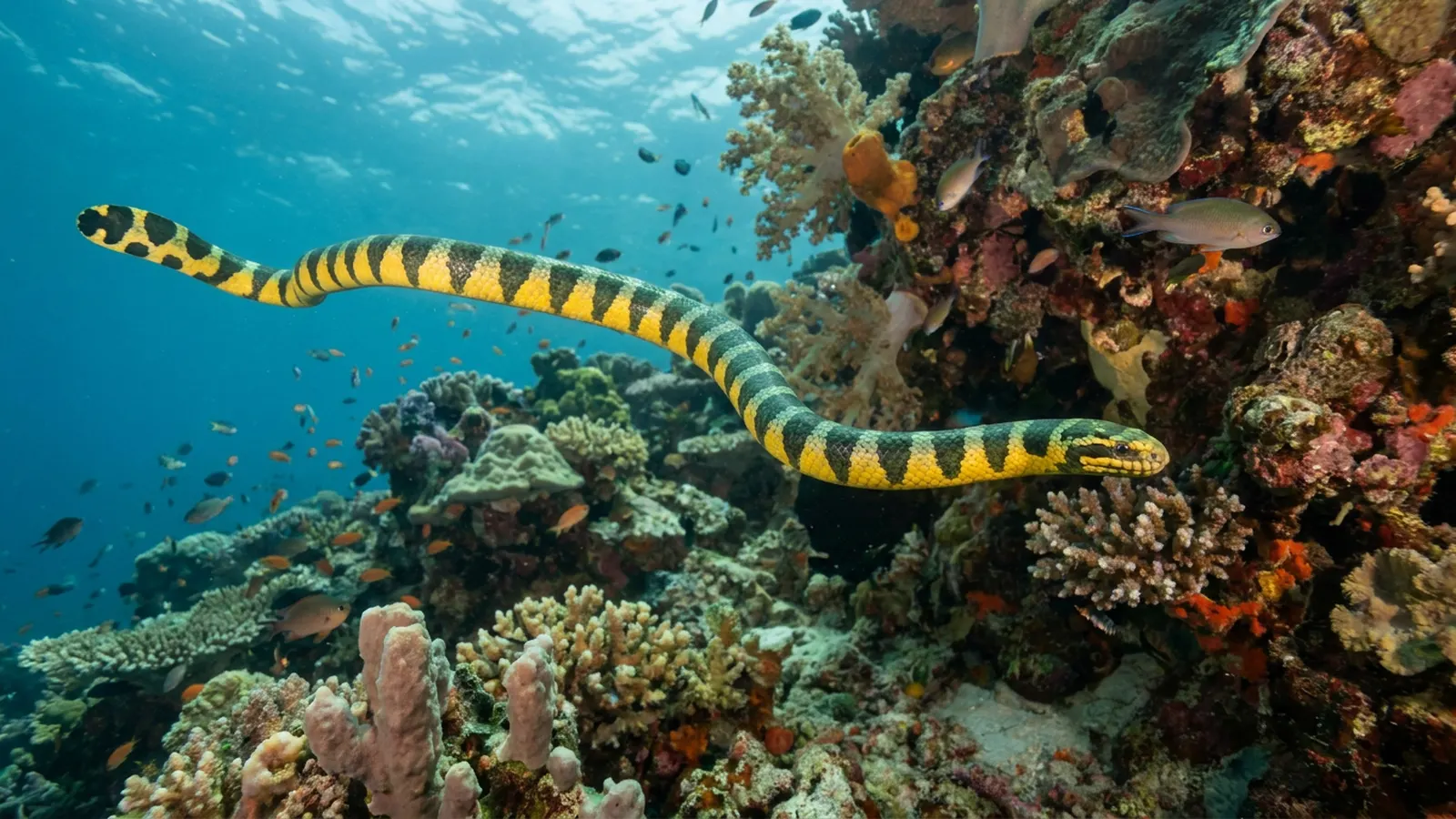
What does Belcher’s sea snake look like?
It is a slender, moderate-sized sea snake, usually pale chrome-yellow to greenish with dark greenish crossbands that do not extend onto the belly, which is why it is called “faint-banded.”
Out of water the body looks faintly yellow. The head is short, also banded, with a small mouth. Its body scales overlap, unlike the juxtaposed scales of some sea snakes, and each back scale carries a small central tubercle. The rear of the body is strongly flattened from side to side into a deep paddle, and the belly scales are very narrow, only slightly wider than the body scales. Adults measure 0.5–1.0 m.
Where does Belcher’s sea snake live?
The Reptile Database lists it from the Indian Ocean, the Gulf of Thailand, Vietnam, the Philippines (Visayan Sea and Panay), Indonesia, New Guinea and Australia; an older Solomon Islands record is not supported, and some Philippine specimens once identified as this species belong to a different snake. Like most Hydrophis, it favours warm, shallow coastal and reef waters. Detailed ecological studies are scarce, and many records come from fishing bycatch.
Is Belcher’s sea snake dangerous?
It is venomous but very timid: it would normally need to be severely mistreated before biting, and even then it usually injects little venom.
Most people bitten are fishers handling nets, and estimates suggest only about a quarter of those bites result in envenoming, because the snake rarely delivers much venom. Still, any bite should be treated as an emergency: keep the person still, apply a pressure-immobilisation bandage if trained, and get to hospital, where staff can monitor for delayed muscle and kidney injury. See are sea snakes dangerous and are sea snakes aggressive.
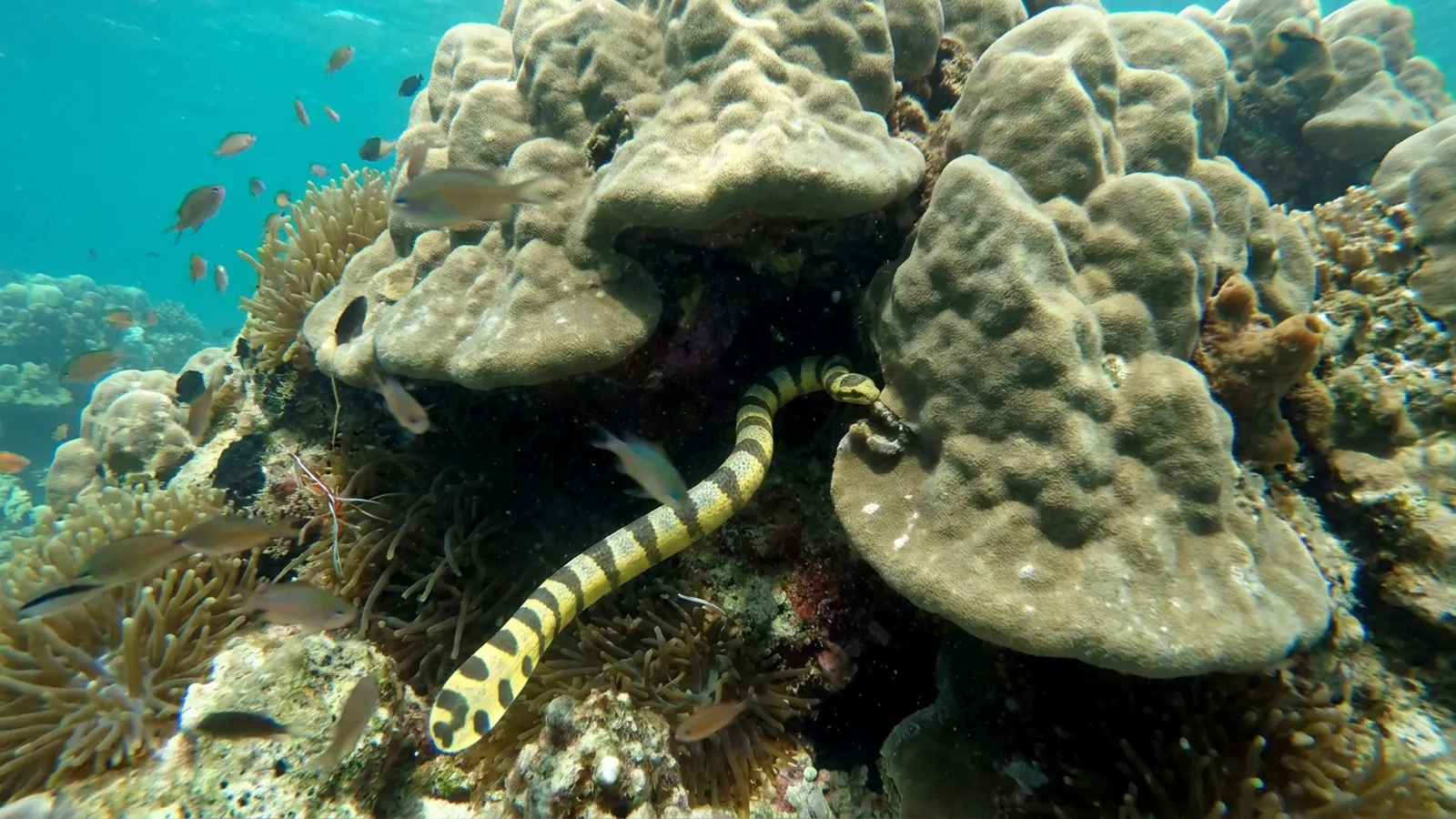
What does Belcher’s sea snake eat?
Specific diet studies are limited, but like related small-headed Hydrophis species it is thought to feed mainly on small fish, probably including eels, taken from crevices and burrows on reefs and soft bottoms. See what do sea snakes eat.
Who was Belcher?
The species commemorates Admiral Sir Edward Belcher (1799–1877), a Nova Scotia-born Royal Navy officer and surveyor who collected the type specimen during his voyages in the Pacific and Asian waters. John Edward Gray of the British Museum described the species in 1849. Belcher is also known for leading one of the expeditions sent in search of the lost Franklin expedition in the Arctic.
How does Belcher’s sea snake reproduce and breathe?
Like other true sea snakes, it is viviparous and gives birth to live young at sea. It breathes air through a long lung, sealing its nostrils with valves while submerged, and can absorb some oxygen through its skin. See how do sea snakes breathe.
Is Belcher’s sea snake endangered?
It is not considered globally threatened, but it is poorly known, and much of what is recorded comes from fishing bycatch. Like other coastal sea snakes it faces bycatch, habitat degradation and warming seas, and the sharp, unexplained declines of sea snakes at Ashmore Reef in the Timor Sea show how quickly reef sea snake populations can collapse.
Is Belcher’s sea snake the most venomous snake?
No. That claim came from a 1996 book that mixed incompatible toxicity tests. The inland taipan is the most venomous snake, and Dubois’ sea snake is the most venomous sea snake.
Is Belcher’s sea snake dangerous?
It is venomous but very timid and rarely bites; only about a quarter of recorded bites cause envenoming.
How big is Belcher’s sea snake?
Adults are about 0.5–1.0 m long.
What does Belcher’s sea snake look like?
It is pale chrome-yellow to greenish with dark greenish crossbands that do not reach the belly, giving a faint-banded look.
Where does Belcher’s sea snake live?
In tropical Indo-Pacific waters, with records from the Indian Ocean, Gulf of Thailand, Vietnam, the Philippines, Indonesia, New Guinea and Australia.
Why is it called Belcher’s sea snake?
It is named after Admiral Sir Edward Belcher, the Royal Navy officer who collected the first specimen.
What is the LD50 of Belcher’s sea snake?
About 0.24 mg/kg when injected intramuscularly in mice, a figure that cannot be directly compared with subcutaneous values for other snakes.
Blane Perun has been exploring Earth’s oceans and marine life for over 25 years. Founder of TheSea.Org in 1999, underwater photographer, coral aquaculture pioneer, and explorer of 80+ countries.
About Blane Perun → More on Sea Snakes →