Butterflyfish — The Coral-Eating Jewels That Swim in Pairs and Tell Us How Healthy a Reef Is
About 130 species in around 12 genera, with Chaetodon by far the largest (~90 species). From Greek chaite (hair) and odous (tooth), for their bristle-like teeth. Most live on tropical reefs of the Indo-Pacific, with about a dozen species in the Atlantic.
What do butterflyfish look like?
Thin, disc-shaped and dazzling.
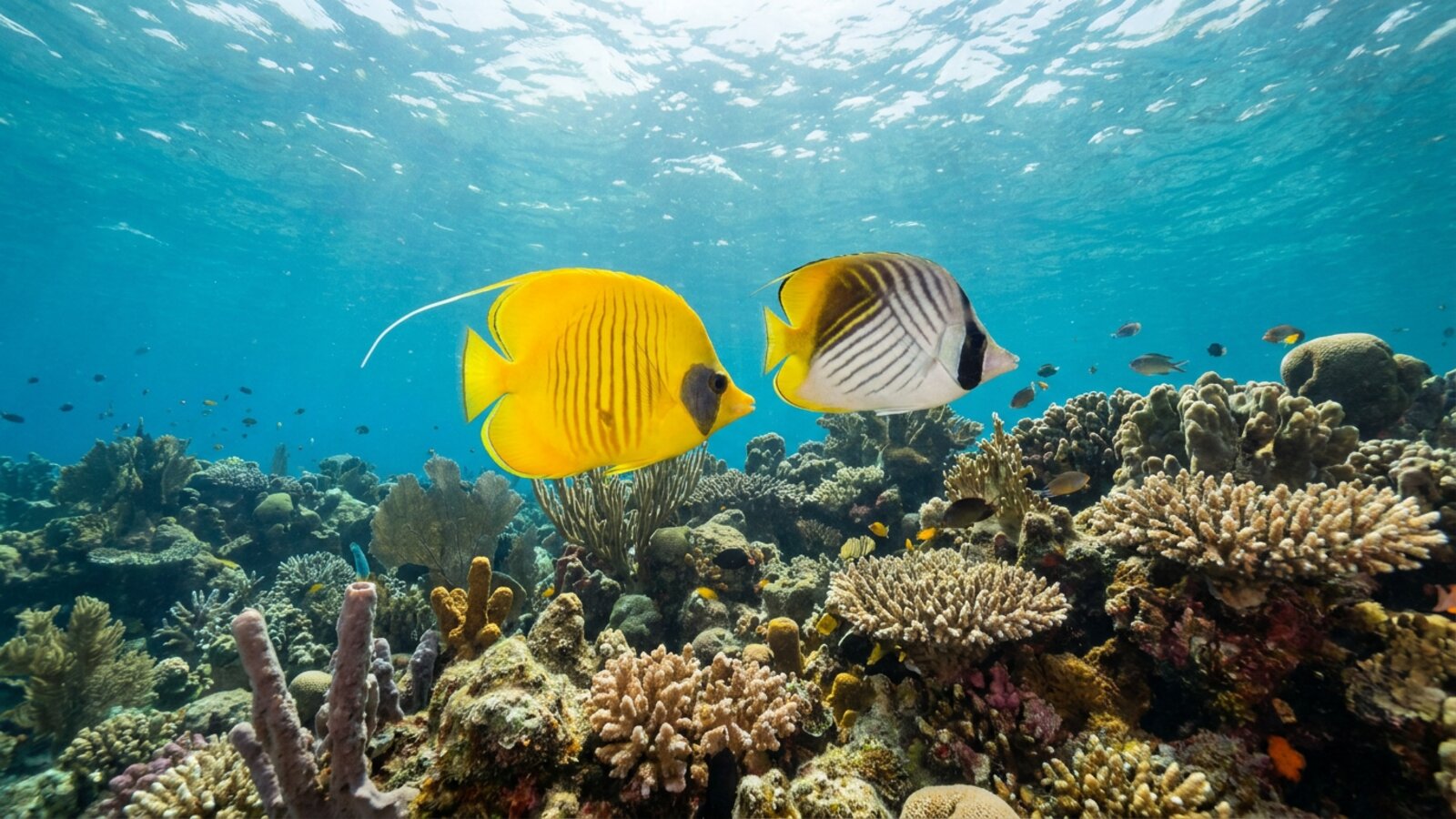
Butterflyfish are laterally compressed, almost as thin as a dinner plate seen side-on, which lets them slip between coral branches. Most are yellow, white and black, with a dark bar hiding the eye and, in many species, a false eyespot near the tail. Their small, protrusible mouths carry rows of fine, brush-like teeth for picking polyps and small invertebrates out of crevices. The longnose butterflyfish (Forcipiger) takes this to an extreme, with a forceps-like snout that probes deep into coral.
What do butterflyfish eat?
Many eat coral, which makes them reef barometers.
| Feeding type | Diet | Examples |
|---|---|---|
| Obligate corallivores | Only live coral polyps and mucus | Chevroned, redfin, triangular and Meyer’s butterflyfish |
| Facultative corallivores | Coral plus worms, crustaceans, algae | Threadfin, raccoon, Klein’s butterflyfish |
| Invertebrate pickers | Worms, tube-feet, small crustaceans | Longnose butterflyfish, foureye butterflyfish |
| Planktivores | Zooplankton in mid-water | Pyramid butterflyfish, schooling bannerfish |
Because obligate coral-eaters depend directly on live coral, their numbers fall quickly when coral dies from bleaching, storms or crown-of-thorns starfish. Reef Check and other monitoring programmes count butterflyfish as an indicator of coral health. After major bleaching on the Great Barrier Reef, coral-feeding butterflyfish populations declined sharply. See how coral bleaching affects the reef and crown-of-thorns starfish.
Do butterflyfish mate for life?
Many form long-lasting pairs.
Many butterflyfish swim, feed and defend territories in male–female pairs that can last for several years, and possibly for life in some species. Pair partners coordinate their movements, and studies suggest they are more effective at defending coral feeding territories together. Spawning occurs at dusk, when the pair rises off the reef to release eggs and sperm. Not all species pair: some form schools, and some are solitary.
Why do butterflyfish have false eyespots?
To make predators aim at the wrong end.
A dark bar hides the real eye, while a round spot near the tail, ringed in white in the foureye butterflyfish of the Caribbean, mimics an eye. The theory is that predators lunge at the “head” and the fish darts off in the opposite direction. Juveniles often have bolder eyespots than adults. Butterflyfish also raise sharp dorsal spines when threatened, and their thin bodies are hard to swallow.
How do butterflyfish grow up?
With a suit of armour.
Butterflyfish larvae, called tholichthys, are covered in bony plates that extend from the head, protecting them during weeks to months in the plankton. When they settle on a reef at night, they lose the plates and develop juvenile colours. Settling juveniles often hide in branching corals that later become their feeding grounds.
When did butterflyfish start eating coral?
Eating coral is harder than it looks. Polyps are small, coated in mucus and armed with stinging cells, and they sit on a skeleton of limestone. Of the roughly 5,000 fish species on coral reefs, a 2010 study by David Bellwood and colleagues counted only 41 that rely mainly on coral for food, and about three-fifths of those are butterflyfish. Using a molecular family tree that included every genus, the team found that coral feeding arose at least five separate times within the family between about 15.7 and 3 million years ago.
The timing matters. It overlaps with a reorganisation of reefs in the Miocene, when fast-growing branching and table corals such as Acropora spread across the Indo-Pacific. Butterflyfish that moved onto reefs at that time diversified rapidly, and the genus Chaetodon split into many species with different diets. In other words, the corals that dominate reefs today helped create the butterflyfish that eat them, and that history explains why so many butterflyfish are vulnerable when those corals die.
Why do butterflyfish pairs stay together?
Pairing in butterflyfish has puzzled biologists because it does not fit the usual explanations. Butterflyfish spawn into the plankton and give no care to their eggs or young, so a pair does not need two parents to raise offspring. Juveniles that have not yet matured sometimes form pairs, and same-sex pairs have been recorded. That suggests pairs have benefits beyond breeding.
In 2018 Jessica Nowicki and colleagues tested one idea on the Great Barrier Reef using two coral-eating species, the redfin butterflyfish and the triangular butterflyfish. Pairs defended their feeding territories together, and partners in long-lasting pairs fought each other less and fed more efficiently than fish whose partners had recently changed. In the redfin, both partners shared defence; in the triangular butterflyfish, males did more of the defending, and both sexes still gained in feeding and body condition. Related work by the same group has looked at the brain hormones involved, finding parallels with the systems that support pair bonds in mammals.
How does bleaching change butterflyfish behaviour?
Because many butterflyfish defend patches of coral against their neighbours, their behaviour changes quickly when coral dies. After the mass bleaching of 2016, Sally Keith and colleagues compared butterflyfish behaviour on reefs across the Indo-Pacific before and after the event. Encounters and fights between butterflyfish became much less frequent once coral cover fell. The researchers argued that with less coral to defend, territories were no longer worth the cost of fighting, and fish shifted to roaming more widely in search of food.
A six-year study of 23 butterflyfish species on reefs in Japan found the same pattern in reverse: aggression fell as coral was lost and rose again to its earlier level once corals recovered. The fish’s flexibility may help them survive short periods of poor feeding, but it does not replace the coral itself. Species that eat only a few kinds of coral, such as the chevroned butterflyfish, which depends heavily on table corals, are among the first to decline after bleaching and among the slowest to return.
How do butterflyfish hear and talk?
Butterflyfish have an unusual hearing aid. In the genus Chaetodon, two forward extensions of the swim bladder, known as horns, reach up to openings in the lateral line canals on the back of the head. Jacqueline Webb and Timothy Tricas, who studied the arrangement in Hawaiian species, named it the laterophysic connection and proposed that it makes the ear and the lateral line more sensitive to sound pressure. No other fish family is known to have quite the same structure.
The fish make sounds as well as hearing them. The Hawaiian multiband butterflyfish produces pulses and clicks during territorial disputes, and recordings show that the sounds are paired with rapid body movements and head shakes. Because pairs defend shared territories, the ability to detect and judge a rival at close range in a noisy reef may be one reason the hearing specialisation evolved.
How does the longnose butterflyfish feed?
The longnose butterflyfish, Forcipiger flavissimus, and its relative the big longnose, F. longirostris, have the longest snouts in the family. Studies of their feeding mechanics show that they can push the jaws forward much further than other butterflyfish, using an unusual arrangement of bones and ligaments in the head. That lets them reach into narrow crevices and pick out tube feet of sea urchins, small shrimp, fish eggs and the tentacles of tube worms. The big longnose eats mostly small crustaceans; the common longnose takes a broader mix.
The big longnose also comes in a rare dark brown form in which the yellow body turns almost black, a colour phase reported from Hawaii and elsewhere in the Pacific. The cause is not known, but divers who see it often think they have found a different species.
Do butterflyfish spread coral disease?
Because coral-eating butterflyfish move from colony to colony and feed on coral tissue, scientists have asked whether they could carry coral diseases between colonies. Studies in the Caribbean of black band disease, a bacterial mat that kills coral tissue as it spreads across a colony, found that butterflyfish fed on the infected bands, and researchers in the Pacific have reported similar feeding on diseased tissue. Experiments have shown that pathogens can survive passage through a fish gut in some cases, but whether butterflyfish spread disease in the wild, or simply follow it, is still debated.
Are new butterflyfish still being discovered?
Yes, mostly in deeper water. Divers using closed-circuit rebreathers have explored the mesophotic zone, from about 30 m to 150 m, and found butterflyfish that are rarely or never seen in shallow water. In 2016 Richard Pyle and Randall Kosaki described Prognathodes basabei from the Northwestern Hawaiian Islands, a deep-water butterflyfish that had been seen and photographed by deep divers before specimens were collected and described. Deep reefs in the Philippines, Micronesia and the Coral Sea have produced other new or rarely recorded species in the genera Prognathodes and Roa.
Why are islands hot spots for hybrid butterflyfish?
Christmas Island and the Cocos (Keeling) Islands in the eastern Indian Ocean sit where Indian Ocean and Pacific reef fish faunas meet. Studies by Jean-Paul Hobbs and colleagues found that these isolated islands have an unusually large number of hybrid reef fish, many of them butterflyfish. Rare species that cannot find a mate of their own kind pair with a related species, and closely related Indian Ocean and Pacific species, kept apart for millions of years by sea-level changes, meet and interbreed. Because butterflyfish pair so visibly, mixed pairs are easy for divers to spot, and they have made the islands a natural laboratory for studying how new species form and how they can blend back together.
How do you count butterflyfish on a dive?
Reef Check and similar programmes ask volunteer divers to count butterflyfish along a fixed line, because they are easy to identify, active by day and closely tied to coral. A diver swims slowly along a 20 m tape and records every butterflyfish within a set distance on either side, noting pairs and species. Repeating the same route each year gives a simple measure of change. Counts fall within months of severe bleaching, before many other fish groups show a decline, which is why butterflyfish remain one of the most widely used fish indicators of reef condition.
How picky are coral-eating butterflyfish?
Coral-eating butterflyfish do not graze at random. Feeding studies on the Great Barrier Reef and elsewhere, many led by Morgan Pratchett, have shown that most coral feeders take bites from only a handful of the coral species around them, and that they favour fast-growing, branching and table corals in the genera Acropora and Pocillopora over massive corals. A specialist like the chevroned butterflyfish may take most of its bites from one or two kinds of table coral, while a generalist like the redfin butterflyfish spreads its feeding across many species. When favoured corals die, specialists struggle to switch, and their body condition falls before their numbers do. That pattern makes diet breadth one of the best predictors of which butterflyfish will survive repeated bleaching.
Where are the best places to watch butterflyfish?
Almost any shallow Indo-Pacific reef will show several species, but some places stand out. In the Red Sea, pairs of masked and Red Sea raccoon butterflyfish hover under table corals, and both species are found almost nowhere else. Hawaii has several endemic species, including the milletseed butterflyfish, which forms large groups feeding on plankton and fish eggs above the reef. The Coral Triangle offers the greatest variety, with a dozen or more species possible on a single dive. In the Caribbean, where the family is much smaller, the foureye, banded, spotfin and reef butterflyfish are the species to learn, usually seen in pairs moving steadily over the reef from one feeding patch to the next.
Whichever reef you visit, the best viewing comes from hovering quietly near a coral head for a few minutes. Butterflyfish are wary of fast swimmers but soon return to feeding around a still diver, and you can watch partners check in with each other every few seconds as they work across the coral.
Butterflyfish vs angelfish: what is the difference?
Look at the gill cover.
Marine angelfish (Pomacanthidae) were once lumped with butterflyfish. Angelfish have a strong spine on the lower gill cover (preopercle), which butterflyfish lack, and they tend to be larger and eat more sponges. Note that the freshwater “angelfish” of aquariums is an unrelated cichlid; see freshwater angelfish (Pterophyllum).
| Feature | Butterflyfish | Marine angelfish |
|---|---|---|
| Gill-cover spine | No | Yes |
| Typical size | 12–22 cm | 15–45 cm |
| Main diet | Coral, small invertebrates | Sponges, algae, tunicates |
| Juvenile colours | Similar to adults | Often totally different |
Are butterflyfish good aquarium fish?
Some are, many are not.
Obligate coral-eaters almost always starve in captivity and should not be collected. Hardier species such as the raccoon, threadfin, auriga, Klein’s and pyramid butterflyfish, and the copperband (prized for eating Aiptasia anemones, though not reliably), adapt better to prepared foods. Most will nip at corals and clams, so they suit fish-only or carefully planned reef tanks.
Which butterflyfish are most common?
Species you are likely to meet.
| Species | Region | How to recognise it |
|---|---|---|
| Foureye butterflyfish (Chaetodon capistratus) | Caribbean, W. Atlantic | Grey-white with a large white-ringed spot near the tail |
| Banded butterflyfish (C. striatus) | Caribbean | White with bold black vertical bands |
| Spotfin butterflyfish (C. ocellatus) | Caribbean | White with yellow fins and a small dark spot on the dorsal fin |
| Threadfin butterflyfish (C. auriga) | Indo-Pacific, Red Sea | Chevron pattern and a trailing filament on the dorsal fin |
| Raccoon butterflyfish (C. lunula) | Indo-Pacific | Black “mask” with white band behind the eye |
| Masked butterflyfish (C. semilarvatus) | Red Sea | Golden yellow with a blue-grey eye patch; often hovers in pairs under table corals |
| Longnose butterflyfish (Forcipiger flavissimus) | Indo-Pacific, E. Pacific | Yellow with an extremely long snout |
| Pennant bannerfish (Heniochus spp.) | Indo-Pacific | Tall white dorsal streamer; often mistaken for the Moorish idol |
The Moorish idol, often confused with bannerfish, belongs to its own family (Zanclidae) and is more closely related to surgeonfish.
What do butterflyfish eat?
Coral polyps, small invertebrates, plankton and algae, depending on species.
How many species of butterflyfish are there?
About 130, most in the genus Chaetodon.
Do butterflyfish mate for life?
Many species form long-term pairs lasting years.
Why are butterflyfish important?
They indicate coral health because many depend on live coral for food.
What is the difference between butterflyfish and angelfish?
Angelfish have a strong spine on the gill cover; butterflyfish do not.
How big do butterflyfish get?
Most are 12–22 cm; the largest reach about 30 cm.
Why do butterflyfish have eyespots?
To confuse predators about which end is the head.
Can you keep butterflyfish in a reef tank?
Some hardy species, yes, but most will eat corals and obligate coral-eaters starve.
- Pratchett, M. S. et al. (eds.) (2013). Biology of Butterflyfishes. CRC Press.
- Pratchett, M. S. et al. (2008). Effects of climate-induced coral bleaching on coral-reef fishes: ecological and economic consequences. Oceanography and Marine Biology: An Annual Review 46: 251–296.
- Hodgson, G. et al. Reef Check monitoring protocols: indicator fish. reefcheck.org.
- Allen, G. R., Steene, R., Humann, P. & DeLoach, N. (2003). Reef Fish Identification: Tropical Pacific. New World Publications.
- Bellwood, D. R. et al. (2010). Evolutionary history of the butterflyfishes (f: Chaetodontidae) and the rise of coral feeding fishes. Journal of Evolutionary Biology 23: 335–349.
- Nowicki, J. P. et al. (2018). Pair bond endurance promotes cooperative food defense and inhibits conflict in coral reef butterflyfish. Scientific Reports 8: 6295.
- Keith, S. A. et al. (2018). Synchronous behavioural shifts in reef fishes linked to mass coral bleaching. Nature Climate Change 8: 986–991.
- Boström-Einarsson, L. et al. (2025). Reef fish aggression tracks resource availability throughout coral loss and recovery. Preprint, doi:10.22541/au.173918719.93877993/v1.
- Webb, J. F., Smith, W. L. & Tricas, T. C. (2002). The laterophysic connection: a novel specialization thought to enhance sound pressure sensitivity in butterflyfishes. Journal of the Acoustical Society of America 112: 2296.
- Aeby, G. S. & Santavy, D. L. (2006). Factors affecting susceptibility of the coral Montastraea faveolata to black-band disease. Marine Ecology Progress Series 318: 103–110.
- Pyle, R. L. & Kosaki, R. K. (2016). Prognathodes basabei, a new species of butterflyfish from the Hawaiian Archipelago. ZooKeys 614: 137–152.
Blane Perun has been exploring Earth’s oceans and marine life for over 25 years. Founder of TheSea.Org in 1999, underwater photographer, coral aquaculture pioneer, and explorer of 80+ countries.
