Manatee Lifespan — 65 Years (and Snooty Made It to 69)
In the wild, healthy West Indian manatees can live 60 to 70 years — longer than virtually any other large marine mammal except whales. In captivity, where boat strikes and cold stress are eliminated, lifespans can match or slightly exceed wild maxima. The longest documented manatee, Snooty, lived in captivity at the South Florida Museum (now The Bishop Museum of Science and Nature) in Bradenton, Florida; he was born in 1948 and died in 2017 at 69 years old — the oldest manatee ever recorded. Ages are determined post-mortem by counting growth-layer groups in the dense bone of the auditory ear capsule, the same method used to age fish from their ear stones. Wild manatees rarely reach the upper end of their potential lifespan: most adult Florida manatees die in early to middle adulthood from boat strikes, cold stress, or starvation, well short of natural senescence. The slow reproductive cycle — one calf every 2-5 years — means the long potential lifespan is essential to population stability. A manatee that survives to 60 might raise 8-12 calves; one that dies at 15 from a boat strike contributes far fewer. The record holder’s full story is in Snooty the manatee.
Manatees can live a long time. A healthy West Indian manatee in a healthy habitat with no boat traffic can plausibly reach 65 or 70 years — an extraordinary lifespan for a marine mammal, comparable to elephants on land. The reality for most Florida manatees is shorter; the species is being killed by boats, cold snaps, and seagrass loss faster than the wild lifespan would predict. The long potential lifespan exists because the slow reproductive cycle requires it: a manatee has to live for decades to leave enough calves behind. When the potential lifespan isn’t reached, that math breaks down and populations decline.
The maximum — Snooty and the 69-year record
The longest-documented manatee in history was Snooty, a captive West Indian manatee born on July 21, 1948, at the Miami Aquarium and Tackle Company in Florida. Snooty lived 69 years at the South Florida Museum in Bradenton until his accidental death in 2017.
Snooty was hand-raised from birth — his mother had been captured pregnant from the wild and gave birth in captivity. From the start he was acclimated to humans, and over the decades he became one of the most beloved aquarium animals in Florida. He never lived in the wild and never met another manatee for extended periods until late in life. By 2016 he had been declared the oldest manatee on record by Guinness World Records, at age 67. He continued to live actively, eating his daily 80 pounds of lettuce, vegetables, and supplements, recognising regular visitors, and serving as the public face of the South Florida Museum.
Snooty died on July 23, 2017 — two days after his 69th birthday — in a tragic accident. A maintenance panel in his enclosure had come loose, and he became trapped in an underwater plumbing access space, unable to surface to breathe. The death was widely mourned and led to substantial public donations to manatee rehabilitation and conservation. The South Florida Museum, now The Bishop Museum of Science and Nature, continues to operate a manatee rehabilitation facility named in Snooty’s honour.
Snooty’s 69 years remain the longest documented manatee lifespan. The figure is widely cited in literature as the upper bound for the species, though it is plausible that some wild manatees reach similar ages without being individually tracked through their lifetimes. Captive longevity tends to slightly exceed wild maxima for large mammals because predation, starvation, and trauma are eliminated — but Snooty’s record is also a testament to extraordinary care from his keepers.
The wild reality — most manatees die long before old age
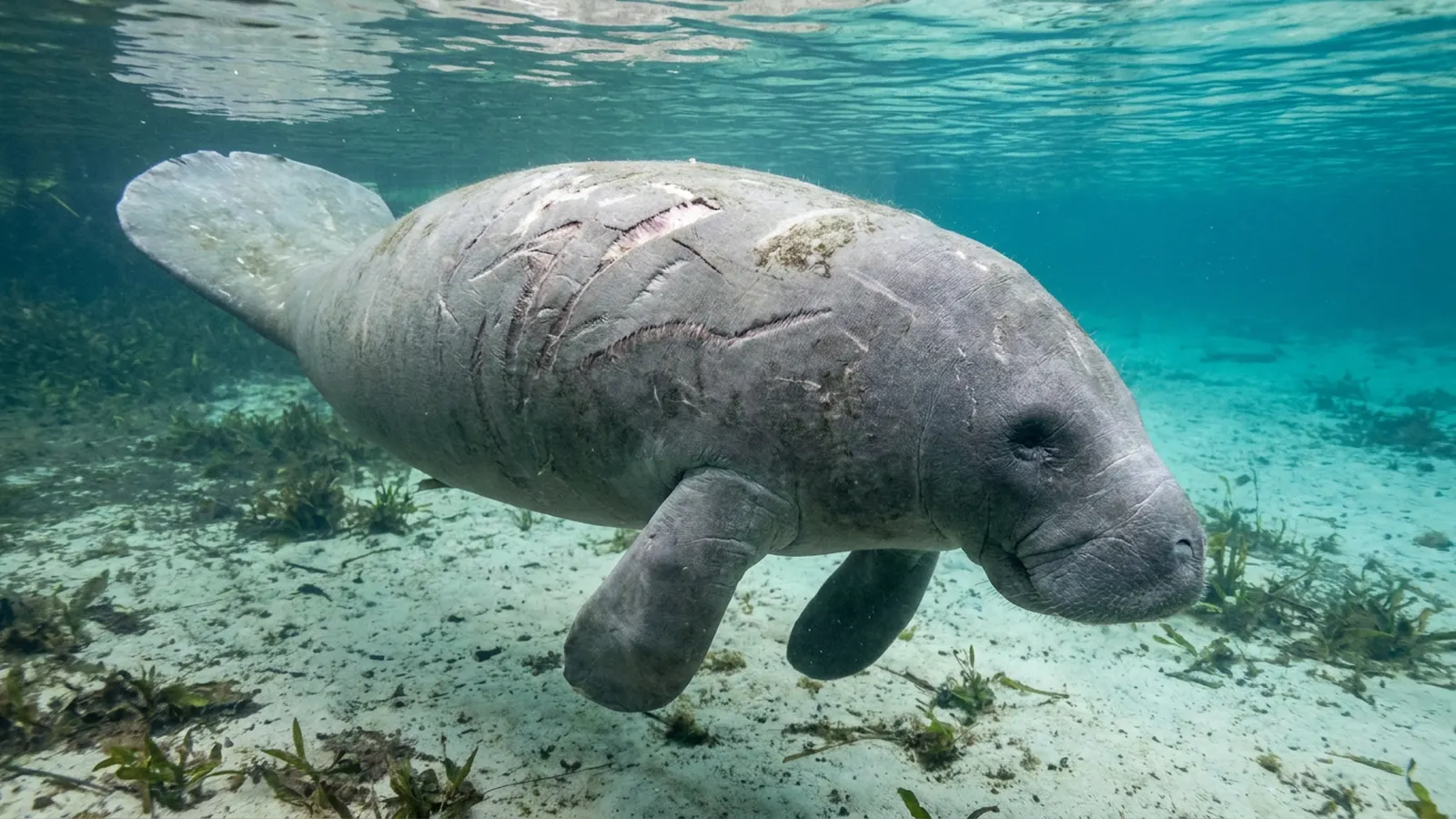
The 60–70 year potential lifespan is rarely realised in modern wild populations. Most Florida manatees die in their teens, twenties, or thirties from human-caused mortality, well short of their biological maximum.
Florida wildlife biologists examine every recovered manatee carcass and estimate age via the growth-layer-count method (described below). The aggregated data shows a sobering pattern: the average age of recovered adult Florida manatees is in the teens to early twenties — nowhere near 65. Most adults die from boat strikes, cold stress, or starvation. The animals that reach their 30s are increasingly few; those reaching 40+ are individually notable. Only a small fraction reach the upper end of the species’ biological potential.
This is not how mammal populations normally work. In a healthy population of a long-lived large mammal, you would expect most individuals to die of natural senescence or disease at ages approaching the species’ maximum lifespan, with a substantial cohort of older animals continuing to reproduce. In modern Florida manatees, the lifespan distribution is truncated. The species is living in conditions that cut decades off its natural lifespan, and the population numbers reflect that.
How biologists determine a manatee’s age — the ear-bone method
A manatee’s age can be determined post-mortem by examining the growth-layer pattern in the dense bone of the auditory bulla — the bony capsule that houses the middle ear. The pattern works like tree rings or fish ear stones.
The auditory bulla — also called the petro-tympanic complex — is one of the densest bones in the manatee skeleton, growing throughout life in seasonal layers. Each year of growth produces a pair of layers: a thicker, less dense layer formed during seasons of plenty (warm months, abundant food), and a thinner, denser layer formed during lean periods (cold winter, food shortage). When the bulla is sectioned and viewed under a microscope after appropriate preparation, these growth-layer groups (GLGs) are visible as concentric rings. Counting the rings gives the age in years, with reasonable accuracy out to several decades.
This is the standard method for ageing manatees, the same technique used to age fish (from their otolith ear stones), cetaceans (from tooth or ear-plug layers), and various other long-lived animals. The method requires the bulla to be recovered from a dead animal — manatees cannot reliably be aged from the outside. For live animals, body size, scarring patterns, and individual identification (from boat-strike scars and other unique features) can give rough age estimates, but not the precision of the bulla method. The records of wild manatee maximum age — 60+ years for some individuals — come from GLG counts of recovered carcasses.
Life stages of a manatee
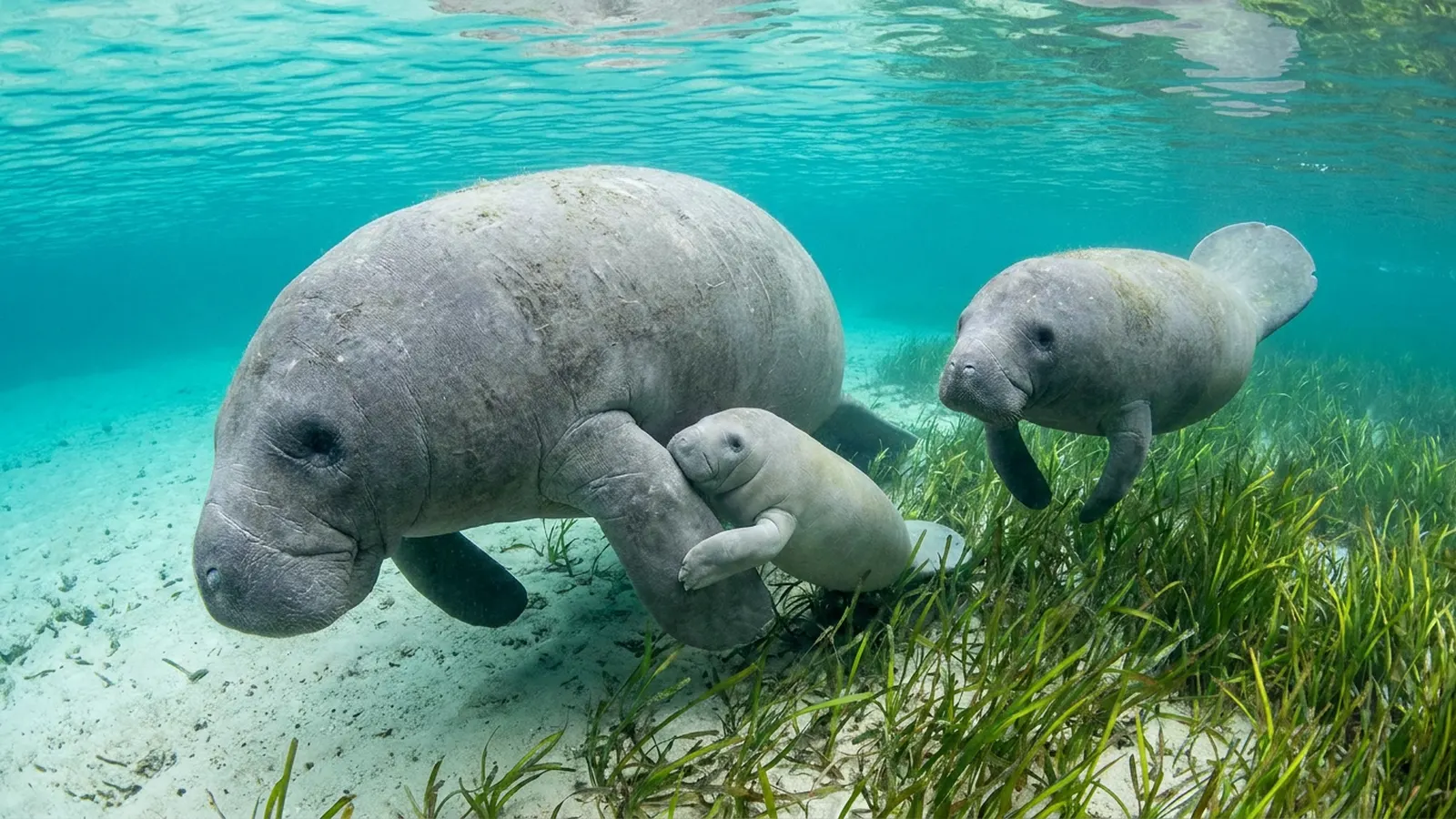
A manatee’s life moves through several distinct phases — calf, juvenile, sub-adult, mature adult, old adult — each with its own characteristic survival challenges and biological milestones. We walk through each phase in our guide to the manatee life cycle.
Calf (birth to 2 years). The most vulnerable phase. Newborn manatees weigh around 30 kg and depend on their mothers continuously. Maternal care includes constant physical contact, nursing, and instruction in feeding, navigation, and predator avoidance. First-year mortality is substantial — estimates range from 15% to 30%, depending on habitat and conditions. Causes of calf mortality include separation from the mother, predation by sharks (rare but possible), birth complications, disease, and starvation when the mother is in poor condition.
Juvenile and sub-adult (2 to 9 years). After weaning, young manatees gradually become independent. Females reach sexual maturity around 4–5 years and may produce their first calves at 5–7. Males don’t reach reproductive size and condition until about 9. This is the phase of rapid growth and the establishment of habitat preferences — young manatees learn the migration routes, feeding grounds, and warm-water refuges they will use for the rest of their lives.
Mature adult (10 to 40 years). The reproductive years. Females calve every 2–5 years; males participate in mating herds whenever opportunities arise. This is also when most boat-strike scarring accumulates — nearly every adult Florida manatee carries propeller scars by middle age. Most population recruitment happens in this phase, and most mortality from human causes also happens here.
Old adult (40+ years). The decades where manatees can in principle live but rarely do in modern conditions. Animals reaching 40+ years are biologically still capable of reproducing, still feeding normally, and not typically showing senescence. They are the most experienced individuals in the population, holding the longest accumulated knowledge of habitat. Their loss to boat strikes or cold stress is disproportionately damaging to population stability because they cannot easily be replaced.
Why manatees live so long — the evolutionary logic
A 70-year lifespan is unusual for a 500-kilogram mammal. Manatees evolved their long lifespan because their reproductive strategy requires it — the slow inter-birth interval would not work in a short-lived species.
The connection between lifespan and reproductive rate is well-established in mammal evolution. Fast-reproducing animals (mice, rabbits) tend to be short-lived; slow-reproducing animals (elephants, whales, primates) tend to be long-lived. The relationship is causal: producing one offspring every few years, with a long gestation and extended parental care, only makes evolutionary sense if the parents live long enough to produce a meaningful number of offspring over a lifetime. Otherwise the species can’t replace itself.
Manatees fit the pattern. A 14-month gestation, one calf per pregnancy, a 2-year mother-calf bond, and a 2-5 year inter-birth interval mean that even a maximally productive female will produce only one calf every 3 years on average. Over a 40-year reproductive career — from sexual maturity at age 5 to senescence at perhaps 50–55 — that’s about 12-13 calves. With substantial calf mortality, perhaps 6-9 of those reach reproductive age themselves. That’s barely enough to maintain a stable population, and only if adult mortality is low.
Cut adult lifespan in half — say, average mortality at age 20 instead of age 60 — and the calf-output drops to perhaps 4-5 in a lifetime, of which maybe 2-3 survive to reproduce. The population can’t maintain itself. The manatee’s slow reproductive cycle requires a long natural lifespan to be sustainable. When human pressures shorten that lifespan, the species cannot adapt fast enough to compensate — one of the central reasons modern manatee conservation has to focus on reducing adult mortality rather than relying on reproduction.
How long do manatees live?
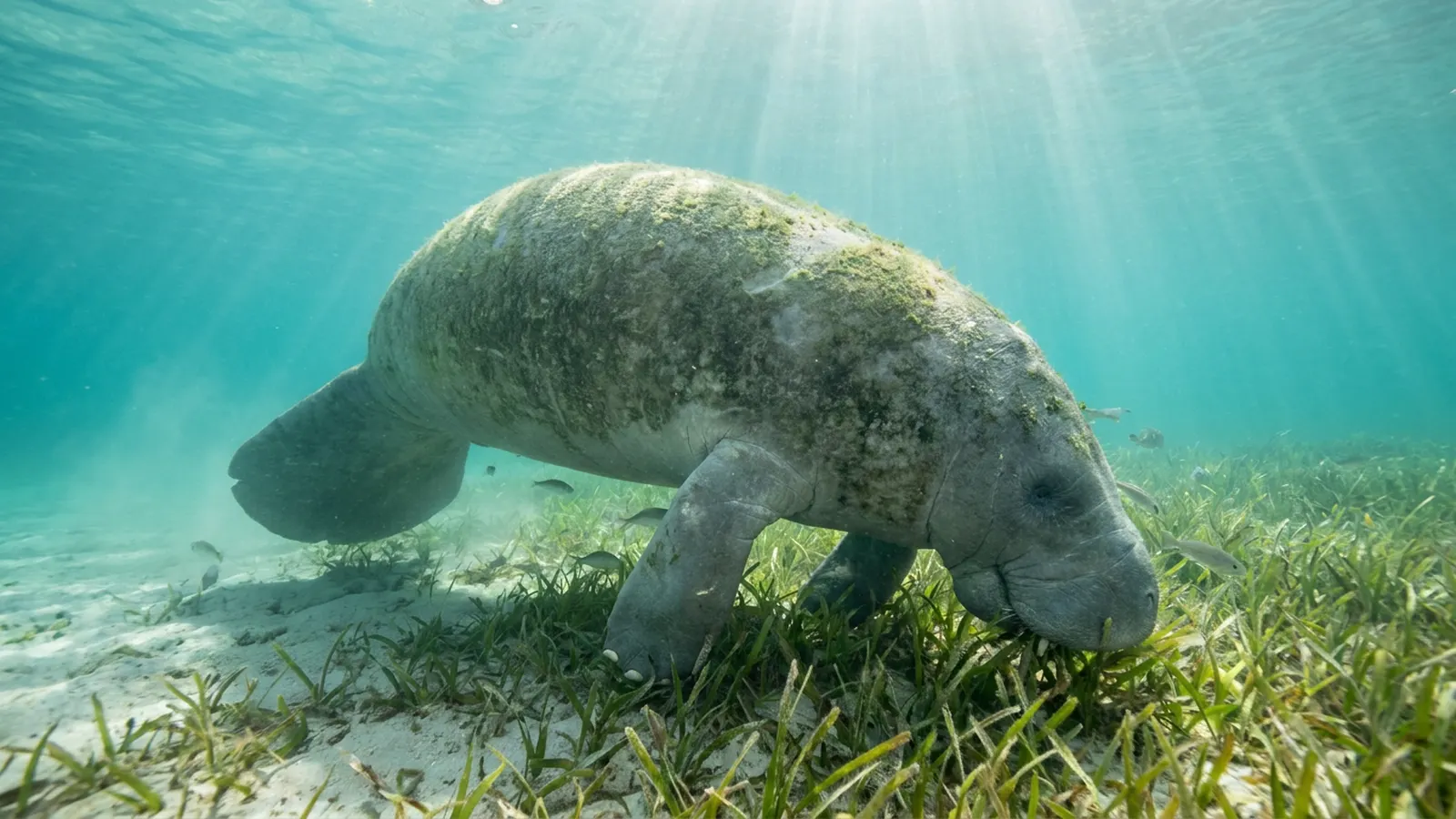
In the wild, healthy West Indian manatees can live 60 to 70 years. The longest documented manatee was Snooty, born in 1948 and died in 2017 at 69 years old in captivity at the South Florida Museum. Wild lifespans rarely reach this maximum due to human-caused mortality; most adult Florida manatees die in their teens to thirties from boat strikes, cold stress, or starvation.
What is the oldest manatee on record?
Snooty, a captive West Indian manatee at the South Florida Museum (now The Bishop Museum of Science and Nature) in Bradenton, Florida. Born July 21, 1948, at the Miami Aquarium, Snooty died on July 23, 2017, at 69 years old. Guinness World Records recognised him as the oldest manatee in 2016. His death was a tragic accident — he became trapped in an underwater plumbing space.
How can you tell how old a manatee is?
By counting growth-layer groups in the dense bone of the auditory bulla — the bony ear capsule — under a microscope. Each year of growth produces a pair of dense and less-dense layers, like tree rings. The method requires a recovered carcass and is the standard way of ageing manatees. Live animals cannot be reliably aged from outside; rough estimates can come from body size, scarring patterns, and identification records.
Do manatees live longer in captivity than in the wild?
Often yes — the same way many large mammals live longer in well-run captive environments because predation, starvation, and traumatic injury are eliminated. Snooty’s 69-year captive lifespan slightly exceeds the documented wild maximum (60+ years from growth-layer counts of recovered carcasses). However, modern wild manatees rarely reach their biological maximum due to human-caused mortality, so captive vs wild comparisons are less about the species’ potential and more about current threats.
Why do manatees live so long?
Their slow reproductive cycle requires it. With a 14-month gestation, one calf per pregnancy, and a 2–5 year inter-birth interval, even a healthy female produces only one calf every few years. To leave enough offspring to maintain the population, individual females need to reproduce for decades — which requires a long lifespan. The 70-year potential lifespan is an evolutionary consequence of slow reproduction.
What is the main cause of death for adult manatees?
Boat strikes (in Florida and the developed Caribbean), cold stress, and starvation from seagrass loss. All three are human-caused. Natural mortality from predation, disease, or senescence accounts for a much smaller fraction of adult deaths. The species’ biological capacity for a long lifespan is being undermined by human-caused mortality faster than reproduction can compensate.
How long do manatee calves stay with their mothers?
Around 2 years. Calves are nursed for about 2 years (though they begin eating plant material at a few months old) and remain in close physical contact with the mother, learning feeding grounds, migration routes, and warm-water refuges. The extended maternal care is one of the reasons the manatee reproductive cycle is so slow.
At what age do manatees stop reproducing?
There is no clear reproductive senescence in female manatees — individuals have been documented calving past 50 years of age. In practice, fertility may decline gradually after the peak reproductive years (typically the 20s and 30s), but female manatees are biologically capable of producing calves throughout most of their lives. Males similarly reproduce throughout adulthood without a clear cutoff.
How does manatee lifespan compare to other marine mammals?
Manatees are among the longest-lived non-cetacean marine mammals. Whales generally exceed them — some whale species live well over 100 years — but manatees outlive seals, sea lions, and most porpoises and dolphins. The 60–70 year wild lifespan is comparable to large terrestrial mammals like elephants and chimpanzees, and reflects the slow reproductive cycle shared with those species.
Can we make manatees live longer?
Not by changing the species — the biological maximum is set. What can be changed is the proportion of manatees that reach their biological maximum, by reducing human-caused mortality. Slower boat speeds in manatee zones, restoration of seagrass habitat, protection of warm-water refuges, and reduction of pollution all contribute to lifting average wild lifespan toward the species’ potential. The species is already capable of 65+ years; the conservation question is how many animals get to live that long.
Blane Perun has been exploring Earth’s oceans and marine life for over 25 years. Founder of TheSea.Org in 1999, underwater photographer, coral aquaculture pioneer, and explorer of 80+ countries.
About Blane Perun →