How Long Can a Pilot Whale Hold Its Breath? — Typically Under 15 Minutes, Up to About 20 on Deep Hunts
Pilot whales can hold their breath for roughly 15–20 minutes. Most dives last only a few minutes, but tagging studies have recorded deep foraging dives of about 18 minutes in long-finned pilot whales (to ~650 m off the Faroe Islands) and about 21 minutes in short-finned pilot whales, which reached over 1,000 m off the Canary Islands. Short-finned pilot whales even sprint at depth to chase squid, earning the nickname “cheetahs of the deep.”
Long-finned pilot whale (Globicephala melas): cooler waters of the North Atlantic and Southern Hemisphere. Short-finned pilot whale (G. macrorhynchus): tropical and warm-temperate oceans. Both are large members of the dolphin family, 3.5–7 m long.
How deep and how long do pilot whales dive?
Tagging studies give the clearest answers.
| Species / study | Max depth | Max duration | Notes |
|---|---|---|---|
| Long-finned, Faroe Islands (2002) | ~650 m | ~18 min | Deeper dives at night |
| Short-finned, Canary Islands (2008) | ~1,000 m | ~21 min | High-speed sprints at depth |
| Short-finned, Hawaii | ~1,000 m+ | Mostly < 15 min | Daytime and night foraging |
Dive limits vary with population, prey and time of day; many deep dives cluster at night when squid migrate up. See the pilot whale profile.
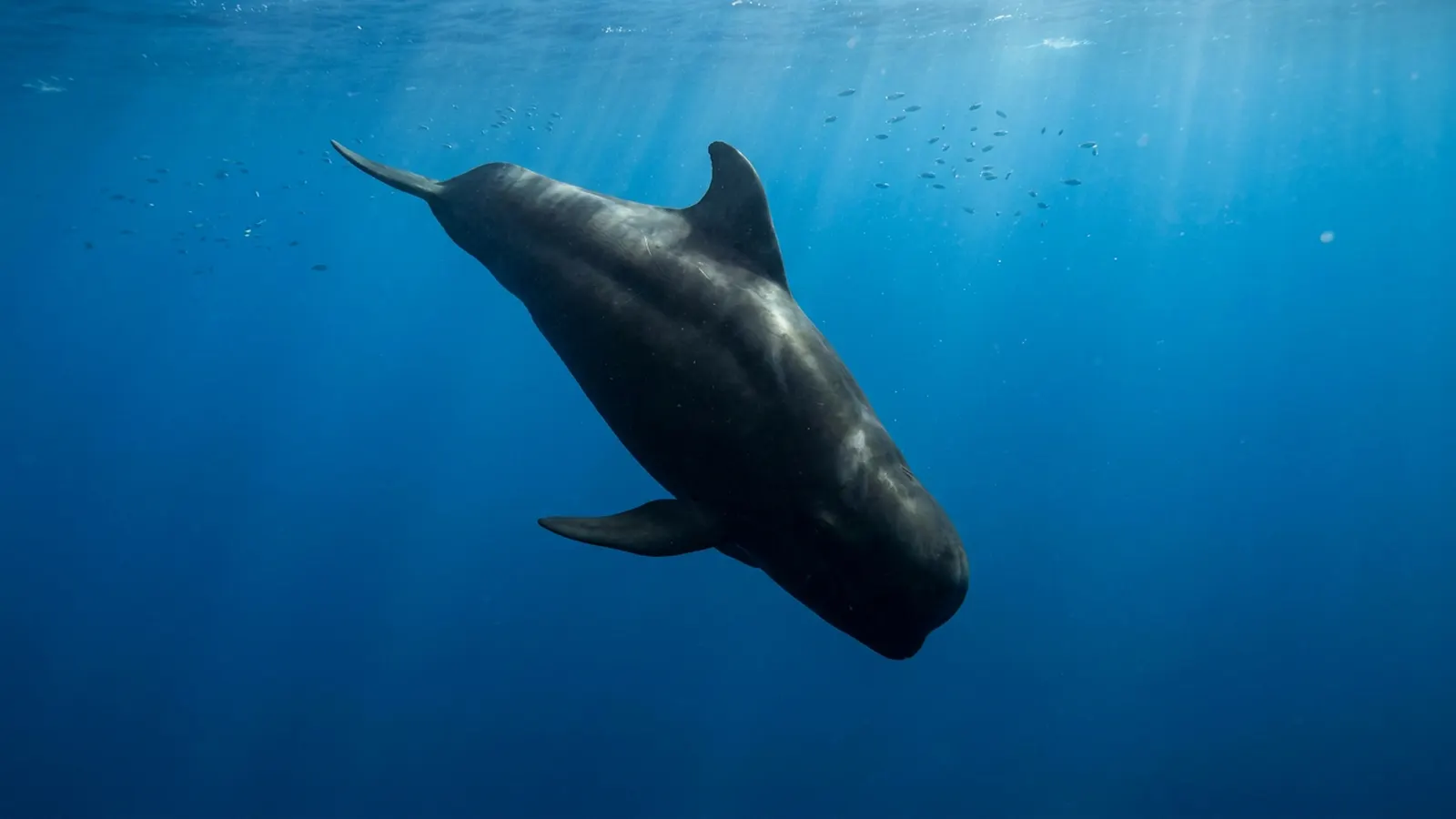
How can pilot whales hold their breath so long?
Oxygen stored in blood and muscle, not lungs.
Like other toothed whales, pilot whales exhale partly before diving and rely on oxygen stored in tissues. Their lungs collapse under pressure, which helps prevent decompression problems. See how long can dolphins hold their breath.
Why do pilot whales sprint at depth?
To catch fast, energy-rich squid.
Natacha Aguilar Soto and colleagues found that short-finned pilot whales off Tenerife made extreme sprints of up to around 9 m/s at depths of 500–1,000 m, chasing large squid. Such bursts use oxygen fast, which is why these dives are shorter than those of the slower, longer-diving beaked and sperm whales. Pilot whales trade dive time for speed.
How does that compare with other whales?
Pilot whales are good divers, but not record-breakers.
| Species | Max breath-hold |
|---|---|
| Cuvier’s beaked whale | ~222 min (record) |
| Sperm whale | ~90 min+ |
| Pilot whales | ~18–21 min |
| Bottlenose dolphin | ~8–12 min |
| Humpback whale | ~30 min+ |
See Cuvier’s beaked whale, the deepest and longest-diving mammal known.
What happens during a pilot whale’s deep dive?
A deep foraging dive follows a fairly regular pattern. After a period at the surface breathing, resting and socialising, a pilot whale arches its back, lifts its tail stock and heads steeply down. On the way down it is mostly silent. Once it nears the depth where squid and fish are concentrated, it begins to echolocate, producing regular trains of clicks that build an acoustic picture of the water ahead. When it locks on to prey, the clicks speed up into a rapid buzz, the acoustic signature of a capture attempt, as the whale closes in.
Digital acoustic recording tags, known as DTAGs, attached by suction cups for a few hours, have made it possible to follow these dives in detail. They record depth, body movement and every sound the whale makes and hears. The 2008 study off Tenerife that earned short-finned pilot whales the nickname cheetahs of the deep sea, led by Natacha Aguilar Soto and published in the Journal of Animal Ecology, used these tags to show that the fastest sprints occurred at the deepest points of dives, during the final chase of prey. After a series of buzzes, the whale turns and climbs back towards the surface, often more slowly than it descended.
Why are pilot whale dives shorter than sperm whale dives?
The answer lies in how they spend their oxygen. Every diving mammal carries a fixed store of oxygen in its blood, muscles and, to a lesser extent, lungs. How long that store lasts depends on how fast it is used. Sperm whales and beaked whales tend to swim slowly and steadily, keeping their metabolic rate low and making their oxygen last for an hour or more. Pilot whales hunt differently: they sprint after fast, muscular squid, and high-speed chases burn oxygen quickly.
Biologists describe the maximum time a diver can stay down without building up large amounts of lactic acid as its aerobic dive limit. Dives within that limit can be followed by a short recovery period at the surface, while longer dives require more anaerobic metabolism and longer recovery. A 2020 study in the Journal of Experimental Biology analysed 3,680 dives from 23 satellite-tagged Cuvier’s beaked whales and found that their median foraging dive lasted 59 minutes, with 5 percent of dives exceeding 77.7 minutes. Pilot whales operate on a very different budget, accepting short dives in exchange for speed and the ability to catch large, fast prey.
How do pilot whales talk to each other at depth?
Pilot whales are among the most vocal of toothed whales, and they stay in contact even when group members are diving separately. Sound production in toothed whales is pneumatic, driven by air moved through the nasal passages, and air compresses as the whale dives. That should make calling at depth more difficult, so researchers have looked at how pilot whales adapt.
A 2016 study in Marine Mammal Science tagged 27 wild short-finned pilot whales with DTAGs and identified several types of communication sounds, including low and medium frequency calls, two-component calls and rasps, bursts of clicks that resemble the feeding buzz but are shorter and slower. The energy of the rasps was not significantly affected by depth, and they became relatively more common than calls deeper in the dive. The authors suggested that click-based signals may help the whales keep in touch under high pressure, although calls were still made at depth as well.
Work on long-finned pilot whales has shown how far those signals can reach. A 2020 study in the Journal of Experimental Biology combined tags on pairs of whales with sound propagation models and found that social calls could potentially link diving and non-diving group members over distances of at least 385 m in the recordings and up to about 1,800 m in theory. Those distances match or exceed the depths at which the whales feed, suggesting that a pilot whale hunting alone in the dark may still be within earshot of its family at the surface.
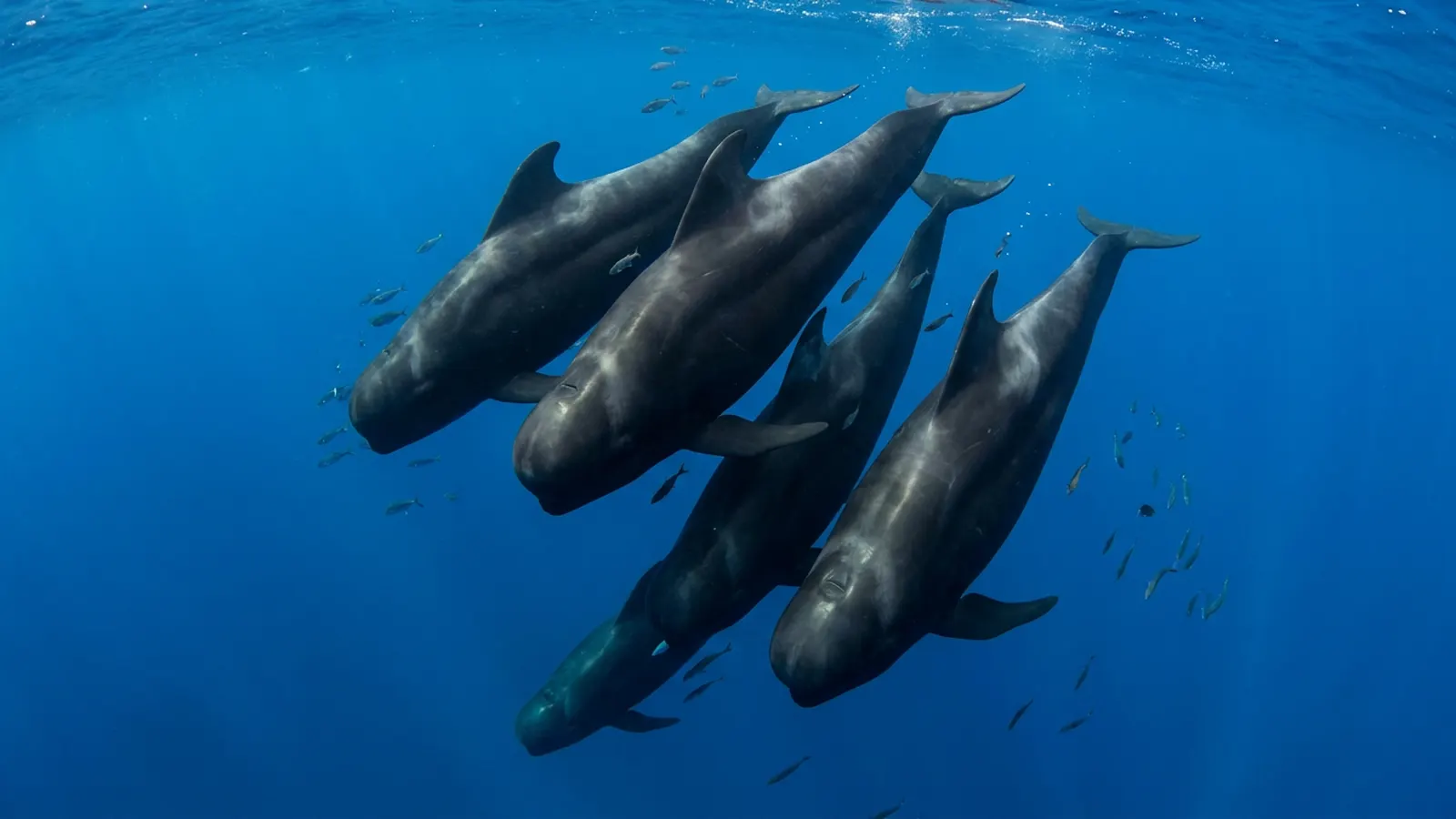
Do pilot whales dive together?
Often, yes. Pilot whales live in stable social groups, and much of their diving is coordinated. Long-finned pilot whales sometimes make synchronised dives in close formation, with individuals touching flippers or bodies as they go down. Researchers studying these group dives have found that females on the left and right flanks of the group lead most often, an arrangement that may help keep the group together much as outriders on a cattle drive keep a herd moving. Mature males and juveniles also lead dives, but far less frequently.
Once at depth, however, individuals often separate to hunt on their own. That creates a trade-off between the benefits of solitary foraging and the protection and social contact of a tight group at the surface. The vocal behaviour described above seems to be one way pilot whales resolve the conflict, allowing them to spread out to hunt and then regroup as they return to the surface.
How do pilot whale calves learn to dive?
Young pilot whales cannot dive as deep or as long as adults. Their smaller bodies hold less oxygen, and their muscles are still developing the high concentration of myoglobin that adult divers rely on. In many toothed whales, calves stay closer to the surface while their mothers make deep foraging dives, sometimes accompanied by other group members.
Pilot whales are known for this kind of cooperative care. Long-finned pilot whales have been observed babysitting calves that are not their own, and in one study many of the babysitters were males. Because pilot whales live in matrilineal groups, with related females at the core and older females often leading, calves grow up surrounded by relatives that can watch over them while their mothers feed in the deep. Short-finned pilot whales also have a long post-reproductive lifespan, with some females living well beyond the end of their breeding years, and older females are thought to pass on knowledge about feeding areas to younger relatives.
Do pilot whales dive differently at night?
Many populations dive more at night, when deep-water animals such as squid and lanternfish rise towards the surface in the daily vertical migration. Long-finned pilot whales tagged off the Faroe Islands in the early 2000s made their deeper dives mostly at night. Short-finned pilot whales off Hawaii forage both by day and by night, while those off Tenerife make deep daytime dives into the dark layers where their prey shelter from the light.
That flexibility reflects the prey available in each region. Where squid stay deep during the day, pilot whales must go down to them; where prey rise at night, the whales can feed at shallower depths and save energy and oxygen. Dive limits measured in one population therefore do not always apply to another, which is why published figures vary so much.
How do pilot whales breathe between dives?
A whale breathes through a single blowhole on top of its head, and it does not breathe automatically as we do. Each breath is a conscious act, timed for the moment the blowhole breaks the surface. Before a deep dive a pilot whale takes a series of quick breaths, exchanging most of the air in its lungs each time, which is far more efficient than a human breath that renews only a small fraction of the lungs. That rapid exchange tops up the oxygen in the blood and muscles and clears carbon dioxide built up during the last dive.
Between bouts of deep diving, pilot whales spend long periods at the surface. Groups often lie still in a tight cluster, a behaviour called logging because the motionless whales look like floating logs. They also travel slowly together, spyhop with their heads raised above the water and slap their tails. Those quiet surface periods are when observers on whale-watching boats usually see them, and they are an essential part of the diving cycle, giving the whales time to recover before the next hunt in the deep.
How does a pilot whale compare with a human freediver?
The comparison shows how specialised whales are. The record for static apnea, holding the breath while floating face down without pre-breathing pure oxygen, stands at a little over 11 minutes for men. With pure oxygen breathed beforehand, a Croatian freediver held his breath for more than 24 minutes in 2021, which is longer than the longest recorded pilot whale dive. But those records are set while lying still in a pool at the surface. A pilot whale makes its dives while swimming hundreds of metres down, chasing prey at high speed and then swimming back up.
Pilot whales also repeat their dives again and again. After a deep dive they need only a short time at the surface before diving again, sometimes making several deep foraging dives in a row before resting. Their bodies carry far more oxygen per kilogram than ours, mostly bound to myoglobin in the muscles and haemoglobin in the blood, and they tolerate high levels of carbon dioxide that would force a human to breathe. Their lungs collapse at depth, which protects them from absorbing excessive nitrogen, a key risk for human divers.
Can noise affect pilot whale diving?
Pilot whales depend on sound to find food and keep in contact, so loud human noise is a concern. Military sonar, seismic airgun surveys, shipping and other noise can mask their calls or change their behaviour. In experiments where sonar signals were played to tagged pilot whales, some animals changed their diving or vocal behaviour, although pilot whales appear less sensitive in some studies than beaked whales, which have stranded in association with naval sonar.
The 2020 study on call propagation in long-finned pilot whales found that the whales called louder and at lower frequencies in noisier environments, suggesting they can adjust to some extent. The authors warned, however, that this ability to cope may be limited as background noise in the ocean increases. Because pilot whales rely on staying in contact during deep dives, anything that shortens the range of their calls could make it harder for them to forage and regroup.
Why do pilot whales strand so often?
Pilot whales are among the species most often involved in mass strandings. In New Zealand, long-finned pilot whales strand in large numbers, especially between December and March. More than 600 pilot whales were involved in a stranding at Farewell Spit in February 2017, one of the largest mass strandings on record. Short-finned pilot whales also strand in groups, with well-documented events in Australia, the Canary Islands and the United States.
The causes are not fully understood. Because pilot whales have such strong social bonds, one leading theory is that when one animal strands, the rest of the group follows rather than abandoning it. Other suggestions include confusing coastal geography with gently sloping beaches that interfere with echolocation, disease, injury from loud noise, and navigation errors. Stranded whales cannot breathe properly because their own weight compresses the chest, which is one reason rescuers work to keep them upright and wet while waiting for the tide.
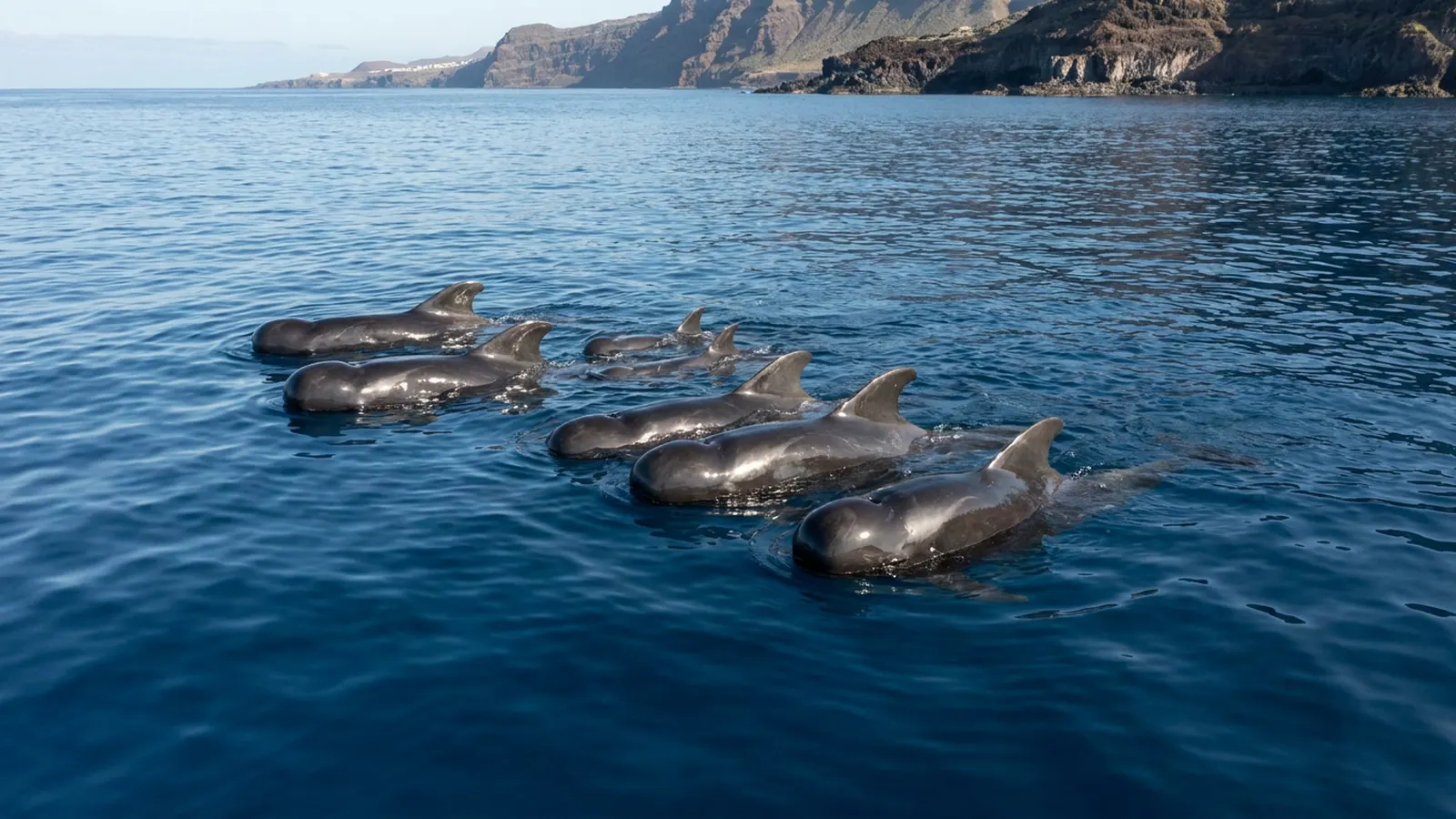
How long can a pilot whale stay underwater?
Usually under 15 minutes; up to about 18–21 minutes on deep dives.
How deep can pilot whales dive?
Short-finned pilot whales reach about 1,000 m; long-finned around 600–650 m.
Are pilot whales dolphins?
Yes, they are large members of the oceanic dolphin family.
What do pilot whales eat?
Mainly squid, plus some fish.
Why do pilot whales strand in groups?
Their tight social bonds mean whole pods follow a leader into shallow water.
How long do pilot whales live?
Females to about 60 years; males usually 35–45.
How often do pilot whales breathe at the surface?
Between dives they breathe every few seconds to a minute, resting and socialising at the surface for long periods.
Where can you see pilot whales?
Tenerife in the Canary Islands has a resident short-finned population; long-finned pilot whales are seen off Nova Scotia, Norway and South Africa.
- Heide-Jørgensen, M. P. et al. (2002). Diving behaviour of long-finned pilot whales Globicephala melas around the Faroe Islands. Wildlife Biology 8: 307–313.
- Aguilar Soto, N. et al. (2008). Cheetahs of the deep sea: deep foraging sprints in short-finned pilot whales off Tenerife. Journal of Animal Ecology 77: 936–947.
- Schorr, G. S. et al. (2014). First long-term behavioral records from Cuvier’s beaked whales reveal record-breaking dives. PLoS ONE 9(3): e92633.
Blane Perun has been exploring Earth’s oceans and marine life for over 25 years. Founder of TheSea.Org in 1999, underwater photographer, coral aquaculture pioneer, and explorer of 80+ countries.
