Are There Sharks in the Mediterranean Sea — Yes, but in Catastrophically Reduced Numbers
Yes — roughly 40 to 50 shark species live in the Mediterranean, from small catsharks to blue sharks, makos, hammerheads and a small, isolated population of great whites. But the large species have collapsed: a 2008 study found hammerhead, blue, mako, porbeagle and thresher sharks had fallen by 96–99.99% from their historical abundance in the north-western basin. Sightings are rare and attacks on people are extremely rare.
The Mediterranean is heavily populated by coastal tourists who often ask whether the warm, blue water hides sharks. The honest answer combines two facts that seem contradictory: yes, multiple shark species live in the Mediterranean, including great whites; and no, swimmers and divers almost never encounter them because populations have collapsed. Understanding the situation requires knowing both the ecology and the conservation history.
Yes. The Mediterranean holds roughly 40 to 50 species of sharks, from small catsharks trawled up every day to blue sharks, makos, threshers, hammerheads and a small, isolated population of great whites. What it no longer holds is many large sharks. Historical records show the big predatory species have collapsed by 96% or more, and a swimmer on a Mediterranean beach is very unlikely ever to see one.
How many shark species live in the Mediterranean?
The exact number depends on the checklist, because some species are known from only a few records, some are vagrants from the Atlantic or the Red Sea, and taxonomists continue to split and merge species. The 2016 IUCN regional Red List assessment, the most thorough recent review, evaluated 73 native cartilaginous fishes in the Mediterranean: 41 sharks, 32 rays and skates, and a single chimaera. Field guides that include rare visitors and deep-water species give totals in the mid to high forties for sharks alone, which is why figures of “about 45” or “about 47” are often quoted.
The sea’s history explains part of the mix. The Mediterranean is connected to the Atlantic only through the narrow, shallow Strait of Gibraltar, and since 1869 to the Red Sea through the Suez Canal. Most of its sharks are Atlantic species that entered through Gibraltar. Its deep basins are unusually warm, at around 13 °C even at great depth, compared with 2–4 °C in most of the deep ocean, which favours some deep-water sharks and excludes others. Because the basin is semi-enclosed, local populations can be isolated from the wider ocean, and the great white shows how vulnerable that can make them.
| Species | Max size | Where it lives | How often seen |
|---|---|---|---|
| Small-spotted catshark | ~1 m | Sea floor, shelf and slope | Very common in trawl catches |
| Blackmouth catshark | ~0.9 m | Upper continental slope | Common in deep trawls |
| Bluntnose sixgill | ~5 m | Deep water, shallower at night | Rarely seen by divers |
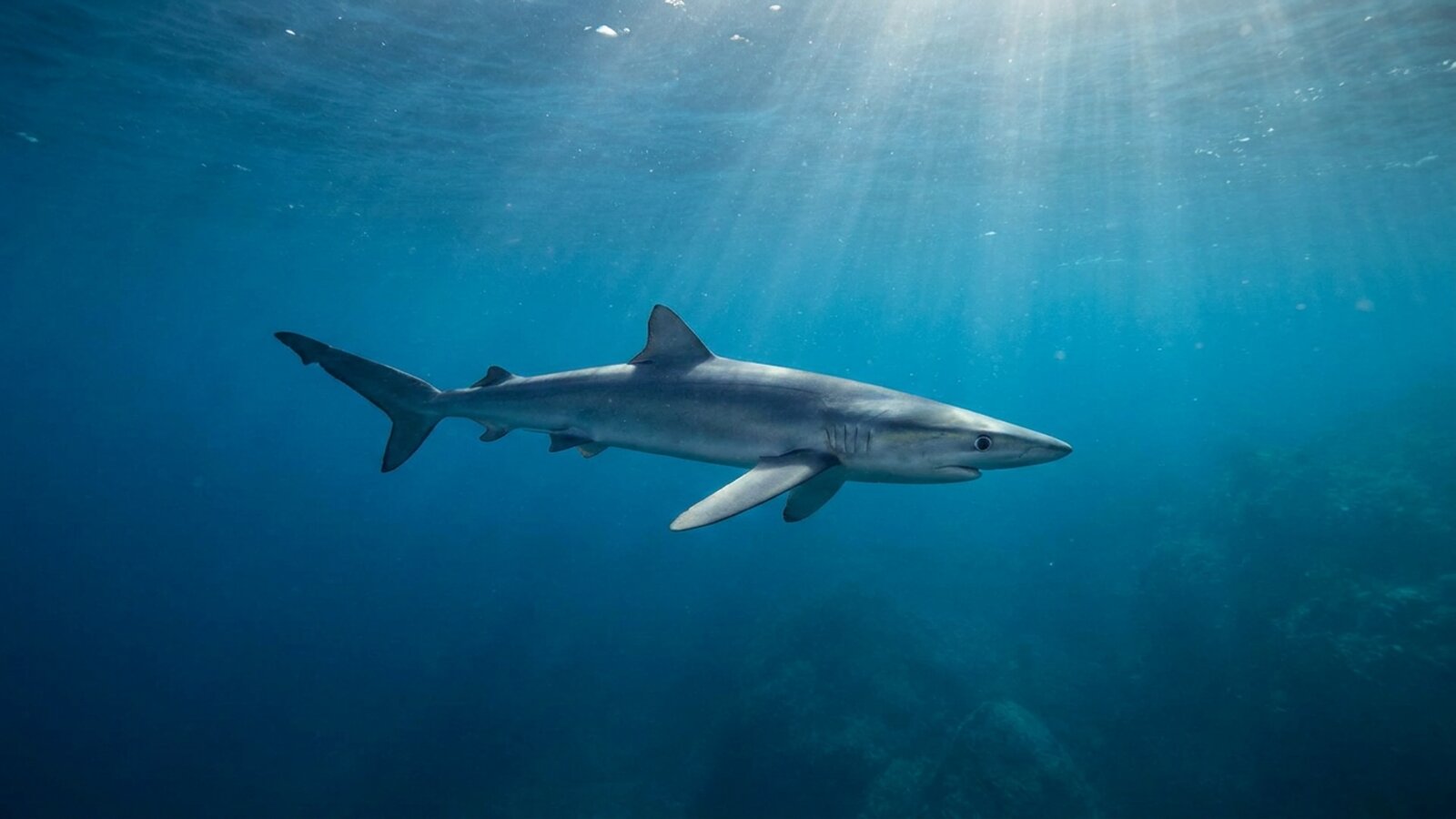
| Blue shark | ~3.8 m | Open sea | Most frequent large pelagic shark |
| Shortfin mako | ~4 m | Open sea | Rare |
| Basking shark | ~10 m | Surface waters, spring | Occasional sightings |
| Sandbar shark | ~2.5 m | Coastal bays | Local aggregations |
| White shark | ~6 m | Coastal and open sea | Very rare |
Which sharks are you most likely to meet?
The most abundant Mediterranean sharks are small bottom-dwellers that most people only ever see on a fish market slab. The small-spotted catshark, Scyliorhinus canicula, is a slender, sandy-brown shark covered in dark spots that lives on sand and mud from shallow water down the continental slope. It lays its eggs in leathery cases, sometimes called mermaid’s purses, that wash up on beaches. The blackmouth catshark, Galeus melastomus, replaces it in deeper water on the upper slope, where it is one of the most common fish taken by deep trawlers. Smooth-hounds of the genus Mustelus, the spurdog or spiny dogfish, and the tiny velvet belly lanternshark, which glows faintly in the dark, round out the everyday catch.
Divers on rocky coasts occasionally meet angel sharks, flattened, ray-like sharks that lie buried in sand waiting for prey. Angel sharks were once common enough in the Mediterranean to be sold routinely in markets, but the family is now among the most threatened groups of sharks anywhere, and sightings in the basin are rare enough to be reported to scientists. The bluntnose sixgill shark, Hexanchus griseus, is a primitive deep-water species with six gill slits that can grow to around 5 m. It usually lives hundreds of metres down but rises toward shallower water at night, and it is occasionally filmed by technical divers or caught by fishermen.
Out in open water, the blue shark, Prionace glauca, is the most frequently recorded large shark, a slim, deep-blue species with long pectoral fins that follows schools of fish and squid. Shortfin makos, threshers and porbeagles also occur, mainly far from shore. Basking sharks, the second-largest fish in the world, appear at the surface in spring and early summer in places such as the Ligurian Sea, the Adriatic and off North Africa, filtering plankton with their mouths wide open. They are entirely harmless.
A few coastal sites host regular gatherings. In Boncuk Cove, in Gökova Bay on Turkey’s south-western coast, a study published in 2018 described a year-round aggregation of sandbar sharks, Carcharhinus plumbeus. Sandbar sharks are stocky grey sharks with a tall first dorsal fin, and they pose little danger to people.
How badly have Mediterranean sharks declined?
Severely. Records going back to the early nineteenth century suggest that the large predatory sharks of the north-western Mediterranean have fallen by 96 to 99.99% from their former abundance.
The key study, by Francesco Ferretti, Ransom Myers, Fabrizio Serena and Heike Lotze, was published in Conservation Biology in 2008. Because there were no proper stock assessments, the team pieced together nine long-term records: commercial and recreational fishery landings, tuna-trap catches, scientific surveys and sighting reports, some starting in the early 1800s. Of the 20 large shark species they considered, only five had enough data for analysis: hammerheads, the blue shark, the shortfin mako and porbeagle (grouped as mackerel sharks), and the common thresher. All five had declined by between 96% and 99.99%. By IUCN criteria every one of them would qualify as Critically Endangered in the region, and the authors concluded that current levels of exploitation put large sharks at risk of extinction in the Mediterranean.
The 2016 IUCN regional Red List reached a similar conclusion across all cartilaginous fishes. At least 53% of the native sharks, rays and chimaeras were found to be at risk of extinction, including 23 of the 41 sharks, and 13 species were recorded as having disappeared from parts of the basin over the previous half-century. The IUCN linked the decline mainly to intensive fishing, and specifically to bycatch: sharks caught unintentionally in trawls, longlines, gillnets and tuna fisheries rather than targeted directly.
Several features of the Mediterranean make it especially hard on sharks. It has been fished intensively for thousands of years, it borders more than 20 countries with very different fisheries rules, and large parts of its shelf are trawled repeatedly. Sharks grow slowly, mature late and have few young, so even modest extra mortality can push a population into decline, and recovery takes decades. Losing the top predators may also reshape the ecosystem below them, by releasing medium-sized predators from control, an effect Ferretti and colleagues flagged as a likely consequence.
Are there great white sharks in the Mediterranean?
Yes, but very few. The Mediterranean has a small, resident population of white sharks that appears to breed there and is genetically distinct from its Atlantic neighbours.
The Italian Great White Shark Data Bank, maintained by shark researcher Alessandro De Maddalena, holds about 640 records of white sharks in the Mediterranean, from the Middle Ages to the present, of which he considers around 80 doubtful. The records include some very large animals. His list of reliable specimens includes a female estimated at 6.6–6.8 m caught off Marseille in October 1925, another of similar size taken near Filfla, Malta, in 1987, and females of around 6 m from Sicily, Majorca and Halkidiki in Greece. The largest specimen that can still be measured is a mounted 5.89 m female caught off Maguelone in southern France in 1956, now in a museum in Lausanne, Switzerland.
The population’s origin was a long-standing puzzle. In 2010, a team led by Chrysoula Gubili sequenced mitochondrial DNA from four rare Mediterranean white sharks and found, unexpectedly, that they were closely related to white sharks of Australia and New Zealand rather than to the much closer Atlantic and South African populations. The researchers suggested that a small number of sharks, perhaps a single founding female, strayed into the Mediterranean around 450,000 years ago, during the climatic swings of the Pleistocene, and that their descendants stayed because white sharks tend to return to the region where they were born. The practical consequence is that the Mediterranean population receives little or no contemporary immigration from the Atlantic, making it extraordinarily vulnerable.
The Strait of Sicily is widely regarded as the main pupping and nursery ground, linked in part to the bluefin tuna that gather there. Juvenile white sharks are easily confused with porbeagles and makos, so many accidental catches probably go unrecognised. Studies have estimated large declines in sightings during the second half of the twentieth century, and De Maddalena puts the current population at anywhere from a few dozen to a few hundred animals, with no reliable count. Mediterranean white sharks feed on tuna, swordfish, other sharks, dolphins and turtles; the sea’s seals, the Mediterranean monk seals, are themselves so scarce that they cannot be a major food source.
Are Mediterranean sharks dangerous to swimmers?
Hardly at all. Popular summaries of historical data put the documented total at a few dozen unprovoked attacks over roughly 150 years, about half of them fatal, most of them long ago. Tens of millions of people swim in the Mediterranean every summer with essentially no risk from sharks.
Most historical attacks involved white sharks, and many involved sponge divers, fishermen or people in the water near tuna fisheries, not beach swimmers. Several famous cases are clouded by uncertainty. A 4.5 m female caught off Sicily in 1908 was found with human remains in its stomach, but those may have come from victims of the devastating Messina earthquake and tsunami of that year rather than from an attack. Sensational news stories about sharks off Spanish, Italian, Croatian or Greek beaches appear most summers, but nearly all involve blue sharks, which are rarely dangerous, sick or disoriented animals near harbours, or mistaken identifications of dolphins and sunfish.
The main reason attacks are so rare is simple: there are very few large sharks left. Unlike Florida, South Africa or Australia, the Mediterranean has no large coastal populations of bull, tiger or white sharks close to busy beaches. Ordinary precautions still apply in any sea: avoid swimming near fishing boats that are discarding catch, do not swim alone far offshore, and leave the water if a shark is reported nearby. If you are lucky enough to see a shark while snorkelling or diving, keep calm, stay still and enjoy the rare sighting, then report it to local researchers, who rely on public records to track these populations.
What is being done to protect them?
For a long time Mediterranean sharks had almost no protection. That began to change in the 2000s. In 2003 the Barcelona Convention, the regional treaty that protects the Mediterranean, adopted an Action Plan for the Conservation of Cartilaginous Fishes, and listed the most threatened sharks and rays in the annexes of its biodiversity protocol. In 2012 the General Fisheries Commission for the Mediterranean (GFCM) adopted Recommendation 36/2012/3, which made those listings binding for fisheries. Species on Annex II, including the white shark, basking shark, angel sharks, shortfin mako and several others, may not be kept on board, landed or sold, and must be released unharmed and alive. The same rules ban finning, the practice of cutting off a shark’s fins and discarding the body, and prohibit trawling within three nautical miles of the coast.
The European Union adds its own rules for its member states, including a requirement that sharks be landed with their fins naturally attached, and several countries protect particular species nationally. Conservation groups such as WWF track how well these rules are implemented, and their reports have repeatedly found that enforcement and catch reporting lag far behind the regulations on paper. Bycatch of protected species continues, especially in longline and gillnet fisheries, and catches of unprotected species such as blue sharks remain substantial.
Recovery will be slow even if protection improves. Large sharks such as the white shark and the shortfin mako take many years to mature and produce few pups, so populations that have fallen by more than 90% need decades of sustained protection to rebuild. There are some encouraging signs: assessments have suggested that the Mediterranean white shark population may have stabilised or slightly increased since it was protected, and citizen-science reporting has improved knowledge of where sharks still occur.
Where are sharks seen in the Mediterranean today?
Sightings are scattered but not random. White sharks are reported most often around Sicily, in the Strait of Sicily and off Tunisia, in the Adriatic, and in the Aegean. Blue sharks are seen across the open sea and occasionally come close to shore. Basking sharks appear seasonally in the Ligurian and Tyrrhenian seas and the Adriatic. Divers can sometimes find angel sharks and small catsharks on sandy bottoms, and the sandbar sharks of Boncuk Cove in Turkey are one of the few predictable shark gatherings in the basin. Deep-water species such as sixgills and gulper sharks are largely the province of scientists using remotely operated vehicles and baited cameras.
For anyone planning a holiday, the practical answer is reassuring: there are sharks in the Mediterranean, but you would be very lucky to see one, and the chance of being harmed by one is vanishingly small. For the sharks themselves the picture is grim, which is why every confirmed sighting is now of real interest to researchers.
Are there sharks in the Mediterranean Sea?
Yes. Roughly 40 to 50 shark species have been recorded, depending on the checklist; the 2016 IUCN regional assessment covered 41 native sharks. Large species have declined by 96% or more since the 1800s, so sightings are rare.
Are there great white sharks in the Mediterranean?
Yes, a small, isolated population. Its closest genetic relatives are white sharks of Australia and New Zealand, and the Strait of Sicily is thought to be its main nursery area. Estimates range from a few dozen to a few hundred animals.
Are Mediterranean sharks dangerous?
The risk is extremely low. Only a few dozen unprovoked attacks have been documented in roughly 150 years, most of them long ago, and most summer shark scares involve harmless or unidentified animals.
What is the most common shark in the Mediterranean?
The small-spotted catshark is the most common, a spotted bottom-dweller usually under 1 m. Among large open-water sharks, the blue shark is seen most often.
Why have Mediterranean sharks declined so much?
Centuries of intense fishing, especially bycatch in trawls, longlines, gillnets and tuna fisheries, combined with sharks’ slow growth and low birth rates.
Are there hammerhead sharks in the Mediterranean?
Yes, mainly the smooth hammerhead, but hammerheads are among the species that declined most, by an estimated 96–99.99% in the north-western Mediterranean.
Are sharks protected in the Mediterranean?
Many are. Since 2012, GFCM rules ban keeping or landing the most threatened species, including white, basking, angel and mako sharks, and ban shark finning across the region.
- Ferretti, F., Myers, R.A., Serena, F. & Lotze, H.K. (2008). Loss of large predatory sharks from the Mediterranean Sea. Conservation Biology 22: 952–964. doi:10.1111/j.1523-1739.2008.00938.x
- Gubili, C. et al. (2010, online). Antipodean white sharks on a Mediterranean walkabout? Historical dispersal leads to genetic discontinuity and an endangered anomalous population. Proceedings of the Royal Society B. doi:10.1098/rspb.2010.1856
- IUCN (2016). More than half of the sharks, rays and chimaeras native to the Mediterranean Sea are at risk of extinction. Mediterranean regional Red List assessment.
- GFCM (2012). Recommendation GFCM/36/2012/3 on fisheries management measures for conservation of sharks and rays in the GFCM area (FAOLEX).
- Filiz, H. (2018). Year-round aggregation of sandbar shark, Carcharhinus plumbeus, in Boncuk Cove in the southern Aegean Sea, Turkey. Zoology in the Middle East. doi:10.1080/09397140.2018.1540148
- National Geographic. Great white enigma: in search of the Mediterranean’s giant sharks (A. De Maddalena, Italian Great White Shark Data Bank).
- Serena, F. (2005). Field Identification Guide to the Sharks and Rays of the Mediterranean and Black Sea. FAO, Rome.
Blane Perun has been exploring Earth’s oceans and marine life for over 25 years. Founder of TheSea.Org in 1999, underwater photographer, coral aquaculture pioneer, and explorer of 80+ countries.
About Blane Perun → Back to Sharks →