Olive Sea Snake — The Curious Reef Snake With a Light-Sensing Tail
The olive sea snake (Aipysurus laevis), also called the golden or olive-brown sea snake, is a large, robust, venomous sea snake of coral reefs in northern Australia, including the Great Barrier Reef, and of Indonesia, New Guinea and New Caledonia. It usually grows to about 1–1.5 m and occasionally to 2 m, and is olive-brown to purplish above and paler below. It is one of the sea snakes divers meet most often, famous for curiously approaching people, and for having light-sensitive cells in the skin of its tail.
If you have dived the Great Barrier Reef or the reefs of the Coral Sea and met a sea snake, there is a good chance it was an olive sea snake. Large, bold and inquisitive, it is the best-known reef sea snake in Australia, and one of the most studied. Its name comes from Greek and Latin: Aipysurus means “high tail,” for its deep, flattened tail paddle, and laevis means “smooth.”
What does the olive sea snake look like?
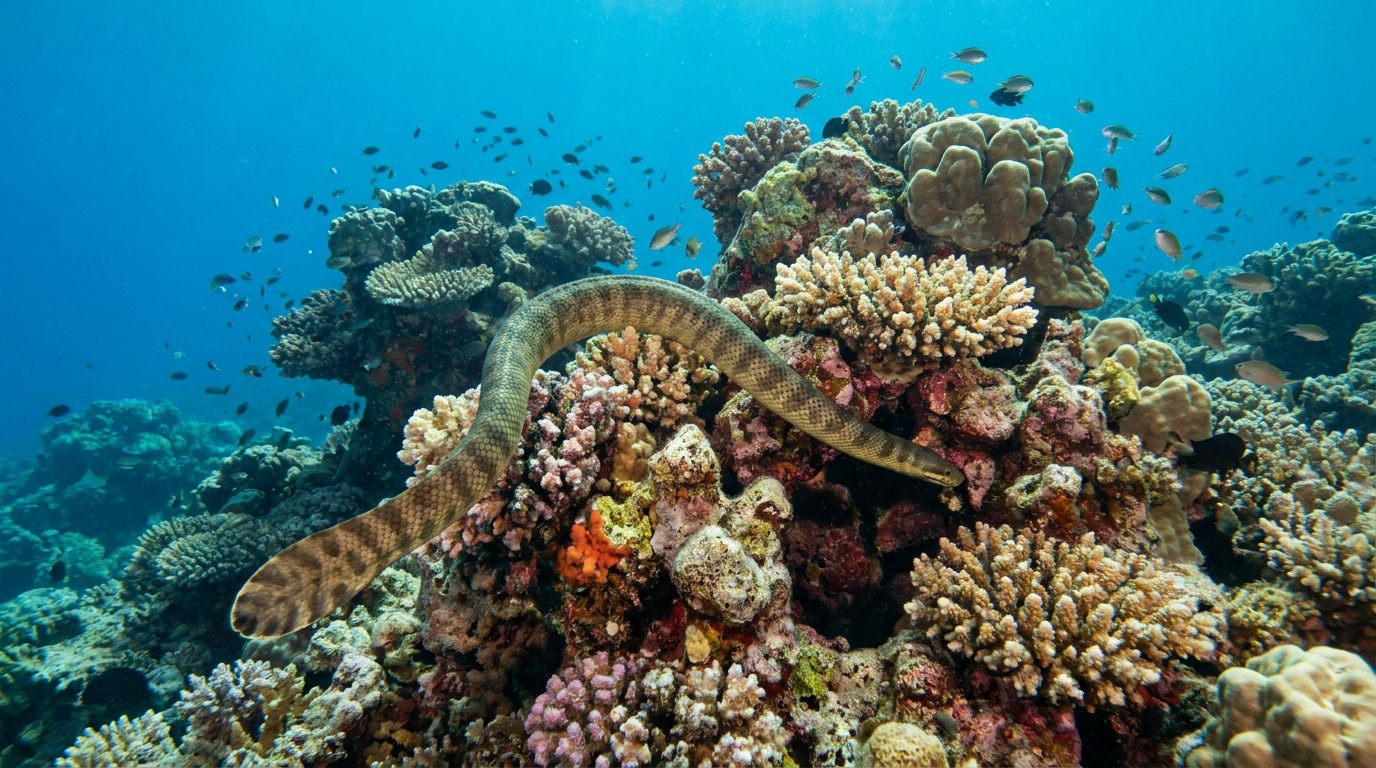
It is a heavy-bodied reef sea snake, olive-brown, brown or purplish above, often with scattered darker or paler flecks, and cream to white underneath, with a deep paddle-shaped tail.
Its head is moderately large with regular, symmetrical head shields, and its belly scales are well developed, typical of Aipysurus reef snakes. Scales are smooth and glossy. Some individuals are a rich golden colour, hence the alternative name golden sea snake. Large adults can be as thick as a wrist, and the tail is noticeably taller than the body is deep.
How big is the olive sea snake?
Most adults measure around 1–1.5 m, and some reach about 2 m, making it one of the largest reef sea snakes. It is much heavier than eel-like species such as the elegant sea snake. Field studies on the Great Barrier Reef suggest individuals can live around 15 years.
Where does the olive sea snake live?
It lives on coral reefs of the tropical eastern Indian Ocean and western Pacific, from Indonesia through northern Australia and New Guinea to New Caledonia.
In Australia it is common on the Great Barrier Reef, the Coral Sea reefs and reefs off Western Australia and the Northern Territory, including Ashmore Reef in the Timor Sea. It stays close to the reef, hiding in coves, crevices and under coral ledges when not hunting or surfacing to breathe, and generally avoids open water. A population once treated as a subspecies, from the Gulf of Carpentaria region, is now recognised as a separate species, Aipysurus pooleorum.
How does the olive sea snake sense light with its tail?
Its tail skin contains light-sensitive cells, letting it detect light on its tail even when its head is hidden.
In the 1960s and 1970s, researchers found that when light shone on the tail of an olive sea snake, it reacted by moving the tail, even with its head covered. The most likely explanation is practical: by day the snake rests with its body stuffed into a coral hole, and a light-sensitive tail tells it whether its tail is still exposed to predators. Light sensitivity in skin occurs across many animal groups, but this was a striking find in a snake. Other sea snakes have not all been tested, so it may not be unique.
What does the olive sea snake eat?
It is a generalist predator that eats fish, crabs, prawns and even fish eggs, hunting by poking its head into crevices in the reef.
It slides its head into holes and gaps, using tongue-flicking and touch to find sleeping or sheltering prey, then bites to inject venom. Its venom contains enzymes that begin breaking down the prey internally, aiding digestion, and it affects both nerves and muscles. See what do sea snakes eat.
Is the olive sea snake dangerous?
It is venomous and capable of a serious bite, and it is one of the species known to approach divers, but genuine attacks are rare.
Divers are often startled when an olive sea snake swims straight at them and investigates their fins, mask or reflection. Studies on the Great Barrier Reef suggest many of these approaches are by males during the breeding season, who may mistake a diver for a potential mate, or are simply curiosity. The calm response is to stay still and let the snake lose interest; swatting or grabbing it greatly increases the risk of a defensive bite. It is listed among the species more likely to bite if provoked. See are sea snakes aggressive and are sea snakes dangerous.
How does the olive sea snake reproduce?
It is viviparous, giving birth to small litters of live young after a long gestation. Young are typically born in the warm season and are independent from birth. Its slow reproduction is one reason local populations can be slow to recover after declines.
Is the olive sea snake declining?
The olive sea snake is assessed as Least Concern globally, but it has disappeared or declined at some reefs. At Ashmore Reef, sea snake numbers including olive sea snakes fell sharply from the late 1990s for reasons still under study. On the Great Barrier Reef, coral loss from bleaching and cyclones reduces the crevices and prey it depends on. Trawl bycatch and illegal collection are additional pressures.
Is the olive sea snake venomous?
Yes, it is venomous and can deliver a serious bite, but it rarely bites unless provoked or handled.
Where does the olive sea snake live?
On coral reefs of northern Australia, including the Great Barrier Reef, and in Indonesia, New Guinea and New Caledonia.
How big is the olive sea snake?
Usually about 1–1.5 m, occasionally up to 2 m.
Why do olive sea snakes approach divers?
Mostly curiosity, and in the breeding season males may mistake divers for potential mates. Staying calm and still is the best response.
What does the olive sea snake eat?
Fish, crabs, prawns and fish eggs, which it finds by probing reef crevices.
Can olive sea snakes see with their tails?
Not see, but they can detect light: their tail skin contains light-sensitive cells, probably to tell when the tail is exposed while resting.
Is the olive sea snake endangered?
It is listed as Least Concern, but populations have declined at some reefs, notably Ashmore Reef.
Blane Perun has been exploring Earth’s oceans and marine life for over 25 years. Founder of TheSea.Org in 1999, underwater photographer, coral aquaculture pioneer, and explorer of 80+ countries.
About Blane Perun → More on Sea Snakes →