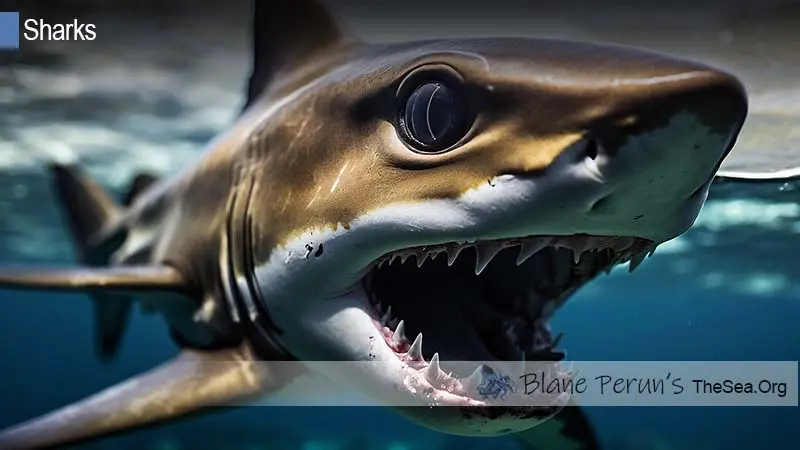
Zero. Sharks Have Zero Bones.
The answer to how many bones sharks have is zero. Sharks are cartilaginous fish — members of the class Chondrichthyes — meaning their entire skeleton is made of cartilage rather than bone. Not mostly cartilage. Not partly cartilage. Every structural element in a shark’s body that would be bone in a human or a bony fish is instead cartilage.
Cartilage is the same material that makes up your nose, your ears, and the cushioning between your joints. It is flexible, lighter than bone, and does not fossilize nearly as well — which is why most of what we know about ancient sharks comes from their teeth rather than their skeletons.
What Is a Shark’s Skeleton Made Of?
A shark’s skeleton consists of cartilaginous versions of all the structures you would find in a bony fish: a skull, a jaw, a spine, gill arches, paired fins with internal supports, and a tail fin. The cartilage is organized in the same general way as bone, but is fundamentally different in composition — it contains no calcium phosphate minerals and no living bone cells (osteocytes).
However, shark cartilage is not soft and floppy. It is dense, tough, and calcified in many regions — particularly around the skull and jaws, where it needs to transmit the enormous forces of a bite. The jaws of a great white shark can exert bite forces of 1.8 tons per square inch. That requires substantial structural integrity, even from cartilage.
Why Cartilage Instead of Bone?
Sharks evolved before bony fish and represent an older evolutionary lineage. Cartilage was not a step down from bone — it was simply the material that worked, and sharks never had evolutionary pressure to switch. The advantages are real: cartilage is significantly lighter than bone (helping sharks remain buoyant without a swim bladder), more flexible (allowing the spine to bend through extreme arcs during fast swimming), and requires less energy to grow and maintain.
The shark body plan — cartilaginous skeleton, multiple rows of replaceable teeth, no swim bladder, powerful heterocercal tail — has been so successful that it has changed remarkably little in 450 million years. The basic shark design predates the dinosaurs by over 200 million years.
What This Means for the Fossil Record
Because cartilage rarely fossilizes, the shark fossil record is heavily biased toward teeth. Sharks continuously shed and replace teeth throughout their lives — some species produce tens of thousands of teeth over a lifetime — and these mineralized teeth preserve extremely well. This is why megalodon, extinct for 3.6 million years, is known almost entirely from its teeth.
Complete shark skeletons in the fossil record are extremely rare. When they do occur, it is usually because the animal was buried quickly in low-oxygen conditions that slowed decomposition long enough for mineral replacement to begin.
Other Cartilaginous Fish
Sharks are not alone. Rays, skates, and chimaeras (ratfish) are also Chondrichthyes — all cartilaginous, all boneless. Together these groups represent over 1,100 species. Everything else you think of as a fish — salmon, tuna, cod, clownfish, eels — is a bony fish (Osteichthyes) with a fully mineralized skeleton.
Frequently Asked Questions
Do sharks have a spine?
Yes — but it is made of cartilage, not bone. The cartilaginous vertebral column gives sharks the flexible, whipping power needed for fast swimming.
Are shark teeth bone?
Shark teeth are not bone — they are made of dentin (the same material as human teeth) covered in enameloid, a hard crystalline coating. Teeth are the only hard, mineralized structures sharks produce, which is why they dominate the fossil record.
Do baby sharks have bones?
No. All sharks — from birth to death — have cartilaginous skeletons. This does not change with age.