Dubois’ Sea Snake — The Most Venomous Sea Snake Ever Tested
Dubois’ sea snake (Aipysurus duboisii), also called the reef shallows sea snake, is a medium-sized sea snake of the reefs and soft seabeds of northern Australia, Papua New Guinea and New Caledonia. In laboratory tests on mice its venom has a subcutaneous LD50 of 0.044 mg/kg, making it the most venomous sea snake tested and the third most venomous snake of all, after the inland taipan and eastern brown snake. Yet its fangs are only about 1.8 mm long and it yields very little venom, and it bites people only when provoked. Adults are usually about 80 cm long.
Ask which sea snake is the most venomous and the textbook answer is Dubois’ sea snake. The figure behind that claim is real — drop for drop, its venom is deadlier to mice than that of any other sea snake tested. But venom toxicity is only one part of danger. Dubois’ sea snake has tiny fangs, delivers a very small amount of venom, lives mostly away from fishing grounds and rarely bites. Understanding the gap between “most venomous” and “most dangerous” is the key to this animal.
What does Dubois’ sea snake look like?
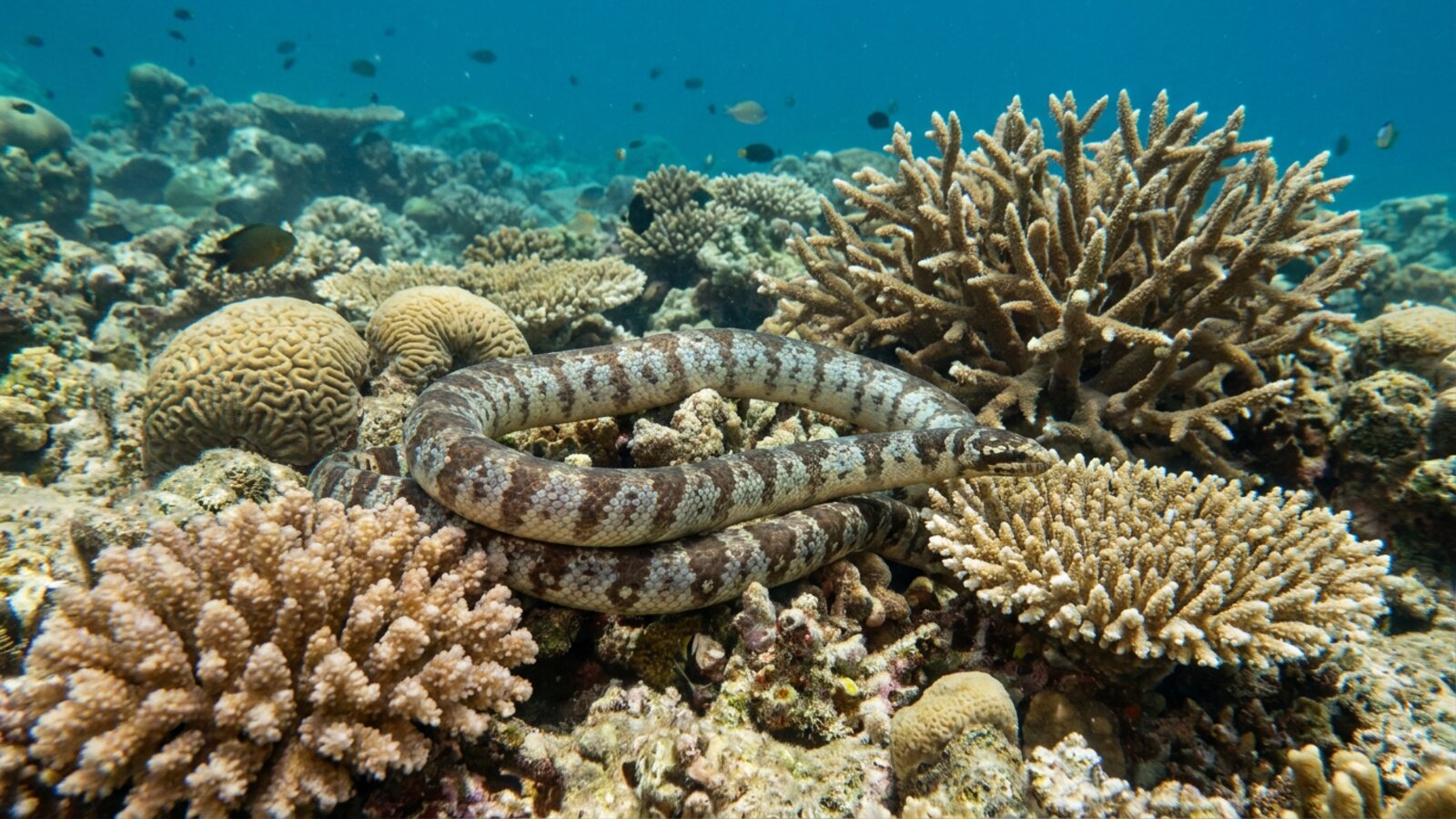
It is a medium-sized, fairly stout sea snake with a head only slightly wider than its neck, a relatively long paddle tail, and highly variable colour, often brown, tan or purplish with darker blotches or bands and paler scattered scales.
The nostrils sit on top of the snout and the nasal scales meet each other, while a row of large subocular scales separates the eye from the lip scales — a useful identification feature in the genus Aipysurus. Body scales are usually smooth but can have small keels or knobs. The chin and throat are paler than the rest of the body. Colour varies so much between individuals that experienced observers rely on head scales and body shape rather than pattern.
How venomous is Dubois’ sea snake?
By the standard LD50 measure, it is the most venomous sea snake known and the third most venomous snake overall.
LD50 is the dose needed to kill half of a group of test animals, measured in milligrams per kilogram of body weight; the lower the figure, the more toxic the venom. Dubois’ sea snake scores 0.044 mg/kg by subcutaneous injection in mice, behind only the inland taipan (about 0.025 mg/kg) and the eastern brown snake (about 0.036 mg/kg). That puts it ahead of the beaked sea snake and well ahead of most land snakes, including cobras. Results vary with the test animal: rabbits are about twice as sensitive to sea snake venom as mice, and fish and frogs even more so, which makes sense for a snake that kills fish.
Its venom, like that of other Aipysurus species, is rich in neurotoxins that block nerve-muscle signals, along with myotoxic components. A serious bite could cause paralysis and muscle damage and would require hospital treatment with sea snake antivenom.
How big is Dubois’ sea snake?
Most adults are around 80 cm long, though the largest recorded individuals reach about 1.48 m including the tail. It is a medium-sized species, smaller and lighter than the related olive sea snake, which often shares its reefs.
Where does Dubois’ sea snake live?
It lives in the tropical waters of northern, eastern and western Australia, southern Papua New Guinea and New Caledonia — the Coral, Arafura and Timor seas and the eastern Indian Ocean.
Its preferred habitats are coral reef flats and nearby areas of sandy or silty seabed with seaweed, sponges, invertebrates and coral heads that offer shelter. It has been found from very shallow reef flats down to about 80 m. It is crepuscular, most active around dawn and dusk, when it hunts along the bottom. Divers on the Coral Sea reefs, the Great Barrier Reef, Ningaloo and the Timor Sea reefs may see it. See also New Caledonia and Papua New Guinea reef maps.
What does Dubois’ sea snake eat?
It preys on moray eels and a variety of bottom-dwelling fish, hunting them in crevices and among coral and sponges.
Like other members of Aipysurus, it is a crevice forager, slipping its head into holes in the reef and sediment to find sheltering prey. Eels are a major target; moray eels can be large and dangerous prey, which may help explain the evolution of a fast-acting, highly toxic venom. Prey items up to about 110 cm long have been recorded. See moray eels and what do sea snakes eat.
How does Dubois’ sea snake reproduce?
It is viviparous, giving birth to live young at sea rather than laying eggs. Litters are small, as in most Aipysurus sea snakes, and newborns are independent at birth. Like its relatives, it probably takes a few years to reach maturity, which makes populations sensitive to increased mortality.
Who was Dubois?
The species name honours the Belgian naturalist Charles Frédéric Dubois, a 19th-century zoologist known for his work on birds and natural history illustration. The species was described by the French-Belgian herpetologist Bavay in 1869 from New Caledonia, and it remains in the genus Aipysurus, the group of reef sea snakes that includes the olive sea snake and the spine-tailed sea snake.
| Species | LD50 (mg/kg) | Type |
|---|---|---|
| Inland taipan | ~0.025 | Land snake, Australia |
| Eastern brown snake | ~0.036 | Land snake, Australia |
| Dubois’ sea snake | 0.044 | Sea snake |
| Yellow-bellied sea snake | ~0.067 | Sea snake |
| Beaked sea snake | ~0.11 | Sea snake |
What is the genus Aipysurus?
Aipysurus is a group of around nine reef sea snakes centred on northern Australia, New Guinea and nearby seas. Its members share large head shields and broad, well-developed belly scales compared with Hydrophis species. The genus includes generalist fish-eaters like the olive sea snake and Dubois’ sea snake, as well as the egg-eating spine-tailed sea snake, whose venom has degenerated. It also contains the Critically Endangered short-nosed sea snake, Aipysurus apraefrontalis, which was rediscovered off Western Australia in 2015 after being feared extinct.
How does Dubois’ sea snake behave?
It is most active at dawn and dusk, moving slowly over reef flats and sediment and pausing to probe holes. During the day it often rests under ledges or in crevices. Like other sea snakes it must surface to breathe, but reef species tend to make relatively short, shallow dives compared with open-water species. Divers usually report it as indifferent or mildly curious, not aggressive, though it will defend itself if grabbed, trapped or harassed. See are sea snakes aggressive.
Is Dubois’ sea snake dangerous to divers?
The risk is low if you leave it alone. It does not attack spontaneously, and its short fangs and tiny venom yield mean that many defensive bites would deliver little venom. Still, any sea snake bite should be treated as a medical emergency: keep the person still, apply a pressure-immobilisation bandage if trained, and get to hospital, where staff can monitor for delayed symptoms. Do not handle, corner or chase sea snakes. More in are sea snakes dangerous.
Is Dubois’ sea snake endangered?
It is listed as Least Concern by the IUCN. However, its relatives in the genus Aipysurus include some of the most threatened sea snakes on Earth: the short-nosed and leaf-scaled sea snakes, which vanished from Ashmore Reef, are listed as Critically Endangered. Coral bleaching, habitat degradation and trawl bycatch are threats to reef sea snakes across northern Australia.
What is the most venomous sea snake?
Dubois’ sea snake (Aipysurus duboisii), with a subcutaneous LD50 of 0.044 mg/kg in mice, is the most venomous sea snake tested.
Is Dubois’ sea snake the most venomous snake in the world?
No. It ranks third by LD50 after the inland taipan and the eastern brown snake, both Australian land snakes.
Is Dubois’ sea snake dangerous?
Its venom is extremely potent, but its fangs are only about 1.8 mm long, it delivers little venom and it rarely bites unless provoked, so the real risk to people is low.
Where does Dubois’ sea snake live?
On reef flats and nearby soft seabeds in northern Australia, southern Papua New Guinea and New Caledonia, down to about 80 m.
What does Dubois’ sea snake eat?
Moray eels and other bottom-dwelling fish, which it hunts in crevices.
How big is Dubois’ sea snake?
Usually about 80 cm, with a maximum recorded length of about 1.48 m.
Which sea snake kills the most people?
The beaked sea snake, which causes most sea snake bites and deaths, mainly among fishers in South and Southeast Asia.
Blane Perun has been exploring Earth’s oceans and marine life for over 25 years. Founder of TheSea.Org in 1999, underwater photographer, coral aquaculture pioneer, and explorer of 80+ countries.
About Blane Perun → More on Sea Snakes →