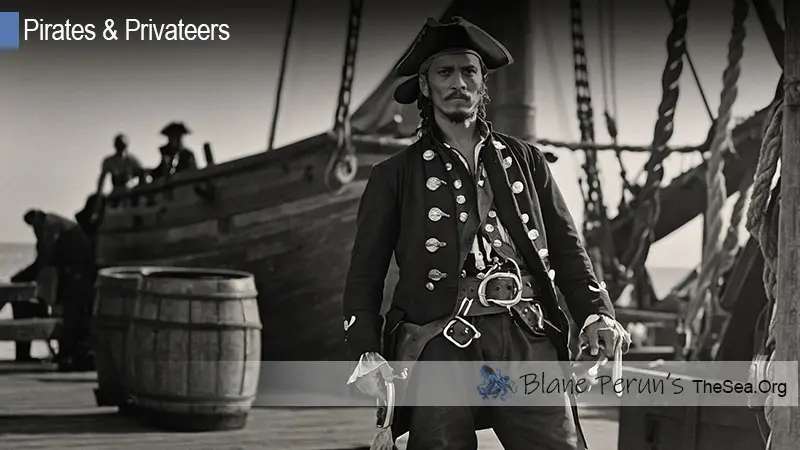
The Man Who Created the Most Famous Symbol in Pirate History
Every child knows the skull and crossbones. It flies on Halloween decorations, poison bottles, and pirate costumes worldwide. But few people know the name of the man who first flew it — Emanuel Wynn, a French pirate who raised the original Jolly Roger in 1700 and changed maritime history forever.
Before Wynn, pirates flew no standardized flag. After him, the skull and crossbones became the universal symbol of piracy, fear, and rebellion on the high seas.
Who Was Emanuel Wynn?
Emanuel Wynn was a French buccaneer operating in the Atlantic and Caribbean during the late 17th and early 18th centuries. Historical records about his early life are sparse — as was typical for pirates of the era, he left few paper trails outside of the incidents that brought him to official attention.
What is documented is that Wynn was an active and capable pirate captain who commanded his own vessel and crew during the period just before the Golden Age of Piracy (1715–1726). He operated in an era of transition, when the old buccaneering culture of the Caribbean was giving way to the more organized piracy that would define the early 18th century.
The First Jolly Roger: 1700
The earliest documented account of a skull-and-crossbones pirate flag comes from a 1700 encounter between Wynn’s vessel and a British Royal Navy ship commanded by Captain John Cranby of HMS Poole. Cranby’s log records that Wynn flew “a black flag with a skull and crossed bones” — the first written description of what would become the Jolly Roger.
The exact design Wynn flew differed slightly from the classic version most people know today. Historical accounts suggest his flag included an hourglass below the skull and crossbones — a symbol meant to tell targeted ships that their time was running out. This addition made the message even more explicit: surrender now, or die.
What Did the Flag Mean?
Before the Jolly Roger, pirates used various flags — often red flags (called jolie rouge in French, meaning “pretty red”), which signaled no quarter would be given. A black flag with a skull introduced a new psychological tactic: the skull was universally understood as a symbol of death, and displaying it gave pirates a powerful tool of intimidation.
The logic was simple: if a merchant ship surrendered immediately upon seeing the flag, no one needed to die. The skull-and-crossbones was less a declaration of violence and more a brutal negotiation tactic. Many ships surrendered without a shot being fired once the flag was raised.
Wynn’s Place in the Golden Age
Wynn’s introduction of the skull-and-crossbones flag predates the Golden Age of Piracy by 15 years. By the time Blackbeard, Bartholomew Roberts, and Calico Jack were terrorizing the seas in the 1710s and 1720s, the Jolly Roger had become standard. Each famous pirate captain put their own spin on it — Blackbeard added a skeleton with a spear, Roberts created elaborate designs — but all of them were building on the template Wynn established.
In that sense, every pirate flag ever flown traces its lineage back to Emanuel Wynn’s black banner off the coast of West Africa in 1700.
What Happened to Emanuel Wynn?
Like many pirates of his era, Wynn’s ultimate fate is unknown. After the 1700 encounter with Captain Cranby — in which Wynn apparently escaped — he disappears from the historical record. He was never captured or tried, at least not in any surviving official documentation.
Whether he retired, died at sea, or simply continued his career below the radar of colonial authorities is a mystery that historians have not been able to resolve. His legacy, however, is entirely secure — immortalized in every skull-and-crossbones flag ever raised.
Frequently Asked Questions
Did Emanuel Wynn really invent the Jolly Roger?
He flew the earliest documented skull-and-crossbones pirate flag in 1700, according to Captain John Cranby’s naval log. Whether he “invented” it or simply popularized a design already in informal use is debated, but his is the first recorded instance.
What did Emanuel Wynn’s flag look like?
Black background with a skull and crossed bones, and reportedly an hourglass below the skull — symbolizing that the target’s time was running out.
Why is the Jolly Roger called the Jolly Roger?
The origin of the name is disputed. Leading theories include a corruption of the French jolie rouge (pretty red), a reference to the devil figure “Old Roger,” or simply a common sailor’s nickname that stuck.