What Was Charles Vane’s Most Famous Ship
The Ranger. It was a Caribbean sloop — single-masted, fore-and-aft rigged, shallow draft — that Vane commanded from his escape from Nassau in July 1718 until his crew voted him out in November 1718. In those four months, The Ranger was the vessel from which he conducted his most documented and historically significant operations: the fireship escape from Nassau’s blockade, the raiding campaign along the Carolina coast, the Ocracoke meeting with Blackbeard, and the encounter with the French man-of-war that triggered his deposition. After the mutiny, The Ranger passed to Calico Jack Rackham, who operated it until October 1720 when it was captured off Jamaica.
Charles Vane’s most famous ship is The Ranger, but its fame is not the product of exceptional technical specifications or dramatic combat victories. The Ranger was a standard Caribbean sloop of its era, not meaningfully different from dozens of similar vessels operating in the same waters. Its historical significance comes entirely from the documented events that occurred during its career: what Vane did with it, what happened on it, and what it became after he lost command of it. Each of those events illuminates a specific aspect of the Golden Age of Piracy.
Why The Ranger rather than Vane’s earlier vessels
Before The Ranger, Vane operated other vessels during his Nassau period. The Ranger is the most famous because it was the vessel during the most consequential and most specifically documented period of his career.
Vane’s activities in Nassau before July 1718 are documented in general terms — he was a senior figure in the pirate community there, he operated vessels, he conducted raids — but the specific vessels and specific events of this period are not individually documented with the same precision as the Ranger period. The Ranger enters the historical record at the most dramatic moment of his career, the Nassau escape, and remains central to the narrative through the Carolina campaign, the Ocracoke meeting, and the crew mutiny. Everything before it is background; everything from July 1718 onward happens on or because of it.
The name The Ranger also has a specific documentary provenance: it appears in Johnson’s General History and in colonial records from the period, giving it a confirmed historical identity that earlier vessels Vane may have commanded do not have in the surviving record. The combination of documentary specificity and historical consequence is what makes it his most famous ship.
The fireship escape: The Ranger’s defining moment
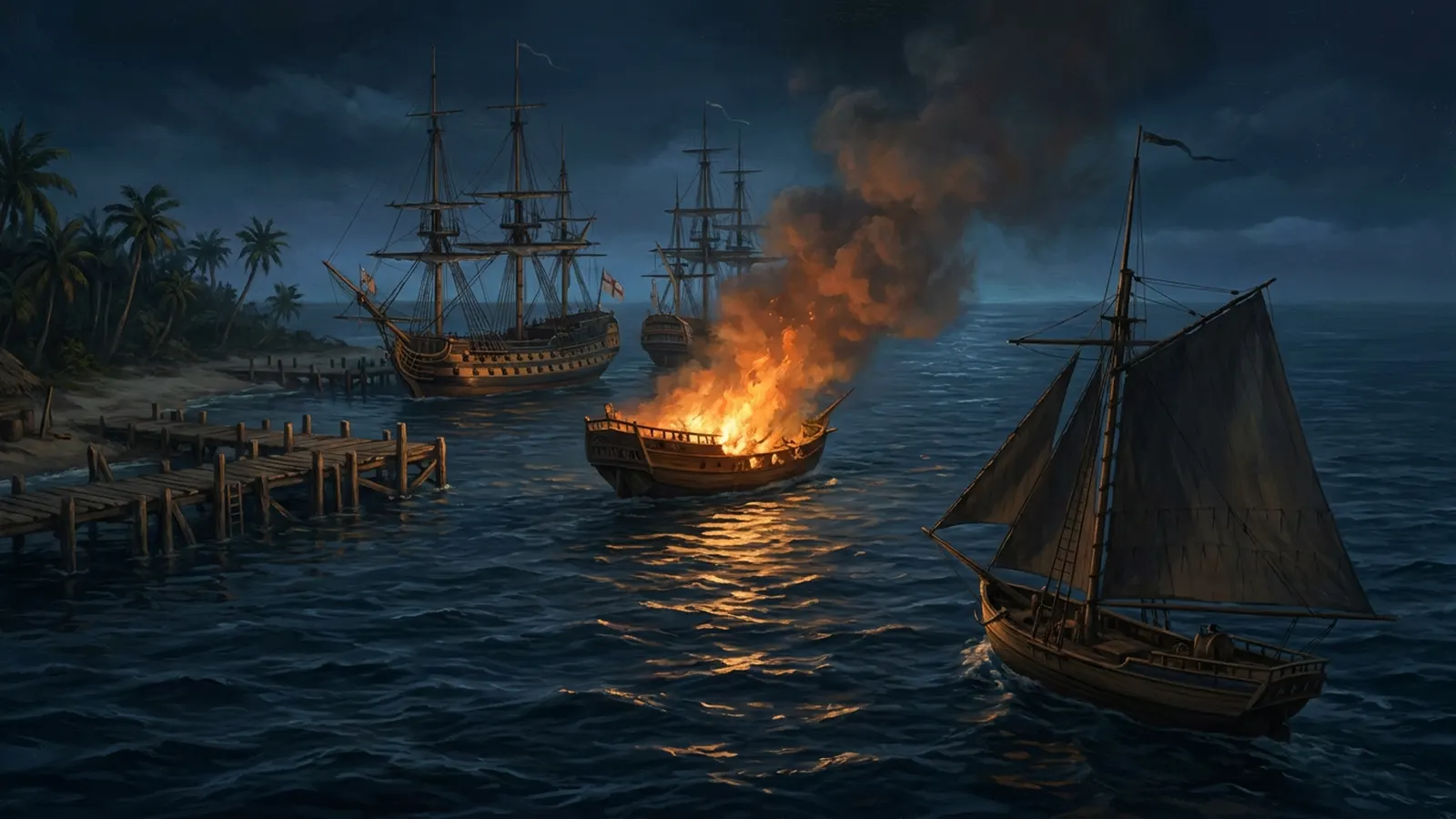
The event that most directly established The Ranger’s place in pirate history was the Nassau escape of July 26, 1718. It is the most tactically sophisticated and most dramatically documented action of Vane’s career, and it was only possible because of The Ranger’s specific characteristics as a sloop.
When Woodes Rogers arrived in Nassau with three Royal Navy warships and the Act of Grace, Vane was in the harbour. He had a captured French prize available. He set the prize ablaze and directed it toward the blockading ships, creating fire-driven chaos in the harbour at night. In the resulting disruption, The Ranger slipped through a gap in the blockade that the fireship’s chaos had created. Rogers posted an immediate reward for his capture. Vane headed for open water.
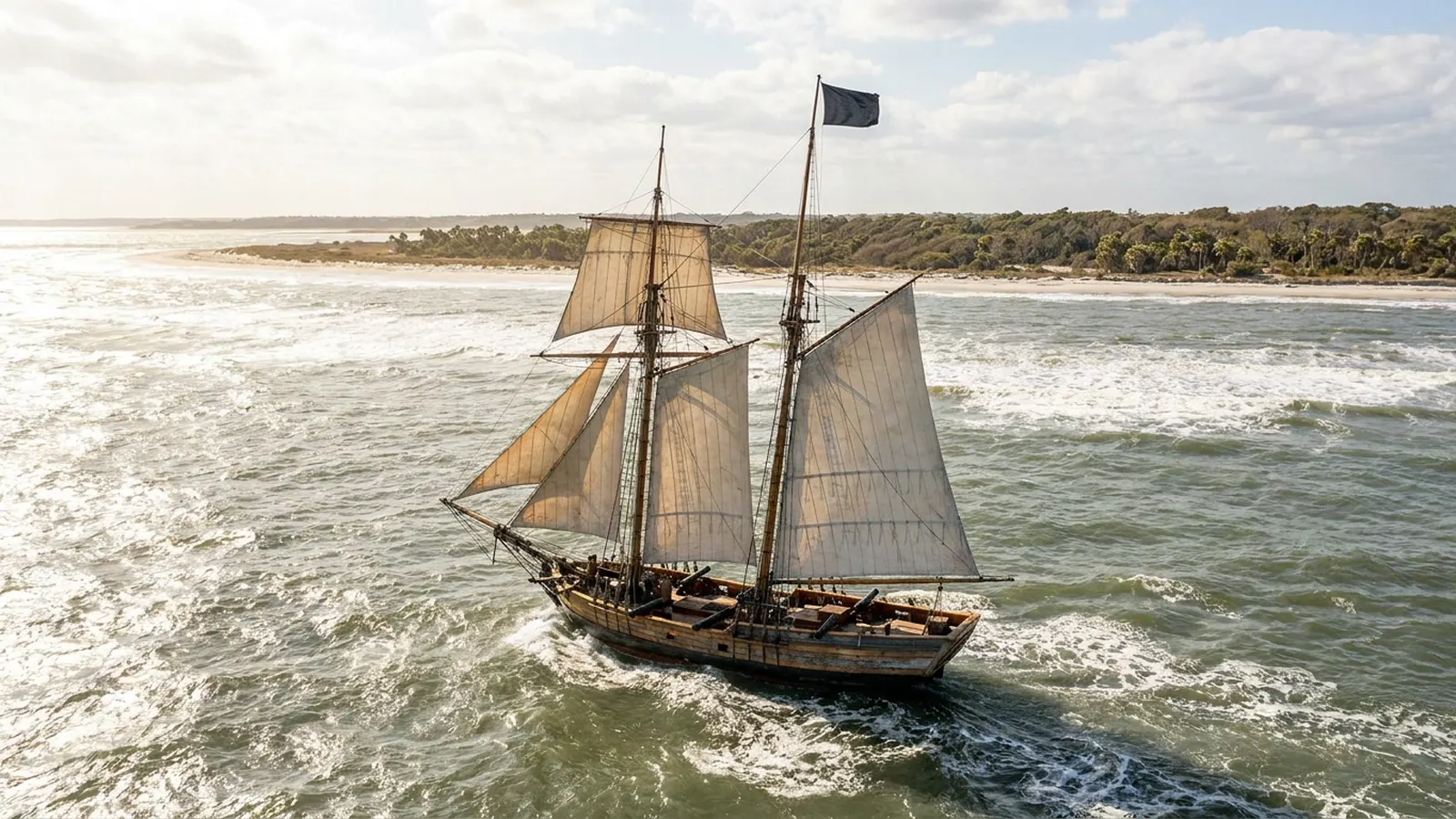
The sloop’s shallow draft and speed under fore-and-aft rigging made this escape possible. A larger, square-rigged vessel could not have manoeuvred through the gap with the same agility. A vessel with deeper draft could not have used the same coastal geography for subsequent evasion. The Ranger’s type was integral to the tactic’s success, not incidental to it.
The Ranger’s operational range: Carolina coast and Caribbean
After escaping Nassau, Vane used The Ranger to conduct a sustained raiding campaign across a substantial geographic range. The vessel’s shallow draft and operational flexibility made this possible without a fixed base.
Vane’s documented operations from July to November 1718 took him from Nassau north to the Carolina coast — a major shipping corridor for colonial trade between the American colonies and Britain — and then through the Caribbean. Colonial correspondence from Carolina governors documents pirate activity consistent with Vane’s movements during this period, and some of those reports can be connected to his operations with reasonable confidence.
The Ocracoke meeting of October 1718 is the most specifically located event of this period. Vane brought The Ranger to Ocracoke Island off the North Carolina coast for a multi-day gathering with Blackbeard and their respective crews. Colonial authorities in North Carolina found this alarming enough to accelerate their naval action against Blackbeard, which resulted in Blackbeard’s death in November 1718. The Ranger’s presence at Ocracoke placed it at the last significant gathering of the Nassau pirate world before that world was definitively closed.
The crew mutiny and the loss of The Ranger
Vane’s command of The Ranger ended not with capture or combat but with a democratic vote of his own crew. In November 1718, he encountered a heavily armed French man-of-war and declined to attack. His crew judged this cowardice under the articles they had signed.
The vote was immediate and binding. Calico Jack Rackham was elected captain. Vane was given a small sloop with a handful of loyal men and sent away. The Ranger, the crew, and all shared property remained with the majority. This event — the peaceful transfer of a pirate vessel from one captain to another through democratic process — is one of the clearest documented examples of Golden Age pirate crew governance functioning as designed.
Vane’s loss of The Ranger ended the most consequential period of his career. Without the vessel, without his crew, and without a base, he was reduced to recruiting a new crew on a smaller vessel and operating with significantly reduced capacity. The three years between the loss of The Ranger and his execution in 1721 were characterised by declining operational scale, a hurricane that wrecked his vessel, and eventually the chance recognition that led to his arrest.
Related on TheSea
What was Charles Vane’s most famous ship?
The Ranger, a Caribbean sloop that Vane commanded from July to November 1718. It was the vessel during the most consequential period of his documented career, including the Nassau fireship escape, the Carolina coast campaign, the Ocracoke meeting with Blackbeard, and the crew mutiny that ended his command.
What type of ship was The Ranger?
A Caribbean sloop — single-masted with fore-and-aft rigging and a shallow draft. This vessel type was dominant among Golden Age Caribbean pirates because it combined speed relative to merchant vessels, shallow-water access for coastal operations, and simple enough rigging for the crew sizes available.
What happened to The Ranger after Vane lost command?
It passed to Calico Jack Rackham after the crew vote that removed Vane in November 1718. Rackham operated it for approximately two years, during which Anne Bonny and Mary Read joined the crew. It was captured off Jamaica in October 1720 by privateer Captain Jonathan Barnet. Rackham was executed in November 1720.
Was The Ranger present at the Ocracoke meeting with Blackbeard?
Yes. In October 1718, Vane brought The Ranger to Ocracoke Island off the North Carolina coast for a multi-day gathering with Blackbeard and their crews. Colonial authorities found this alarming enough to accelerate naval action against Blackbeard, resulting in his death the following month.
Why is The Ranger historically significant despite being an ordinary sloop?
Because the documented events of its career — the fireship escape, the Carolina campaign, Ocracoke, the crew mutiny, and its subsequent capture under Rackham — map the arc of the Nassau pirate world’s final years with unusual documentary precision. The vessel was unremarkable; the events that occurred on and around it were not.
Blane Perun has been exploring Earth’s oceans and marine life for over 25 years. Founder of TheSea.Org in 1999, underwater photographer, coral aquaculture pioneer, and explorer of 80+ countries.
About Blane Perun →