How Do Sea Urchins Taste? — What Shapes the Flavor of Uni, From Kelp Bed to Sushi Counter
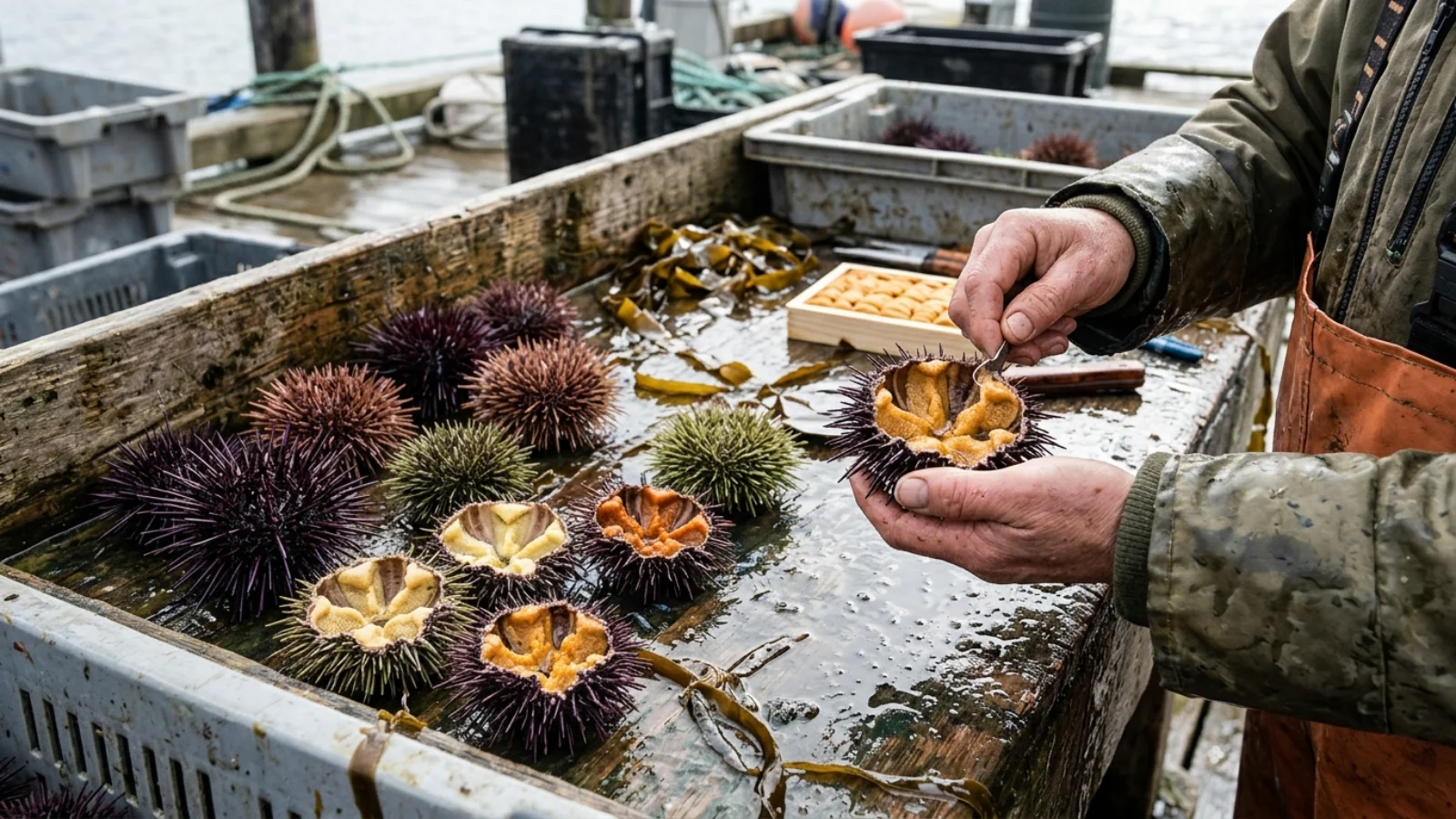
Sea urchin tastes sweet, briny and rich, with a buttery, custard-like texture. But the flavour is not fixed: it is set by species, what the urchin ate, the season (how close it was to spawning), how fast it was processed and whether it was packed with alum or in salt water. That is why Japan grades uni carefully and why prices vary several-fold.
That page describes the flavour itself. This one explains the five factors that make one uni taste better than another, and how buyers judge it. Start with what do sea urchins taste like? if you have never tried it.
How does diet change the taste of sea urchin?
More than anything else. A well-fed urchin on kelp makes sweet, plump roe; a starving urchin makes thin, bitter roe or none.
Sea urchins store energy in their gonads. When kelp and other algae are plentiful, the gonads swell with nutrients and free amino acids, including the sweet-tasting glycine and alanine. In urchin barrens, where grazing has stripped the kelp, urchins survive on scraps and their gonads shrink. Feeding trials in Japan have shown that diet changes the amino acid make-up of gonads directly: adding alanine to the feed of Mesocentrotus nudus raised the alanine content of its roe. This is why “urchin ranching” (collecting barren urchins and fattening them on kelp or prepared feed) can turn a pest into premium uni. See sea urchins eating kelp.
Does the season affect uni flavour?
Yes. Gonads are fullest and sweetest in the months before spawning, and can turn runny or strong once spawning begins.
In Maine, for example, green urchins usually spawn around April, and the commercial harvest is best from November to March, before the roe develops into ripe eggs and sperm. Most fisheries are timed this way. Out of season, gonads can be small, soft or sharp tasting.
| Factor | Better flavour | Worse flavour |
|---|---|---|
| Diet | Kelp-rich forest | Barren, starved |
| Season | Pre-spawning | Spawning and just after |
| Freshness | Opened within hours | Several days old |
| Packing | Salt water (ensui) or none | Heavy alum |
| Colour | Bright, even yellow-orange | Dull, blotchy, brown |
How is uni graded?
By colour, shape, firmness and how intact the lobes are, with yield setting the value of the catch.
Japanese buyers rank uni first on colour. For many species a light, bright yellow ranks highest, and a deep, even orange is prized in bafun uni. Buyers want lobes that are firm, unbroken and of similar size, with no weeping. At the dock, yield matters: Maine’s fisheries managers note that a roe-to-body-weight ratio of about 10% is the commercial minimum and 10–20% is best.
Do different species taste different?
Yes. Each species has its own size, colour and balance of sweetness and brine.
Hokkaido’s bafun uni (Strongylocentrotus intermedius) is small, deep orange and intensely sweet. Murasaki uni (Mesocentrotus nudus) is paler and cleaner. California red urchin (Mesocentrotus franciscanus) gives large, creamy golden lobes. Mediterranean Paracentrotus lividus is small and strongly marine. Which species are worth eating at all is covered in are all sea urchins edible?
How do sea urchins themselves taste things?
Not with a tongue. Urchins sense dissolved chemicals in the water with their tube feet and other surface tissues.
Sea urchins have no head, nose or tongue. They detect food chemically: urchins move toward the scent of kelp and other algae, and their many tube feet and outer tissues carry chemosensory cells. This “tasting” through the skin lets an urchin find drift kelp across the bottom and choose between foods. It is the same ability that makes urchins swarm onto kelp when it becomes available. More on how they find and handle food is in how do urchins consume their food?
How should you taste uni to judge it?
Plain, cool (not ice-cold) and on its own first.
Taste a lobe with nothing on it, or just a pinch of salt, before reaching for soy sauce. Let it warm a minute out of the fridge. Note the sweetness up front, the salinity, the texture and the finish: good uni ends clean, bad uni leaves a bitter or metallic aftertaste.
How do sea urchins taste?
Sweet, briny and buttery, with a soft custard texture. The exact flavour depends on species, diet, season and freshness.
Why does uni from different places taste different?
Different species, water temperatures and diets. Kelp-fed cold-water urchins usually give the sweetest roe.
What is the best season for sea urchin?
The months before spawning. In Maine that is roughly November to March.
What colour uni is best?
Bright, even yellow to orange, depending on species. Dull or blotchy roe is lower grade.
Does alum change the taste of uni?
It can. Alum firms the lobes but heavy use leaves a bitter, astringent edge.
Can sea urchins taste food?
They sense dissolved chemicals through their tube feet and skin, which lets them locate and choose food, but they have no tongue.
What is ensui uni?
Uni packed in sterilised salt water instead of on alum-treated trays, prized for a cleaner, sweeter taste.
- Takagi, S. et al. (2020). Diet and gonad amino acids in Mesocentrotus nudus. Frontiers in Marine Science 7: 593.
- Maine Department of Marine Resources. Green sea urchin spawning, harvest season and roe yield standards.
- UC Davis (2019). Northern California kelp collapse and urchin barrens.
Blane Perun has been exploring Earth’s oceans and marine life for over 25 years. Founder of TheSea.Org in 1999, underwater photographer, coral aquaculture pioneer, and explorer of 80+ countries.
About Blane Perun →