Yellow Sea Cucumber — The Knobbly Little Plankton Catcher of Indo-Pacific Reefs
The yellow sea cucumber (Colochirus robustus) is a small sea cucumber of the tropical Indo-Pacific, about 6–7 cm (2.4–2.8 in) long, with a bright yellow, angular body studded with thick, finger-like knobs. It lives on reefs and rocky bottoms down to about 25 m and feeds on plankton by spreading a crown of branched tentacles into the current.
It is sometimes called the robust sea cucumber, after its scientific name. Its compact size, colour and armoured look make it a favourite of macro photographers in the Philippines and Indonesia, and it turns up regularly in the aquarium trade. It has also attracted chemists, who have isolated several new toxins from its tissues, and biologists interested in its unusual ability to split in two and regrow the missing half.
What does the yellow sea cucumber look like?
A short, angular, bright yellow cucumber with five ridges carrying thorn-like knobs, a ring of feathery tentacles at the front and rows of tube feet underneath.
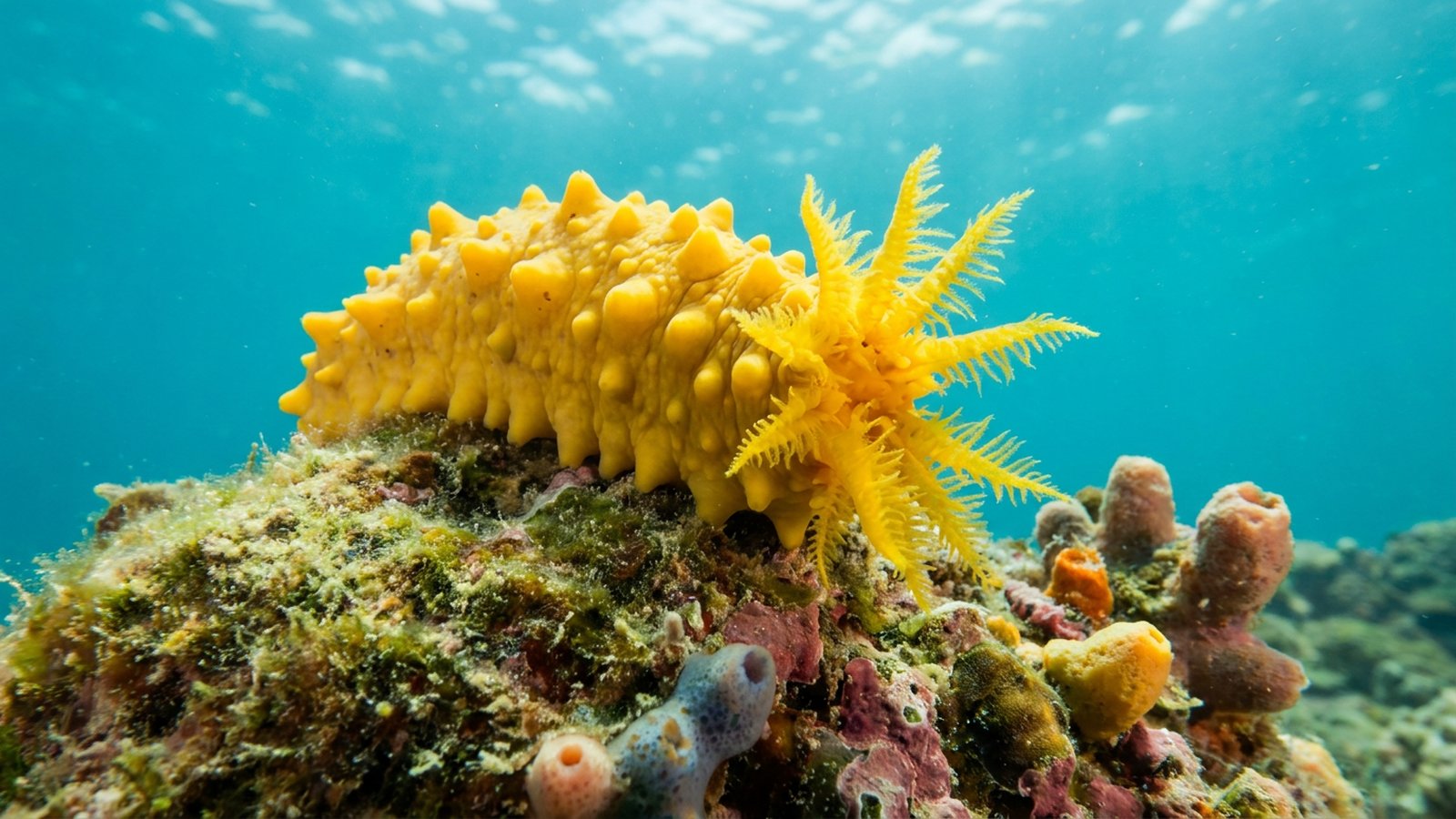
Most sea cucumbers are soft and sausage-shaped. Colochirus robustus looks more like a small armoured box. The body is roughly cylindrical but has five shallow longitudinal ribs, which give it an angular, almost square cross-section. The ribs carry thick, blunt, finger-like or thorn-like protuberances, so the animal looks knobbly or spiky even though the knobs are soft to the touch. There is often a slight constriction near the rounded rear end.
The colour is a vivid lemon yellow, sometimes deepening to orange, and sometimes with grey between the ridges. The underside carries three rows of tube feet that grip rock, rubble or sponge. At the front is a ring of branched, feathery feeding tentacles. Accounts describe about eight large tentacles; members of its family usually have ten, of which the two lowest are often much smaller, so only eight are obvious in the field. When disturbed, the animal can pull its tentacles and the front of its body inside, a trait shared by its whole order.
Like all sea cucumbers, it has no hard shell. Its skeleton is reduced to microscopic calcareous ossicles embedded in the skin, plus a ring of larger plates around the throat that anchors the muscles of the mouth and tentacles. The shapes of the ossicles differ between species and are one of the main tools taxonomists use to identify sea cucumbers under the microscope.
How do you tell it from similar animals?
Its small size, yellow colour and ridged, knobbly body are distinctive, but it can be confused with relatives in the same genus and family, and with unrelated “Yellow Sea” cucumbers.
The closest look-alikes are other species of Colochirus. C. quadrangularis, for example, has the same angular, knobbly build, but its colours differ, often red, orange or pale with contrasting papillae. Sea apples of the genus Pseudocolochirus, in the same family, are much larger, plumper and smoother, typically purple or red with yellow tube feet and a large, colourful crown of tentacles. Some small cucumbers in other families are yellow too, but they lack the ridged, thorny body.
The name can also cause confusion in searches. The sea cucumber farmed in large numbers around the Yellow Sea and Bohai Sea of northern China is Apostichopus japonicus, the Japanese or prickly sea cucumber, a large deposit feeder that is unrelated to the little reef-dwelling yellow sea cucumber.
| Feature | Yellow sea cucumber | Sea apple | Black sea cucumber |
|---|---|---|---|
| Scientific name | Colochirus robustus | Pseudocolochirus spp. | Holothuria atra |
| Order | Dendrochirotida | Dendrochirotida | Holothuriida |
| Typical size | About 6–7 cm | Much larger, rounded | Tens of centimetres |
| Body | Angular, five ribs with thorn-like knobs, yellow | Smooth, plump, purple/red with yellow feet | Soft, black, often sand-coated |
| Feeding | Catches plankton with branched tentacles | Catches plankton with branched tentacles | Swallows sand and sediment |
| Aquarium risk | Moderate | High | Moderate |
How is the yellow sea cucumber classified?
The species was described by the Swedish zoologist Hjalmar Östergren in 1898. Several later names, Colochirus luteus and C. squamatus, both named by Sluiter in 1901, and C. robustoides, named by Ekman in 1918, are now treated as synonyms. The World Register of Marine Species accepts Colochirus robustus Östergren, 1898, in the family Cucumariidae, a group of small to medium sea cucumbers characterised by ten branched tentacles.
The Cucumariidae belong to the order Dendrochirotida, from Greek words meaning “tree hands”, a reference to the branched tentacles. Dendrochirotids are suspension feeders. They share a muscular front section called the introvert, which can be pulled into the body together with the tentacles, and a ring of ten calcareous plates around the pharynx. Molecular studies place the order in a large group called Neoholothuriida, whose members have two gonads, along with burrowing sea cucumbers and several deep-sea orders. In 2020 Chinese researchers published the complete mitochondrial genome of C. robustus, adding it to the DNA data used to work out sea cucumber relationships.
Where does the yellow sea cucumber live?
On reefs and rocky bottoms of the central Indo-Pacific, especially the Philippines and Indonesia, from shallow water to about 25 m.
Records come mainly from the Coral Triangle, including the Philippines and Indonesia, and from the South China Sea, where Russian and Vietnamese researchers have studied it in Nha Trang Bay, Vietnam. Some guides describe its range more broadly as the Indo-West Pacific. Depth ranges given in field guides run from about 3 m to about 25 m (10–80 ft).
The species favours places with moderate to strong water movement: reef slopes, rubble fields, rocky outcrops and the tops of sponges or boulders that stick up into the current. It is often seen in small groups, several animals perched close together on the same rock. That clustering probably reflects good feeding spots more than social behaviour, since each animal needs a steady flow of water to bring plankton to its tentacles. Dive sites in Anilao in the Philippines and around Bali and Komodo in Indonesia are among the places where it is regularly photographed.
What does a yellow sea cucumber eat?
Plankton and fine organic particles, caught on sticky, branched tentacles held up in the current.
Most sea cucumbers that divers see are deposit feeders. Species such as the black sea cucumber crawl over the sand, shovel sediment into their mouths with short, mop-like tentacles and digest the bacteria, microalgae and organic matter it contains. The yellow sea cucumber feeds in a completely different way. It anchors itself with its tube feet, raises the front of its body and spreads its feathery tentacles into the passing water. Zooplankton, phytoplankton and organic particles stick to the mucus-covered branches.
Every so often the animal pushes one tentacle at a time into its mouth and pulls it out again, wiping off the trapped food, then spreads it once more. Watching a feeding colony is a little like watching a set of slow-motion fans: each tentacle swings in turn, while the others stay out fishing. When food is scarce, or when a fish nips at it, the animal withdraws its tentacles and closes up into a small, tight yellow lump.
Suspension feeding ties the species to water movement. In still water a dendrochirotid cucumber catches very little. That is why it sits on high points in the current, and why, in aquariums, it often starves even when other animals do well.
How does it breathe and move?
Sea cucumbers breathe in an unusual way. Inside the rear end of the body is a pair of branched tubes called respiratory trees. The animal draws water in through its anus, pumps it into the trees, where oxygen passes into the body fluid, and then expels it again. The respiratory trees also help remove waste. Tube feet on the underside, operated by the water vascular system that all echinoderms share, let the yellow sea cucumber creep slowly across the bottom. It rarely moves far once it finds a good spot, but it will shift position if the current changes or conditions become poor.
How does the yellow sea cucumber reproduce?
Sexually by spawning, like most sea cucumbers, and, under stress at least, asexually by splitting in two.
Little has been published on the spawning season or larvae of this particular species. Most sea cucumbers release eggs and sperm into the water for external fertilisation, and the embryos develop into small, free-swimming larvae that drift in the plankton before settling and changing into miniature adults. Some dendrochirotids have short-lived larvae that do not feed, and a few species brood their young, so the details vary even within the family.
The more unusual finding concerns asexual reproduction. Russian researchers led by Igor Dolmatov studied sea cucumbers in Nha Trang Bay, Vietnam, and reported in 2012 and 2014 on asexual reproduction, self-amputation and regeneration in several species. According to summaries of that work, C. robustus divided by fission when kept in a tank under poor conditions, although no evidence of fission was found in wild populations. In fission, a crack appears around the middle of the body and slowly widens until the two halves separate. The rear half then grows a new mouth and tentacles, and the front half a new anus.
The same work found that when the animal was cut in two, both halves could survive and regenerate, which is not the case for most dendrochirotids, where usually only the front end survives. Evisceration, the dramatic expulsion of internal organs that many sea cucumbers use to escape predators, could not be triggered in C. robustus by injecting potassium chloride, a standard laboratory method, but was seen in animals kept in poor conditions. Both fission and evisceration in this species seem to be responses to stress.
Is the yellow sea cucumber toxic?
Yes. Like most sea cucumbers it contains triterpene glycosides, soap-like toxins that damage cell membranes. It is generally considered less risky in an aquarium than a sea apple, but it should still be treated with care.
Sea cucumbers are protected by chemicals often called saponins or holothurins. They are triterpene glycosides: a steroid-like core attached to a chain of sugars. These compounds act like detergents on cell membranes. They taste bad to predators, and in high concentrations they can kill fish by damaging their gills. Most fish leave sea cucumbers alone for this reason.
In 2015 and 2016 a team led by Alexandra Silchenko at the Pacific Institute of Bioorganic Chemistry in Vladivostok published two papers on the glycosides of C. robustus. They described eight new compounds, which they named colochirosides A1, A2, A3, B1, B2, B3, C and D, along with six glycosides already known from other dendrochirotid sea cucumbers. All were sulfated holostane glycosides with four-sugar chains, and colochiroside D had a type of sugar chain not seen before. When tested, most of the compounds were more strongly haemolytic, destroying red blood cells, than cytotoxic to cancer cells, and several had strong effects.
For aquarists the practical message is clear. A healthy yellow sea cucumber is unlikely to cause trouble, but a dying, damaged or badly stressed animal can release these toxins into the water. Sea apples, which are larger and contain more toxin, have a much worse reputation, and their relatives in the family are known to release toxins when damaged or even during spawning.
Do people eat the yellow sea cucumber?
Large sea cucumbers such as sandfish and prickly redfish are dried and sold as bêche-de-mer or trepang, and some species are heavily overfished. The yellow sea cucumber is far too small to be important in that trade. A 2017 study by Chinese researchers nonetheless described C. robustus as used in East and Southeast Asia as food and for medicinal purposes, and tested peptides prepared from it in mice. Mice given the peptides for eight weeks showed increased lymphocyte proliferation and natural killer cell activity. Results in mice do not show that eating this sea cucumber benefits people, and wild collection of a small, slow-growing reef animal for supplements would be hard to justify.
Can you keep a yellow sea cucumber in a reef tank?
Yes, but it is best left to experienced reefkeepers, because it needs steady feeding and its toxins are a risk if it dies.
The biggest problem is starvation. A clean, nutrient-poor reef tank contains very little plankton, and a suspension feeder that cannot catch enough food shrinks slowly over weeks or months before it dies. Target feeding with phytoplankton, rotifers, copepods or other fine particulate foods, several times a week, gives it a better chance. It needs moderate, steady flow to bring food to its tentacles, and rock or rubble to cling to.
Keep it well away from pump and powerhead intakes, which can suck in and injure a small cucumber and cause it to release toxins. Avoid tankmates that nip at tentacles, such as some angelfish, butterflyfish, puffers and crabs. Activated carbon in the filter helps remove toxins if something goes wrong, and a dead or dying cucumber should be removed at once. In return, the yellow sea cucumber is peaceful, harmless to corals and fascinating to watch when its tentacles are out. Because it can split in two under stress, finding two smaller animals where there was one is not necessarily good news: it may be a sign that conditions are poor.
How to find and photograph it on a dive
Look on raised rocks, sponges and rubble mounds on slopes with a gentle to moderate current, especially at macro sites in the Philippines and Indonesia. Its bright colour makes it easy to spot once you know its size: think of a thumb-sized yellow box rather than a typical sea cucumber. Approach slowly and keep your fins off the bottom. If you move too fast or bump the rock, it will pull in its tentacles, and you may have to wait several minutes for them to come back out. The best images show the full crown of tentacles spread against a dark background, with the knobbly ridges of the body in sharp focus.
How big does a yellow sea cucumber get?
About 6–7 cm (2.4–2.8 in) long.
What does a yellow sea cucumber eat?
Plankton and fine organic particles caught on its sticky, branched tentacles.
Is the yellow sea cucumber reef safe?
It is harmless to corals, but like all sea cucumbers it contains toxins that can be released if it dies or is badly stressed.
Is the yellow sea cucumber the same as a sea apple?
No. Both are filter-feeding cucumariids, but the sea apple is larger, smoother and more toxic.
Where does the yellow sea cucumber live?
On reefs and rocky bottoms of the central Indo-Pacific, especially the Philippines and Indonesia, down to about 25 m.
Why is my yellow sea cucumber shrinking?
Most often starvation. It needs regular feeding with phytoplankton or other fine foods and steady flow.
Can the yellow sea cucumber split in two?
Yes. It has been seen dividing by fission in aquariums under poor conditions, and both halves can regenerate.
Does it shoot sticky threads?
No. Sticky Cuvierian tubules are found in some Holothuria and Bohadschia species, not in Colochirus.
- WoRMS (2026). Colochirus robustus Östergren, 1898. World Register of Marine Species.
- Silchenko, A.S. et al. (2015). Colochirosides B1, B2, B3 and C, novel sulfated triterpene glycosides from the sea cucumber Colochirus robustus. Natural Product Communications 10.
- Silchenko, A.S. et al. (2016). Colochirosides A1, A2, A3 and D, four novel sulfated triterpene glycosides from the sea cucumber Colochirus robustus. Natural Product Communications 11.
- Dolmatov, I.Yu. et al. (2012). Asexual reproduction, evisceration, and regeneration in holothurians from Nha Trang Bay of the South China Sea. Russian Journal of Marine Biology 38.
- Dolmatov, I.Yu. (2014). New data on asexual reproduction, autotomy, and regeneration in holothurians of the order Dendrochirotida. Russian Journal of Marine Biology 40.
- Yang et al. (2020). The complete mitochondrial genome of the sea cucumber Colochirus robustus. Mitochondrial DNA Part B 5.
- Du, X. et al. (2017). Peptides from Colochirus robustus enhance immune function in C57BL/6 mice. International Journal of Molecular Sciences 18: 2110.
- Wikipedia: Colochirus robustus, Cucumariidae, Dendrochirotida and Holothurian (morphology, distribution, anatomy).
- Florent’s Guide to the Tropical Reefs: Colochirus robustus (size, depth, range).
- LiveAquaria: yellow sea cucumber care notes.
Blane Perun has been exploring Earth’s oceans and marine life for over 25 years. Founder of TheSea.Org in 1999, underwater photographer, coral aquaculture pioneer, and explorer of 80+ countries.
About Blane Perun →