What Do Sea Urchins Taste Like? — Sweet, Briny and Buttery — When It’s Fresh
Fresh sea urchin (uni) tastes sweet, briny and rich, often compared to sea-salted butter, egg yolk or custard, with a texture that melts on the tongue. The sweetness comes from free amino acids such as glycine and alanine; the savoury depth from glutamic acid. Uni that tastes bitter, metallic or fishy is old, came from a starving urchin, or was heavily treated with alum.
For many people, yes, the first time. The texture surprises more than the flavour: soft, creamy and slightly grainy, unlike any fish. People who like oysters, caviar or rich foie gras usually take to it quickly. A poor first sample (old tray uni) puts many people off for good, so try it fresh from a busy sushi bar or straight from the shell.
Fresh sea urchin tastes sweet, salty and rich at the same time. The first impression is clean seawater, then a buttery sweetness that spreads across the tongue and lingers, with a savoury depth underneath. The texture is as distinctive as the flavour: soft, creamy and faintly grainy, closer to custard or a just-set egg yolk than to any fish. Good uni is never fishy. If it tastes bitter, metallic, sour or of ammonia, something went wrong: it is old, it came from a poorly fed urchin, it was close to spawning, or it was heavily treated with preservative.
This page is about flavour and texture: what you should expect on the tongue, the chemistry behind the sweetness and the bitterness, why the same dish can be sublime in one restaurant and unpleasant in another, how cooking changes the taste, and how to judge uni yourself. For which species are eaten and which are not, see are all sea urchins edible?. For how to open and serve one, see can you eat sea urchins?. Market grades and species differences are covered in more detail on how do sea urchins taste?
What does good uni taste like?
Clean, sweet and long. Ocean salt first, then a buttery sweetness, then a savoury, mineral finish.
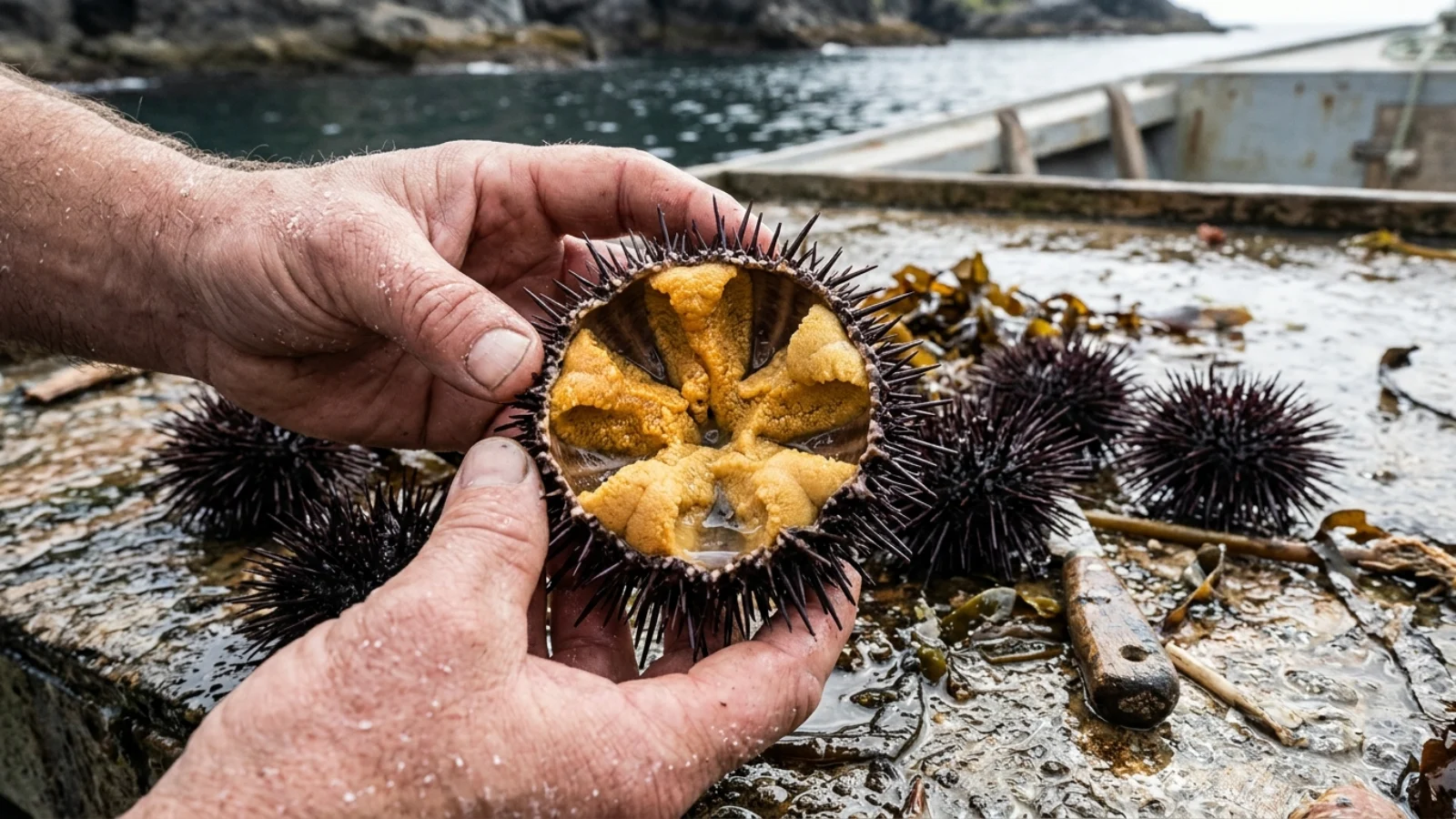
The part of a sea urchin that people eat is the gonad. Each urchin has five of them, arranged like the points of a star inside the round shell, and they are full of nutrients the animal stores for spawning. That stored food is what gives uni its flavour. Both male and female gonads are eaten, and most diners cannot tell them apart.
At its best, uni tastes like the cold water it came from with a spoonful of cream stirred in. Tasters usually describe the flavour in three layers. The opening is briny and fresh, like an oyster or a breath of sea air. The middle is sweet and rich, which is where the comparisons to butter, egg yolk and custard come from. The finish is savoury and mineral, sometimes with an iodine or seaweed note that is stronger in some species than others. The best uni has a long finish: the sweetness hangs around for several seconds after you swallow, without any bitter aftertaste.
Texture is half the experience. Fresh lobes hold their shape when lifted with chopsticks but collapse almost instantly in the mouth. The surface has a fine, slightly pebbled grain, the outlines of the tiny sacs that make up the gonad. When uni goes soft and runny, or when the lobes look smeared and wet, it has lost freshness or was taken from an urchin that was about to spawn.
Temperature changes what you taste. Uni served very cold tastes muted, because cold dulls our perception of sweetness. A few minutes at cool room temperature opens up the sweet and savoury notes. That is one reason sushi chefs handle uni as little as possible and serve it promptly once it leaves the refrigerator.
Why is sea urchin sweet?
Because urchin gonads are packed with free amino acids, and several of them taste sweet or savoury to us.
Uni is unusual among seafood because so much of its taste comes from small dissolved molecules rather than from fat or muscle protein. Japanese food scientists have studied those molecules closely, because the taste of uni sets its price. In 1964 the chemist Komata analysed the extracts of urchin gonads and used omission tests, in which a synthetic version of the extract is rebuilt and then tasted with one compound left out at a time. The compounds whose removal changed the taste were judged “taste-essential”. Komata identified glutamic acid as the source of umami, glycine and alanine as the main sweet compounds, and methionine and valine as bitter compounds that are nevertheless part of the characteristic urchin flavour.
That last point matters. A trace of bitterness is part of what makes uni taste like uni rather than like sweetened butter. Methionine in particular contributes to the distinctive flavour. The problem comes when the balance tips and the bitter amino acids, which also include arginine, histidine, leucine, lysine and phenylalanine, start to dominate.
More recent work has turned this chemistry into a practical recipe for better-tasting uni. Studies by Shigeki Takagi and colleagues on the northern Japanese urchin Mesocentrotus nudus found that the most desirable gonads combine a high alanine content, a strong umami taste and a low arginine content. In a 2020 feeding trial reported in Frontiers in Marine Science, adding alanine to the urchins’ feed raised the alanine in their gonads, showing that sweetness can be steered through diet. The same research group reported that urchins taken from a barren and fed fresh kelp for a few months produced gonads good enough for high-end sushi restaurants.
| Compound | What you sense | What it tells you |
|---|---|---|
| Glycine, alanine | Sweetness | High in well-fed roe; alanine can be raised through diet |
| Glutamic acid | Umami (savoury depth) | Gives the “meaty”, brothy backbone |
| Methionine, valine | Bitterness, but also the “urchin” character | Needed in small amounts; too much tastes harsh |
| Arginine and other bitter amino acids | Bitterness | Lower levels are linked to better-tasting roe |
| Pulcherrimine | Bitterness | Found in ovaries of the Japanese green urchin, not in testes |
| Butyl acetate, benzaldehyde | Fruity, green and sweet aromas | Markers of high-quality, kelp-fed roe |
| Dimethyl sulfide | Putrid, sulfurous smell | Common in roe from starving urchins in barrens |
What does sea urchin smell like?
Fresh uni smells faintly sweet and green, like a clean rock pool. Bad uni smells sulfurous.
Much of what we call flavour is really smell, and uni is no exception. A 2020 study in PLOS ONE by Takagi and colleagues identified 48 volatile compounds in the gonads of M. nudus. The number of odour-active compounds varied sharply with the urchins’ diet: 25 in kelp-fed cultured urchins, 14 in wild urchins from an Eisenia kelp bed, and only 6 in urchins from a barren. The “sea urchin-like” aroma was attributed to compounds such as 2-butanol, 2-ethylhexanol, benzaldehyde and ethylbenzene.
The barren urchins had one prominent smell of their own: dimethyl sulfide, which the testers described as strong and putrid. Feeding kelp reduced that odour and increased pleasant, sweet aromas. A companion study in the journal Sensors concluded that the most marketable gonads had green and fruity aromas from butyl acetate, a sweet aroma from benzaldehyde, a strong umami taste and low bitterness, and no unpleasant sulfurous odour. In practice, this means you can often judge uni with your nose before you taste it. A clean, faintly sweet ocean smell is a good sign. Anything sour, sulfurous or reminiscent of ammonia is not.
Why does some uni taste bitter or metallic?
Age, diet, sex and season, and the preservative used on most tray uni. Any one of them can turn sweet uni bitter.
Age. Once an urchin is opened, its gonads begin to break down within days. The lobes lose their firmness, the surface grain blurs, and sour, metallic or ammonia notes appear. This is the single most common reason people dislike uni the first time they try it. A tray that has spent too long in transit or in a display case can taste nothing like the same product a few days earlier.
Diet. Urchins that graze on kelp and other large seaweeds build plump, bright, sweet gonads. Urchins from barrens, the rocky seafloors stripped of kelp, survive on scraps and produce small, dull, often bitter gonads. The PLOS ONE study above shows the effect in the chemistry: barren urchins had fewer pleasant aroma compounds and more of the putrid-smelling dimethyl sulfide. Diet can also go wrong in the other direction. In a 2025 Norwegian trial on the edible urchin Echinus esculentus and the green urchin Strongylocentrotus droebachiensis, a formulated feed increased gonad size but also raised bitter-tasting free amino acids, and fed E. esculentus developed a stronger off-taste and aftertaste. Another Japanese study found that M. nudus fed the kelp Eisenia bicyclis developed gonads that lacked the typical sea urchin taste. Quantity of food and quality of flavour are not the same thing.
Sex. In the Japanese green urchin Hemicentrotus pulcherrimus, researchers led by Yuko Murata identified a bitter amino acid they named pulcherrimine. It was found in ovaries at a mean of 1.37 mg per 100 g and was not detected in any of the testes examined, and its concentration tracked the bitterness that tasters reported. So in that species, at least, female roe can carry a bitterness that male roe does not. A 2026 metabolomic study of Heliocidaris crassispina also found distinct taste and odour profiles in male and female gonads, though it found no difference in gonad size.
Season. As spawning approaches, the gonads fill with eggs or sperm. They become softer, sometimes runny, and the flavour grows stronger and less sweet. The best eating usually comes in the months before spawning, when the gonads are full of stored nutrients but not yet ripe. In a year-long study of the rock urchin Paracentrotus lividus on the Atlantic coast of Portugal, gonads were firmer, brighter and more reddish-yellow during the growing and early maturation period, and the authors concluded that November to February was the best time to harvest. That population spawned once, between May and July.
Preservative. Most uni sold on wooden trays has been treated with alum, a sulfate salt of aluminium (often aluminium potassium sulfate), sometimes with alcohol, to keep the delicate lobes from collapsing. It works, but only for a limited time, and it leaves its own trace. Some diners notice a faint bitter or astringent edge on alum-treated uni, and as the product ages it can develop a metallic, fishy taste. The alternative is ensui uni, packed in chilled salt water instead, which many people find cleaner and sweeter. Additive-free trays are also increasingly available.
Does sea urchin taste different by species and region?
Yes, noticeably. Species, water temperature and diet all shift the colour, sweetness and finish.
| Type | Typical character |
|---|---|
| Ezo bafun uni, Hokkaido (S. intermedius) | Small, deep orange lobes; intensely sweet and rich |
| Kita murasaki uni, northern Japan (M. nudus) | Paler yellow; lighter, cleaner sweetness |
| California red (M. franciscanus) | Large golden lobes; creamy and mild |
| Maine and Atlantic green (S. droebachiensis) | Smaller lobes; briny, sweet |
| Mediterranean rock urchin (P. lividus) | Small coral-red lobes; strongly marine, iodine notes |
| Chilean (L. albus) | Large lobes; bold, often sold frozen or canned |
Japanese markets broadly sort uni into two families. Uni from species related to the bafun urchins tends to be a darker orange and is sold as aka (red) uni. Uni from species related to the murasaki urchins is paler yellow and sold as shiro (white) uni. Aka uni is generally the sweeter and richer of the two, and it keeps a little longer, which is why it often sells at a premium. Shiro uni is lighter and cleaner, and some chefs prefer it for nigiri. Neither is simply “better”; they suit different palates and dishes.
Outside Japan the contrasts are just as clear. Large red urchins from California and British Columbia give big, golden, mild and creamy lobes. Green urchins from Maine, Atlantic Canada and Norway tend to be smaller and brinier. Chilean uni is bold and is often sold frozen or canned. The Mediterranean rock urchin, eaten raw from the shell in southern France, Italy, Spain and Portugal, has small coral-red lobes with a pronounced marine, iodine flavour that many Europeans prize and many first-time eaters find intense.
Peak seasons differ too. Japanese guides list March to April for bafun uni, July to August for ezo bafun uni, June to September for murasaki uni, and September to November for kita murasaki uni. Imported red urchin peaks from about October to May. Because of these overlapping seasons, Japan can serve good uni year-round, and Japan alone eats most of the world’s catch; estimates of its share range from about 70% to 90% depending on the source and year.
What does sea urchin compare to?
Oyster for the brine, egg yolk for the richness, and custard or butter for the texture.
No single food captures uni, but several get close in one dimension. The brine and mineral finish recall a good oyster. The richness and the way it coats the mouth resemble a soft egg yolk. The texture, smooth with a fine grain, is like a set custard or very soft butter. Among seafood, the coral (roe) of scallops and lobster tomalley are perhaps the closest relatives in flavour, though both are firmer and less sweet.
It helps to know what uni is not like. It is not fishy like salmon roe, it does not pop like caviar, it is not chewy like octopus and it is not firm like a scallop. Caviar is separate salted eggs; uni is the whole gonad, eaten fresh and unsalted in most cases. People who enjoy oysters, foie gras, bone marrow or soft cheeses usually take to uni quickly, because they already like rich, savoury foods with a soft texture. People who dislike oysters often dislike uni for the same reasons.
How does cooking change the taste of uni?
Gentle heat firms the texture and rounds off the brine; high heat destroys what makes it special.
Raw is the default in Japan, where uni is served on nigiri, wrapped in seaweed as gunkan-maki, or piled over rice as uni-don. Raw service shows off both the sweetness and the melting texture. Uni only became a common sushi topping after the Second World War, when the gunkan-maki style and better handling made it practical to serve.
Cooked uni behaves like an enriched butter or egg yolk. Whisked into a warm pasta sauce, scrambled eggs, a risotto or a savoury custard such as chawanmushi, it melts and thickens the sauce while seasoning it with a sweet salinity. Mediterranean cooks use the rock urchin in exactly this way in spaghetti ai ricci and in sauces for fish. Light searing or grilling in the shell firms the lobes and brings out a nutty, toasty note. Prolonged or high heat, however, turns uni grainy and dull and drives off the delicate aromas, so most recipes add it at the end, off the heat.
Salt-cured and fermented uni are different products altogether. Japan has long made shiokara-style salted uni and uni mixed with sake lees, which are much stronger, saltier and more pungent than fresh uni. In Japanese writing, salted uni is even spelled with different characters from fresh uni, though the word is pronounced the same.
Is sea urchin an acquired taste?
For many people, yes, mostly because of the texture and because their first sample was poor.
Ask people who dislike uni why, and the answer is usually texture first and flavour second. A soft, creamy, slightly grainy food from the sea surprises people who expect seafood to be firm. The second common reason is a bad first sample. Old tray uni, heavily treated with alum or kept too long, can taste bitter, metallic and fishy, and one experience like that puts many diners off for good.
The best way to give uni a fair trial is to try it fresh, either from a busy sushi bar with high turnover or straight from a live urchin opened in front of you. Taste a lobe on its own before trying it with rice or soy sauce, which can mask the sweetness. If you can, compare a premium aka uni with a shiro uni, or a salt-water packed tray with an alum-treated one. Most people who try good uni this way understand quickly why it commands such high prices.
How to judge uni before you eat it
Look at colour, shape and surface, then smell it. Your eyes and nose will catch most bad uni.
Colour. Good uni is bright and even: pale yellow, golden or deep orange depending on species, without dark, grey or brownish patches. Colour comes largely from carotenoid pigments; in the Portuguese study of P. lividus, echinenone was the main pigment. Colour by itself does not guarantee sweetness, but dull or blotchy lobes are often a sign of poor diet or age.
Shape. Lobes should be plump, intact and well defined, with a dry-looking, finely grained surface. Lobes that are flattened, torn, weeping liquid or melting into one another are past their best.
Smell. Fresh uni smells clean, faintly sweet and of the sea. Any sour, sulfurous or ammonia smell is a warning sign, and the uni will taste the way it smells.
Source and handling. Uni that has travelled a long way frozen or alum-treated rarely matches uni opened close to where it was caught. Raw uni is a perishable raw seafood, so buy it from a reputable seller, keep it cold and eat it quickly. For more on the safety side of eating it uncooked, see can you eat sea urchins raw?.
What does uni taste like?
Fresh uni is sweet, briny and buttery with a melting, custard-like texture and a savoury, mineral finish. It should not taste fishy.
Does sea urchin taste fishy?
Good uni should not. A fishy, metallic or ammonia taste means the roe is old, came from a poorly fed urchin, or was heavily treated with alum.
Why does my uni taste bitter?
Usually age, alum preservative, roe from a starving urchin or one close to spawning, or in some species bitter compounds such as pulcherrimine in female roe.
Is sea urchin sweet?
Yes. Free amino acids such as glycine and alanine give uni its natural sweetness, while glutamic acid adds savoury depth.
What does sea urchin smell like?
Fresh uni smells clean and faintly sweet, like a rock pool. A sour or sulfurous smell, often from dimethyl sulfide, is a warning sign.
Which uni tastes best?
Hokkaido bafun uni and fresh red urchin from California are among the most prized, but aka and shiro uni suit different tastes.
Is uni like caviar?
Only loosely. Caviar is separate salted eggs that pop; uni is the whole gonad, soft and creamy, and usually unsalted.
Does cooking ruin uni?
Gentle heat is fine and makes it behave like an enriched butter in pasta or eggs. High or prolonged heat makes it grainy and dull.
- Takagi, S. et al. (2020). Effects of glutamic acid, alanine, aspartic acid and glycine supplementation on gonads of Mesocentrotus nudus. Frontiers in Marine Science 7: 593 (reviews Komata 1964 omission tests).
- Komata, Y. (1964). Studies on the extractives of uni (sea urchin gonads). Nippon Suisan Gakkaishi 30: 749–756.
- Takagi, S. et al. (2020). Odor-active compounds from the gonads of Mesocentrotus nudus fed Saccharina japonica kelp. PLOS ONE 15: e0231673.
- Takagi, S. et al. (2020). Quantification of the flavor and taste of gonads from Mesocentrotus nudus using GC-MS and a taste-sensing system. Sensors 20: 7008.
- Murata, Y. et al. (2001). Determination of a novel bitter amino acid, pulcherrimine, in the gonad of the green sea urchin Hemicentrotus pulcherrimus. Fisheries Science 67: 341–345.
- Tsoukalas, D. et al. (2025). Impact of roe enhancement on quality parameters in Echinus esculentus and Strongylocentrotus droebachiensis. npj Science of Food.
- Rocha, F. et al. (2019). Effect of sex, season and gametogenic cycle on gonad quality of Paracentrotus lividus in Portugal. Scientific Reports 9.
- Su, D. et al. (2026). Sex-specific differences in gonad flavor of Heliocidaris crassispina. Foods 15.
- Takagi, S. et al. (2022). Gonad traits in Mesocentrotus nudus fed Eisenia bicyclis: lack of sea urchin-like taste. Algal Research.
- Sushi University. What is uni? Types, seasons and additives.
- Tasting Table. The chemical used to preserve uni and what is replacing it.
Blane Perun has been exploring Earth’s oceans and marine life for over 25 years. Founder of TheSea.Org in 1999, underwater photographer, coral aquaculture pioneer, and explorer of 80+ countries.
About Blane Perun →