Types of Sea Urchins in Hawaii — A Snorkeler’s Field Guide to the Wana and Their Cousins
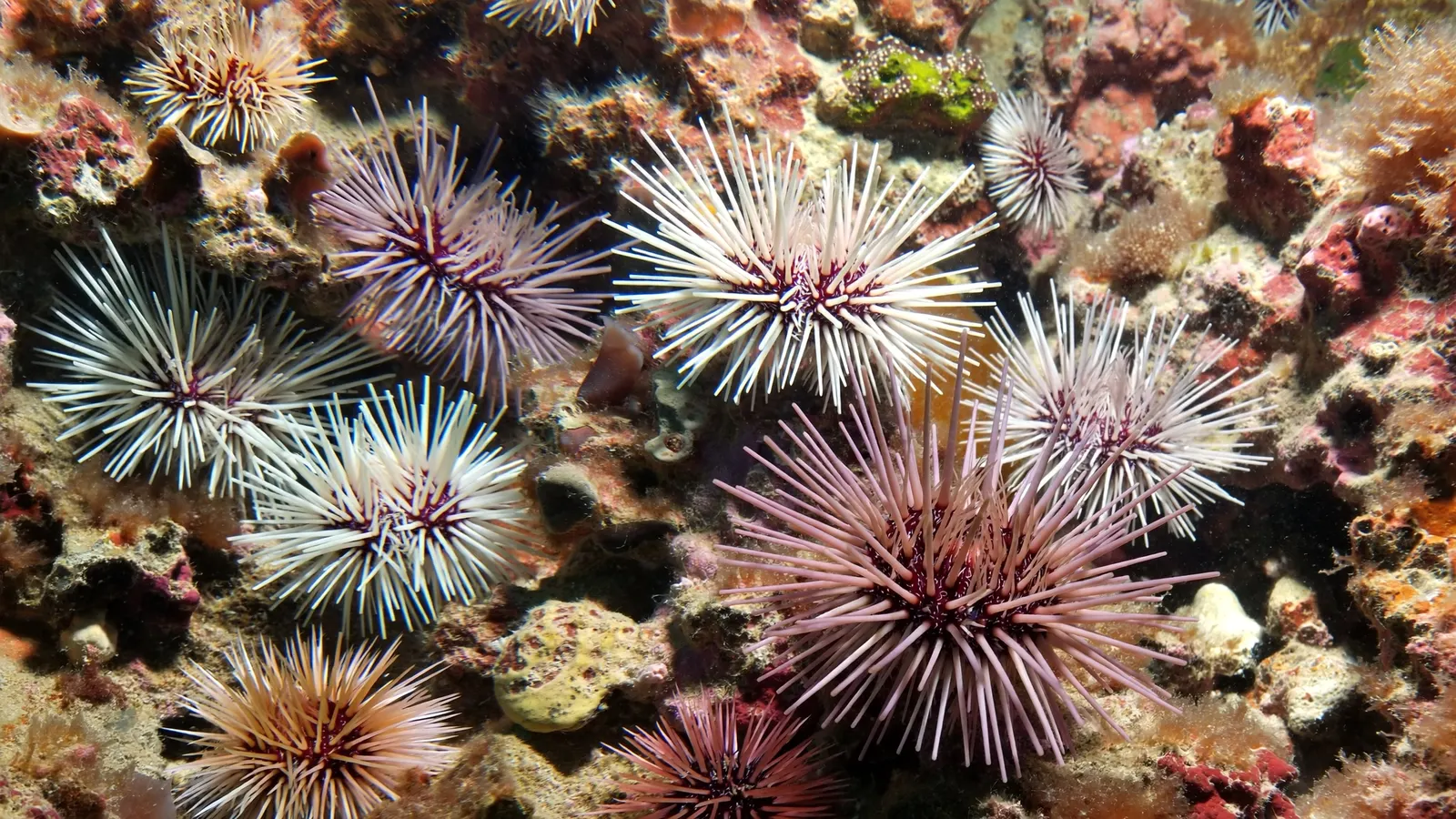
About 75 sea urchin species live in Hawaiian waters, with around 22 common in the shallows. The ones snorkelers meet most are the long-spined wana (Echinothrix and Diadema), the rock-boring urchin (Echinometra mathaei), the collector urchin (Tripneustes gratilla), the red slate pencil urchin (Heterocentrotus mamillatus) and the shingle or helmet urchin (Colobocentrotus atratus). Only the long-spined wana are a real hazard to swimmers.
Wana is the general Hawaiian word, used especially for the long-spined urchins. Other traditional names include ‘ina, hāwae and hā‘uke‘uke (the shingle urchin of wave-washed shores). Urchin gonads were a traditional delicacy. For ecology and conservation, see sea urchins of Hawaii.
Which sea urchins will you see snorkelling in Hawaii?
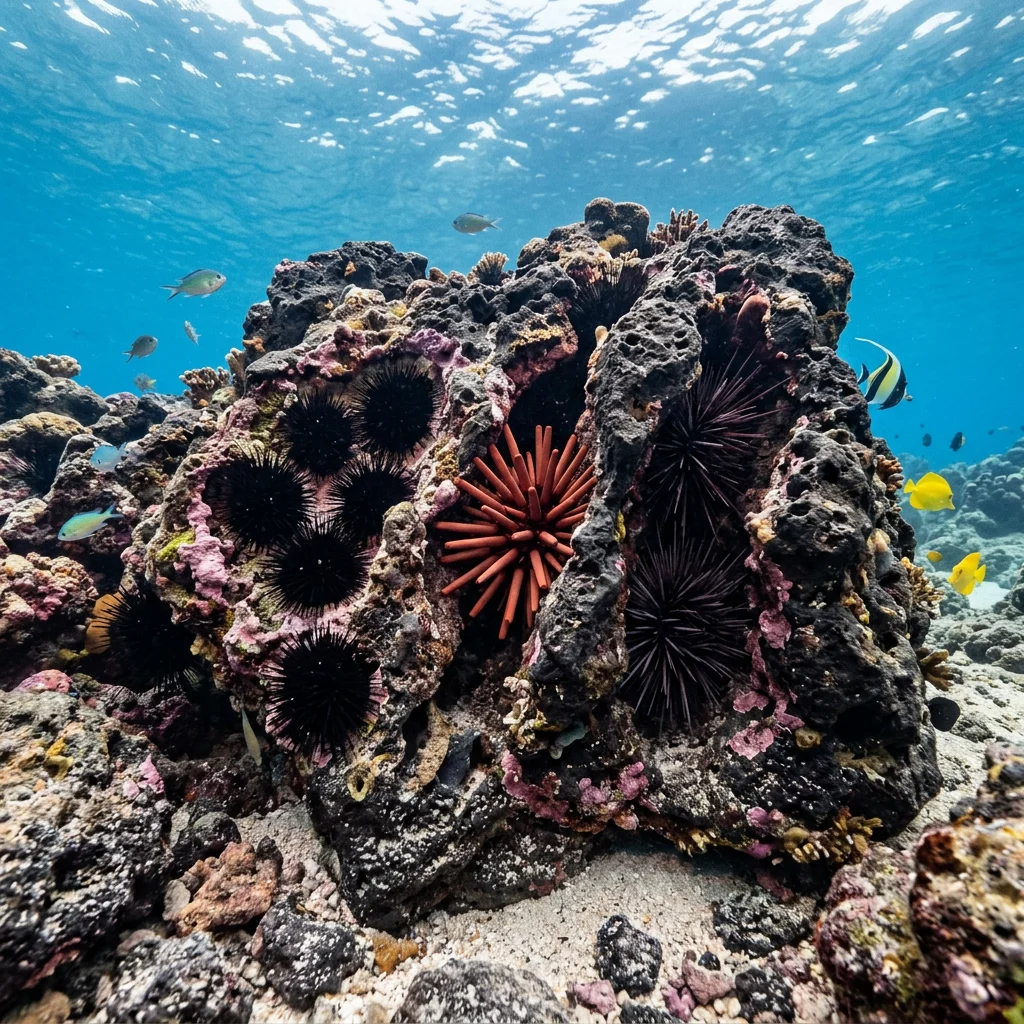
Mostly these six.
| Urchin | Scientific name | How to recognise it | Hazard |
|---|---|---|---|
| Banded / black wana | Echinothrix calamaris | Large; long spines, all black or banded black and white | Painful; brittle spines break off in skin |
| Blue-black wana | Echinothrix diadema | Large; long dark spines with a blue-green sheen | Painful; brittle spines |
| Long-spined wana | Diadema spp. | Very long, thin black spines | Painful; brittle spines |
| Rock-boring urchin | Echinometra mathaei | Small; short spines; pale green to pink; sits in holes | Minor |
| Collector urchin | Tripneustes gratilla | Short spines; purple to black, often with shells and algae on top | Minor |
| Red slate pencil urchin | Heterocentrotus mamillatus | Thick, blunt red-brown spines like crayons | Very low |
| Shingle / helmet urchin (hā‘uke‘uke) | Colobocentrotus atratus | Flat, black, spines reduced to a tiled mosaic; wave-swept rocks | Very low |
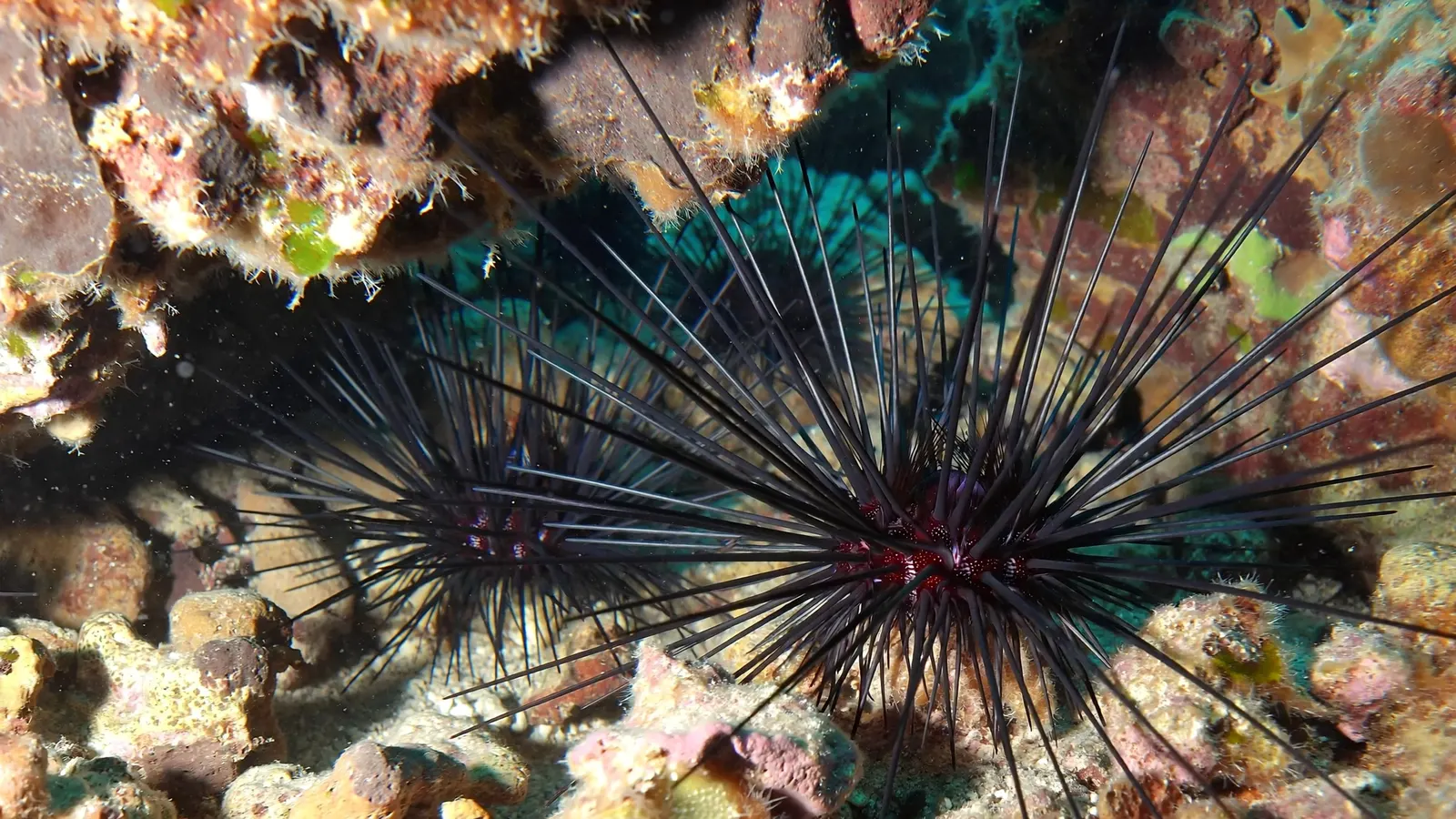
What are the long-spined wana?
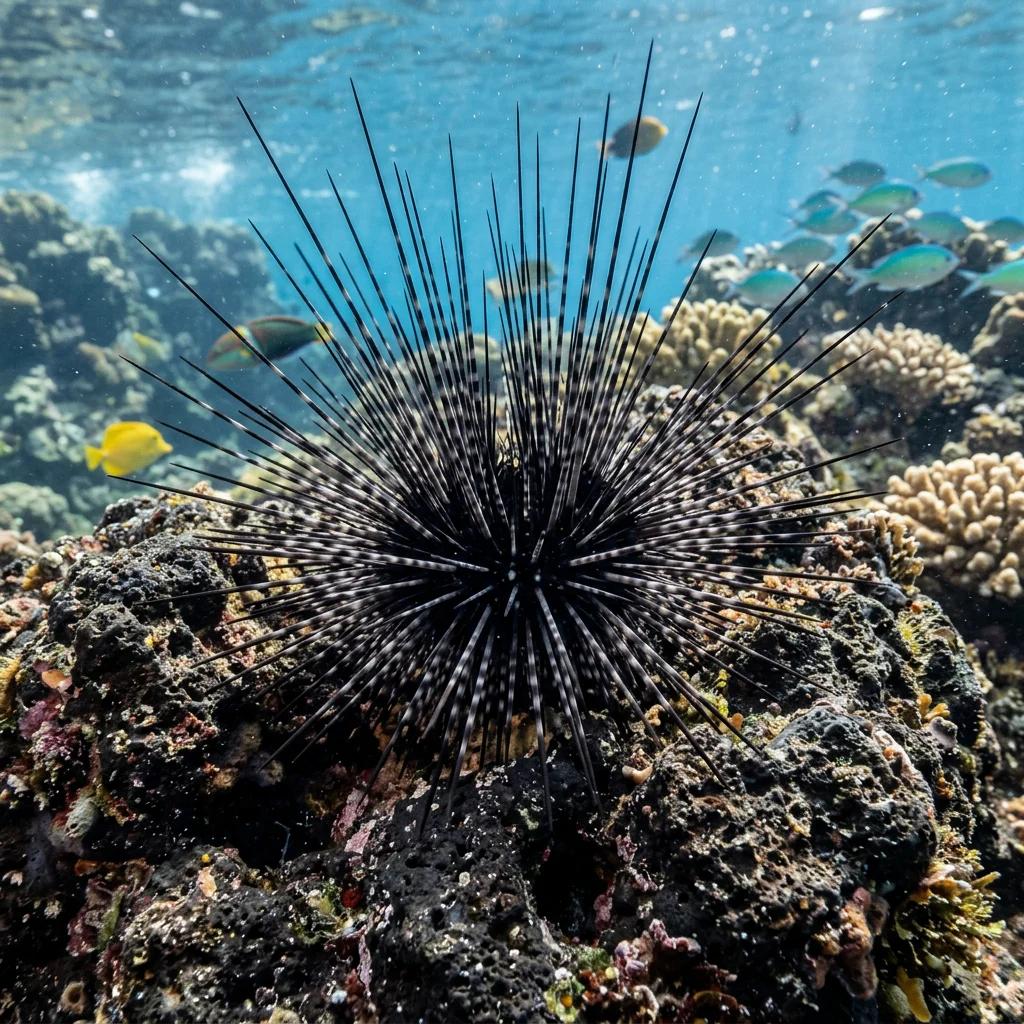
The urchins to avoid. Long, sharp, brittle spines that snap off in skin.
Echinothrix calamaris, the banded urchin, occurs in an all-black form and a black-and-white banded form, and some observers report that the black form is the more common on Hawai‘i Island. Along with E. diadema and Diadema species, wana shelter in crevices and under ledges by day and move out to graze at night. Their spines carry irritating compounds, and the pigment in black spines can leave a tattoo-like mark in the skin until it fades. See are sea urchins poisonous in Hawaii?
How do you tell the black wana apart?
Three groups of long-spined urchins live on Hawaiian reefs, and they are easy to confuse. The banded urchin, Echinothrix calamaris, has two kinds of spines: long, thick, hollow primary spines, often banded in light and dark rings, and a dense layer of short, very fine secondary spines underneath. Reef guides give it a total size, spines included, of about 10 to 20 centimetres, and it is found from a few metres down to about 45 metres. The blue-black urchin, Echinothrix diadema, is similar in size but its spines are uniformly dark, often with a blue or green sheen in good light, and it is usually found in shallower water.
Diadema urchins, represented in Hawai‘i by Diadema paucispinum, have even longer, thinner, needle-like spines that can be several times the width of the body. The best clue is the body itself: Diadema species usually show a ring around the anal cone on top of the body and small, bright spots on the skin between the spines. In a 1968 survey of Kealakekua and Hōnaunau bays on the Kona coast, the biologist Thomas Ebert found Diadema uncommon, while Echinothrix was the dominant urchin at some sites, making up about two thirds of the urchin biomass at the Napō‘opo‘o lighthouse. Ebert noted that even specialists had trouble telling the two Echinothrix species apart underwater, so a snorkeler who is unsure is in good company.
For safety, the distinction matters less than the shared design. All wana have long, brittle spines that pierce skin easily and snap off, leaving fragments behind. They react to shadows and movement by swinging their spines towards the threat, so a hand placed near a crevice can be met by a bristling cluster of points.
Which Hawaiian urchin is most common?
The rock-boring urchin, Echinometra mathaei, on many shallow reefs and tide pools.
It is small, with a test and spines only a few centimetres long, and varies from pale green to pink, often with pale tips to the spines, which gives it the alternative name white-tipped urchin. It grinds pockets into limestone and wedges itself inside, so you see spines poking out of holes. On some reefs it occurs in huge numbers and erodes the reef rock.
In Ebert’s survey of Kealakekua Bay, Echinometra mathaei made up about a third of all the urchins counted in the quadrats at one site, and the average test was only about 2.4 centimetres across. Each urchin scrapes its burrow with its teeth and spines and usually stays in or near it, grazing on algae that grow around the entrance and catching drifting fragments. Because the burrow protects it from fish and waves, the urchin is almost impossible to pull out, and trying to do so damages both urchin and reef.
Its close relative, the oblong urchin or black rock-boring urchin, Echinometra oblonga, is darker, often black or deep purple, with a slightly oval test up to about 6 centimetres across. It lives in very shallow water, usually less than 3 metres deep, and favours more wave-exposed rock than E. mathaei. In the Kona survey it was rare in the sheltered cove but more common on the exposed parts of the coast. Together, these two burrowers are a major cause of bioerosion on Hawaiian reefs, slowly turning solid limestone into sand.
What are the friendly-looking Hawaiian urchins?
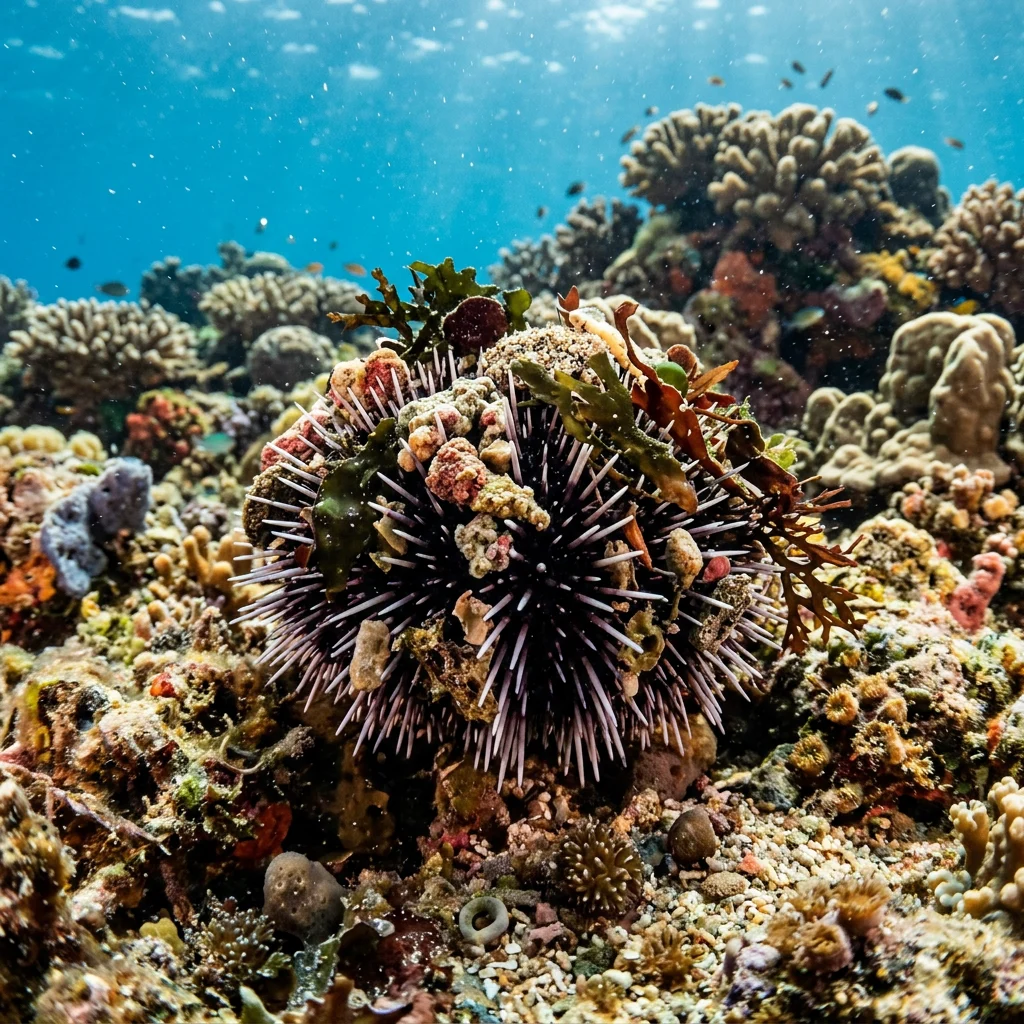
Slate pencil, shingle and collector urchins, with blunt or short spines.
The red slate pencil urchin is named for its thick, blunt spines, which resemble the slate pencils once used to write on school slates. It lives in low intertidal and subtidal crevices and is common along the Kona coast. The shingle urchin (hā‘uke‘uke) clings to surf-pounded lava rock, its spines flattened into a smooth dome that sheds waves; it is a major intertidal grazer. The collector urchin covers itself with shells, rubble and algae and grazes seaweed; the state raises it in a hatchery to control invasive algae. See slate pencil urchin and sea urchins wearing hats.
How is a sea urchin built?
All of Hawai‘i’s urchins share the same basic plan, which helps when identifying them. The body is enclosed in a rigid shell called a test, made of interlocking plates of calcium carbonate, which is globe-shaped in most species and flattened in a few. Movable spines sit on ball-and-socket joints on the test, and between them run rows of slender tube feet that end in suckers. The tube feet, worked by a water-filled hydraulic system, let the urchin cling to rock, climb and move, and in collector urchins they hold the camouflage of shells and algae in place.
Scattered among the spines are tiny pincer-like organs called pedicellariae, which clean the surface and, in some species, deliver venom. The mouth is on the underside and contains a five-part jaw known as Aristotle’s lantern, with teeth that scrape algae from rock and, in the burrowing species, grind out their holes. Hawaiian urchins reproduce by spawning: males and females release sperm and eggs into the water at the same time, and the fertilised eggs develop into larvae that drift in the plankton for weeks before settling on the reef. This drifting stage is how urchins reached and colonised islands as isolated as Hawai‘i.
Which unusual urchins can divers find?
Beyond the common shallow species, Hawai‘i has several urchins that are worth looking for on deeper or quieter reefs. The needle-spined urchin, Echinostrephus aciculatus, is a small burrowing urchin that sits in a vertical hole in the rock with a crown of fine, straight, often reddish spines sticking out. It uses these spines to trap pieces of drifting algae and pulls them down into its burrow. Reef guides record it from about 2 to 30 metres deep.
The rough-spined urchin, Chondrocidaris gigantea, is a pencil urchin, a member of the ancient group called cidaroids. Its thick primary spines are covered with tiny projections and are often coated with sponges, algae and other small organisms, which makes the animal look shaggy. It lives deeper than most of the species above, roughly 10 to 45 metres, and is known from Hawai‘i and New Caledonia. In the 1968 Kona survey, Ebert found it only in the deepest parts of his transects.
The pebble collector urchin, Pseudoboletia indiana, resembles the collector urchin and, like it, holds pieces of shell, coral rubble and algae on its upper surface with its tube feet. It is about 10 to 13 centimetres across and is found from about 2 to 30 metres. Because both species carry debris, the safest way to tell them apart is with a good photograph; the collector urchin is usually larger, with short spines that are often tipped in white or orange.
Why does Hawaii farm collector urchins?
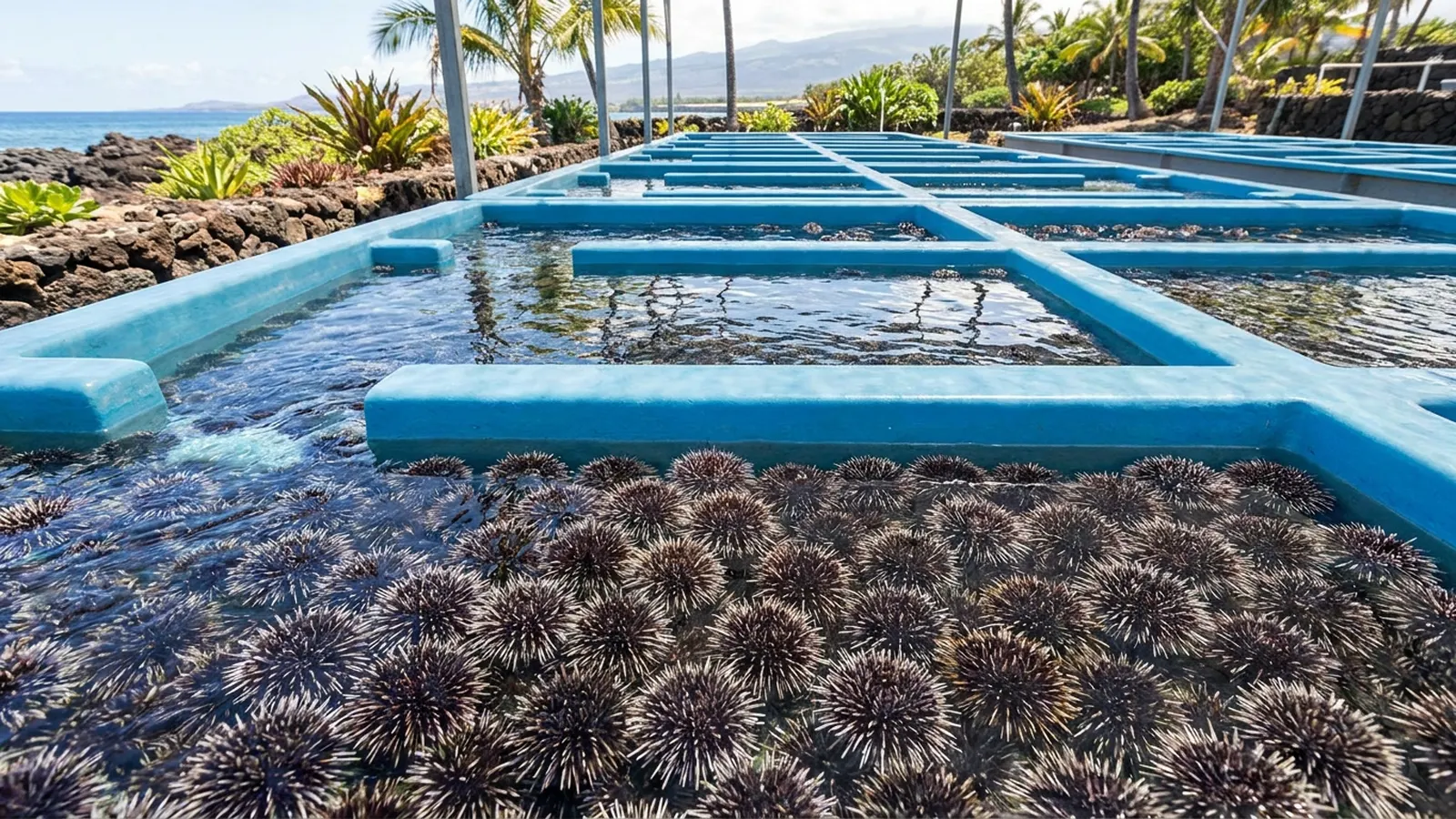
The collector urchin, Tripneustes gratilla, has become one of the most important animals in Hawaiian reef restoration. In the early 1970s several red seaweeds, including Kappaphycus and Eucheuma species and gorilla ogo, Gracilaria salicornia, were introduced to Kāne‘ohe Bay on O‘ahu for aquaculture experiments. They escaped and spread across the patch reefs, smothering corals.
From 2005 the state’s Division of Aquatic Resources (DAR), The Nature Conservancy and the University of Hawai‘i used a barge-mounted suction system nicknamed the Super Sucker, through which divers vacuumed the algae from the reef at a rate of roughly 270 to 450 kilograms an hour. Removal alone could not stop regrowth, which can happen within months, so DAR began raising native collector urchins at its Anuenue Fisheries Research Center hatchery and releasing them onto cleared reefs to graze the regrowth. Research suggested that about two urchins per square metre were needed to keep the algae under control. By 2023 DAR had released its one millionth hatchery urchin.
Collector urchins are good candidates because they are native, eat large amounts of seaweed and are rarely dangerous to people. The programme has become a model for using native grazers to manage invasive algae on coral reefs. In the Kona survey of 1968, the species was most abundant in protected areas where living coral was sparse, with an average of 4.3 urchins per square metre inside one dense bed at Palemano Point.
How does the shingle urchin survive the surf?
The shingle or helmet urchin, Colobocentrotus atratus, is one of the strangest urchins in Hawai‘i. Up to about 7 centimetres across, it lives on lava rock in the surf zone from the waterline to about 2 metres deep, where breaking waves would tear most animals away. Its upper spines are reduced to flat, many-sided plates that fit together like tiles, while the spines around its edge form a flattened skirt. Hawaiian names recorded for it include hā‘uke‘uke and kaupali, the latter meaning “cliff-clinging”.
For a long time its smooth dome was assumed to be the secret of its grip. Research on its biomechanics by Romana Santos and Patrick Flammang in 2007 found that the main factor is the number and strength of its tube feet: in their measurements it consistently showed higher adhesion than more typical urchins such as Echinometra. The shape seems to help spread the force of the water over the tube feet, but it is the dense carpet of suction-cup feet that keeps the urchin attached.
What do urchins do for Hawaiian reefs?
Sea urchins are among the main grazers on Hawaiian reefs, alongside herbivorous fishes such as surgeonfishes and parrotfishes. By scraping algae from rock and dead coral they help keep space open for corals and coralline algae to settle. Too few grazers and seaweed can take over; too many and the urchins can strip the reef bare and erode it. On some reefs, burrowing urchins remove substantial amounts of limestone, contributing to the sand of Hawaiian beaches.
Urchins are also food for many reef animals. Triggerfishes, wrasses, pufferfishes and helmet and triton snails all prey on them. Ebert recorded a triton snail eating a slate pencil urchin on the Kona coast. When predatory fishes are overfished, urchin numbers can rise sharply, which is one reason reef managers watch them as indicators of the health of the whole system.
What should you do if you step on a wana?
Most wana injuries happen to swimmers and waders who put a foot or hand down on a reef or rock without looking, or who are pushed onto the reef by a wave. The spines break off in the skin and are painful. According to the Maui Ocean Center, the pain usually fades within a few hours, and fragments left in the skin are gradually absorbed by the body. Black spine pigment can make an injury look worse than it is, staining the skin for a while after the spines themselves have gone.
Get out of the water, remove any spines that stick out of the skin and can be pulled out easily, and clean the wound. Deeply embedded spines, spines in joints, signs of infection, or an allergic reaction need medical attention. Prevention is simple: wear reef-safe footwear when wading over rocks, keep your hands off the reef, and choose sandy entry points rather than rocky ledges, especially when there is surge.
What part do urchins play in Hawaiian culture?
Urchins were a familiar part of life for Native Hawaiians. Wana is the general name, used above all for the long-spined species, and other traditional names include ‘ina, hāwae and hā‘uke‘uke. The gonads of several species were eaten as a delicacy, and urchin spines were used as tools for carving and abrading. An urchin appearing in a dream or vision was considered to carry special meaning. Today, anyone collecting urchins must follow state fishing regulations, and on many reefs, including protected areas, taking marine life is prohibited.
Where are the best places to see urchins in Hawaii?
Any rocky shore or reef: tide pools, lava benches and shallow bays.
Collector urchins have been recorded at Puakō Bay, Hōnaunau Bay and Keauhou on the Big Island; shingle urchins at Ka Lae and the Old Kona Airport. On O‘ahu and Maui, shallow reefs and tide pools hold wana and rock-boring urchins. See Maui and coral reefs of Hawaii.
How many types of sea urchins are in Hawaii?
About 75 species, with around 22 common in shallow water.
What is the Hawaiian word for sea urchin?
Wana, used especially for long-spined urchins. Other names include ‘ina, hāwae and hā‘uke‘uke.
Which Hawaiian sea urchins are dangerous?
The long-spined wana (Echinothrix and Diadema), whose brittle spines break off in skin.
What is the black sea urchin in Hawaii?
Usually a wana such as Echinothrix calamaris or E. diadema, or a Diadema.
What is a shingle urchin?
Colobocentrotus atratus, a flat, helmet-like urchin of surf-swept rocks with tile-like spines.
Can you eat sea urchins in Hawaii?
Urchins were a traditional food, but collecting rules apply; check state regulations.
- Maui Ocean Center. Hawaiian urchin names; ~75 species, 22 common in shallows; traditional food use.
- A Wilderness Journal (2015). Field notes on Big Island urchin species and locations.
- Hawai‘i DLNR Division of Aquatic Resources. Collector urchin hatchery and biocontrol.
- Honolulu Star-Bulletin, Ocean Watch (2001). Wana, slate pencil and shingle urchins; spine injuries.
- Ebert, T. A. (1971). A preliminary quantitative survey of the echinoid fauna of Kealakekua and Honaunau Bays, Hawaii. Pacific Science 25: 112–131.
- Reef Resilience Network. Building reef resilience through invasive algae removal and urchin biocontrol in Kāne‘ohe Bay.
- Santos, R. & Flammang, P. (2007). Tube-foot adhesion and attachment strength in the shingle urchin Colobocentrotus atratus compared with other sea urchins (summarised in Echinoblog, April 2008).
- Charpin, F. Florent’s Guide to the Hawaiian Reefs: sea urchin species accounts (sizes and depths).
Blane Perun has been exploring Earth’s oceans and marine life for over 25 years. Founder of TheSea.Org in 1999, underwater photographer, coral aquaculture pioneer, and explorer of 80+ countries.
About Blane Perun →