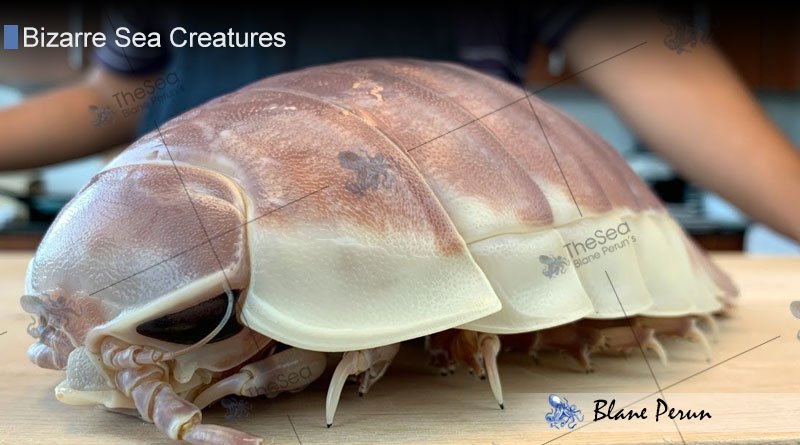
The Deep-Sea Roly-Poly
The giant isopod (Bathynomus giganteus) is exactly what it looks like: an enormous version of the pill bug or roly-poly you might find under a rock in your garden. Both are isopod crustaceans; the deep-sea version simply took the body plan and scaled it up dramatically — from a few millimeters to over 50 centimeters in the largest documented specimens.
This size increase at depth is called deep-sea gigantism — a phenomenon seen in several marine invertebrate groups, likely driven by cold temperatures, high pressure, and the metabolic advantages of large body size in food-scarce environments.
Anatomy and Defenses
Giant isopods are heavily armored — their body is covered in overlapping calcified plates, and like their terrestrial cousins, they can roll into a tight ball when threatened, protecting their softer undersides. Seven pairs of legs make them capable but slow walkers on the seafloor. Their compound eyes are large relative to body size, well-adapted to detect movement in low-light conditions.
Diet and the Feast-or-Famine Lifestyle
Giant isopods are primarily scavengers. On the abyssal plain, food arrives unpredictably — a whale carcass, a large fish, organic material sinking from the surface. Giant isopods can eat enormous quantities when food is available, gorging to the point of appearing swollen. Then they may go months or years without eating, their metabolism slowing to a near-standstill.
A giant isopod at the Toba Aquarium in Japan famously refused food for over five years before dying in 2014 — one of the longest documented fasting periods for any animal. This extreme metabolic flexibility is essential for survival in the deep sea’s boom-and-bust food economy.
Distribution
Giant isopods are found at 170–2,140 meters depth in the Atlantic, Pacific, and Indian Oceans. They are most abundant at bathyal depths (200–2,000 meters) on soft sediment bottoms where organic material accumulates.
FAQs
How big do giant isopods get?
The largest documented specimen was approximately 76 cm. Most adults reach 19–37 cm. Females tend to be larger than males.
Can you eat a giant isopod?
Yes — they have been eaten in Taiwan and appear at some seafood restaurants in Asia. The flavor is reportedly similar to crab or lobster.