Can You Eat Sea Urchins Raw? — Yes, and Raw Is How Most Uni Is Eaten
Yes. Raw is the standard way to eat sea urchin: the gonads (uni) are served as sushi and sashimi, spooned from the shell, or folded into dishes at the last second. Fresh uni from a clean, licensed source is generally safe for healthy adults. The risks are the usual raw-seafood ones: bacteria from poor handling, warm storage and seafood allergy. Pregnant people, young children and the immunocompromised are usually advised to avoid raw seafood.
Because heat ruins it. The gonads are mostly delicate cells rich in fat, free amino acids and sugars. Raw, they are sweet and custard-like. Cooked hard, they turn grainy and lose most of their sweetness. Even cooked dishes such as Italian urchin pasta add the roe off the heat so it only warms through. For what uni is and where it comes from, start with can you eat sea urchins?
Is raw sea urchin safe to eat?
For most healthy adults, yes, provided it is fresh, kept cold and comes from clean water.
Uni is not a filter feeder like an oyster, which strains large volumes of seawater and can concentrate pathogens and toxins. Sea urchins graze algae and detritus, so the gonads are a lower-risk raw seafood than raw shellfish. That does not make them risk-free. Bacteria can grow on opened roe left warm, and urchins collected near sewage outlets or polluted harbours can carry contamination. Treat raw uni like sashimi-grade fish: buy from a busy, reputable supplier, keep it near 0–4°C, and eat it quickly.
| Risk | What causes it | How to reduce it |
|---|---|---|
| Bacterial illness | Warm storage, poor handling, polluted water | Buy from licensed sources; keep cold; eat within a day or two |
| Allergy | Sensitivity to seafood proteins | Avoid if you react to shellfish or roe; try a small amount first |
| Spoilage off-flavours | Age, oxidation, starvation of the urchin | Smell and taste test; reject bitter or ammonia notes |
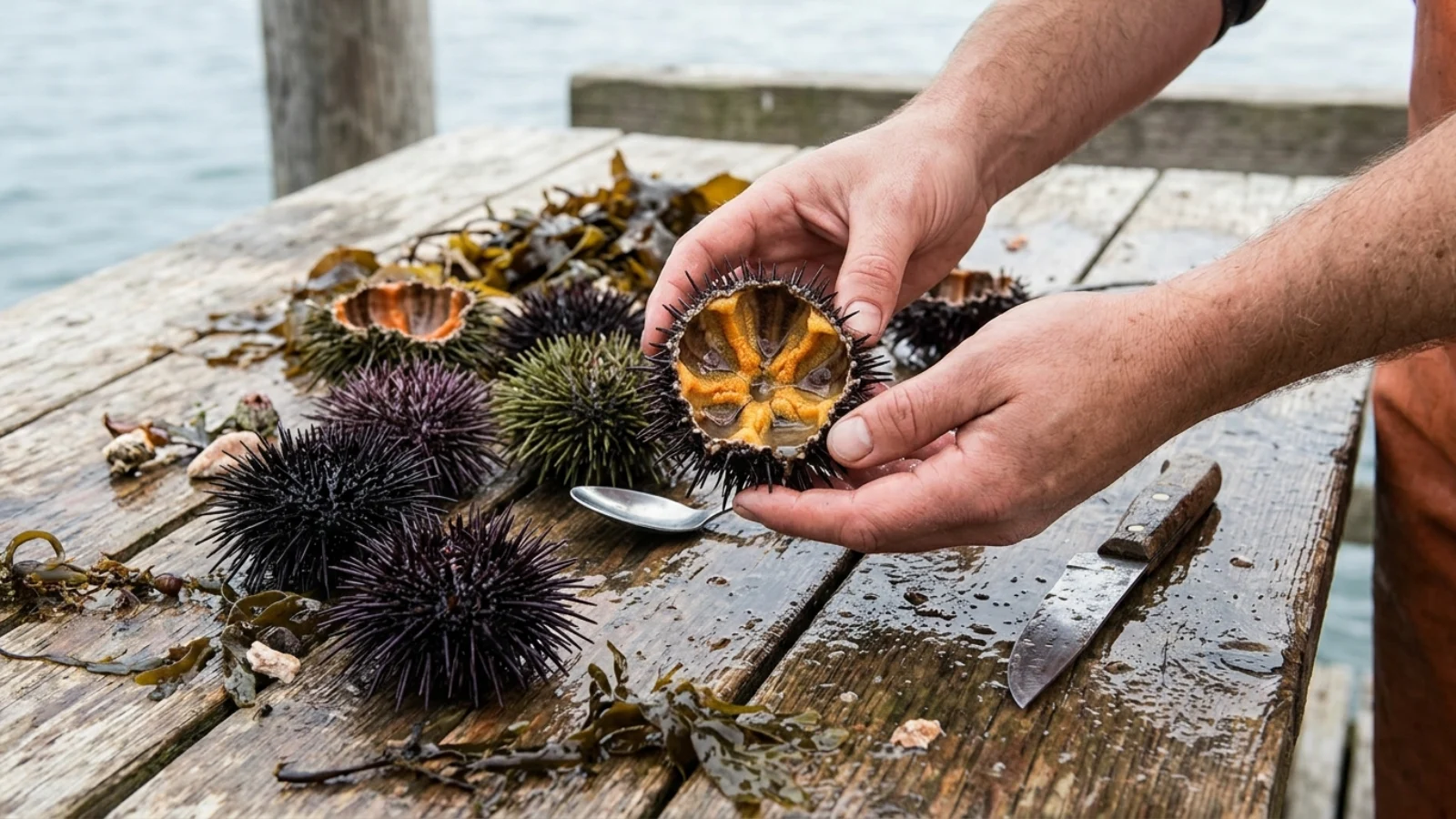
| Spine injuries | Handling whole urchins | Thick gloves or a towel; tongs |
How can you tell if raw uni is fresh?
Look for firm, separate lobes with a bright, even colour and a clean ocean smell.
Fresh lobes are plump and hold their shape, with a fine grainy surface. Colour varies by species and diet, from pale yellow to deep orange, and is not a freshness test on its own. What gives old uni away is texture and smell: lobes that have slumped and run together, weep liquid, smell of ammonia or taste sharply bitter or metallic. Packaged uni sold on wooden trays is often treated with alum to keep the lobes firm, which extends shelf life a little and can add a faint astringent edge. Uni sold in salt water (ensui uni) is untreated and prized for its cleaner flavour.
Has raw sea urchin ever caused food poisoning?
Yes. Outbreaks are uncommon, but at least one well-documented cluster was traced to raw urchins.
In July 2006, Hong Kong’s Centre for Health Protection and Centre for Food Safety investigated a run of food poisoning linked to Japanese restaurants. Sixty-six people in 24 groups fell ill after eating at four outlets of one restaurant group between 27 June and 3 July, and seven more people became sick after meals at a Japanese noodle chain on 2 and 3 July. The restaurant patients, 23 men and 43 women, ranged in age from 7 to 75. Most of those affected had eaten raw sea urchin before their symptoms began. The bacterium Vibrio parahaemolyticus was found in a stool sample from one patient, and both clusters were traced to the same seafood supplier, which was told to stop distributing the product.
The illnesses were typical of this kind of bacterial food poisoning. People at the noodle chain reported diarrhoea, vomiting, stomach pain, nausea and fever, starting between about 3 and 23 hours after eating, and their symptoms were generally mild. Two patients from the restaurant cluster were admitted to hospital and later discharged. Afterwards, the authorities reminded sushi and sashimi sellers to buy from reliable sources, use separate equipment for raw dishes and keep them apart from other foods at 0–4°C.
Why is Vibrio the main concern with raw seafood?
Because it lives naturally in coastal seawater and multiplies fast when seafood is kept warm.
Vibrio parahaemolyticus is not a sign of sewage pollution. It is a normal marine bacterium, most abundant in warm months, and it rides into kitchens on the surface of fish and shellfish. A study by the Toyama Institute of Health, published in the Japanese Journal of Food Microbiology in 2014, found the bacterium in 86.9% of seawater samples taken from fishing ports in the warm season between 2008 and 2012. The risk comes when contaminated seafood sits at room temperature, giving the bacteria time to reach levels that cause illness.
Japan, where raw seafood is eaten daily, learned to manage this the hard way. In 1999 and 2001 the national health ministry issued guidelines that included washing fish in sterilised seawater rather than harbour water and moving seafood in refrigerated transport. When the Toyama team compared market fish from 1979–1995 with fish from 2008–2012, the share carrying the bacterium had fallen from 66.3% to 50.6%, and the average level had dropped too. The authors linked the guidelines to fewer food poisoning cases in recent years. Not every strain is equally dangerous: the team found the tdh gene, a marker of disease-causing strains, in about a fifth of samples, and isolated the pandemic O3:K6 strain from two of them. The lesson for uni is the same as for sashimi: cold, clean handling from boat to plate matters more than anything else.
What rules apply to seafood sold for eating raw?
In Japan, seafood sold shelled or filleted for raw consumption has to meet a bacterial limit, water rules and a temperature limit.
Under Japan’s Food Sanitation Act standards, fresh or frozen fish and seafood sold as fillets or shelled for eating raw may contain no more than 100 MPN (most probable number) of V. parahaemolyticus per gram. Water used in processing must be safe for food processing, sterilised seawater, or artificial seawater made from safe water. Fresh raw-consumption products must be kept below 10°C, and frozen ones at −15°C or colder. The published standard does not name sea urchin roe specifically, but it shows the kind of controls that the world’s biggest raw-seafood market relies on.
Other countries handle the risk mainly through licensing, so that harvest areas are monitored and product can be traced. That is one practical reason to buy uni from established fishmongers and restaurants rather than from unknown sellers: if something goes wrong, the supply chain can be traced, as it was in Hong Kong.
Is frozen, salted or jarred uni the same as fresh?
No. Processing changes the texture and flavour, and some forms are no longer truly raw.
Fresh uni on wooden trays is the benchmark, but it keeps for only a few days even in a chiller, according to a 2017 market review by the Icelandic food research institute Matís. Freezing buys time but costs quality. Ice crystals rupture the soft lobes, so thawed uni loses firmness and releases liquid; for that reason frozen roe sells for a fraction of the price of fresh. If you buy frozen uni to eat raw, thaw it slowly in the fridge and eat it the same day.
Salted uni is a traditional Japanese way of preserving the catch. The Matís review describes several grades, from lightly salted shio uni at about 7–8% salt to heavily salted styles at 25–40% salt and fermented pastes. These are condiments as much as delicacies, used in small amounts on rice or in sauces. In Europe, roe is also sold pasteurised in small jars; pasteurisation uses heat, so the result is no longer raw in texture or taste, but it lasts much longer than fresh roe.
Why do buyers pay more for live urchins?
Because a living urchin is the freshest possible package for raw roe.
Inside an intact shell the gonads stay sealed and cold, and nothing has been washed, trimmed or treated. That is why so much of the international trade moves urchins alive. The Matís review found that live animals made up 65–70% of Japan’s urchin imports, and in the mid-2000s nearly 89% of those live shipments came from Russia, a short flight or sea crossing away. Maine processors have used both routes, either air-freighting whole urchins or extracting the roe locally before flying it out. For a cook, the practical version is simple: a lively urchin with moving spines and gripping tube feet, opened just before serving, takes most of the guesswork out of eating uni raw.
How should you store raw uni at home?
As cold as possible without freezing, sealed, and for as short a time as possible.
Put tray or tub uni in the coldest part of the fridge as soon as you get home, ideally in the 0–4°C range recommended to Hong Kong sushi sellers, and leave it in its packaging until you are ready to serve. Use clean, dry utensils, and don’t return leftovers that have sat on the table. Whole live urchins should be kept cold and damp, not submerged in fresh water, and opened just before eating. Once opened, the roe should be eaten within hours; if it starts to smell sharp or sour, throw it out.
Timing your purchase helps too. Gonads are at their best in the months before spawning; in Maine, for example, the state fisheries agency has reported that green urchin roe quality peaks from November to March, with spawning around April. Out-of-season roe can be thin, watery or bitter, and may be less pleasant raw even when it is perfectly safe.
Who should not eat raw sea urchin?
The same groups advised to avoid sushi and raw oysters.
Health agencies generally advise pregnant people, infants and young children, older adults and anyone with a weakened immune system (from illness, chemotherapy or immune-suppressing drugs) to avoid raw or undercooked seafood. People with known seafood allergies should be cautious: allergic reactions to sea urchin roe have been reported, and some people who react to fish roe also react to uni. If in doubt, talk to a doctor before trying it.
Can you be allergic to sea urchin?
Yes. Sea urchin roe allergy is uncommon but well documented, and reactions can be severe.
Japanese allergists, who see more uni eaters than anyone, have studied the problem in the lab. A team led by Kenichi Tanaka at Fujita Health University examined blood serum from five patients with confirmed sea urchin allergy and reported their results in International Archives of Allergy and Immunology in 2014. They noted that the roe can trigger anaphylaxis even the first time someone eats it. The patients’ antibodies reacted to ten different roe proteins. The two most important were a large major yolk protein of about 170 kDa, recognised by four of the five patients, and a small 18 kDa protein from the egg’s cortical vesicles.
That small protein matters for anyone who already reacts to other roe. In the same study, salmon roe extract blocked antibody binding to it, a sign of cross-reactivity between sea urchin roe and salmon roe (ikura). A separate case study by Ayako Yamasaki and colleagues in Acta Dermato-Venereologica identified the sea urchin’s major yolk protein as the culprit in a patient who suffered anaphylaxis after eating roe. Because uni is a gonad full of egg-related proteins, people allergic to fish eggs should be especially careful, and anyone who has had a serious reaction to seafood should ask an allergist before trying it.
What is the best way to eat raw uni?
Simply. The less you do to good uni, the better it tastes.
The classic preparations are nigiri or gunkan-maki sushi, uni-don (a bowl of warm rice topped with roe), and sashimi with a drop of soy or a pinch of salt. In the Mediterranean, people crack urchins on the rocks and scoop the roe onto bread with lemon. In Chile, raw erizos are dressed with lemon, onion and coriander. For warm dishes, stir raw uni into pasta, risotto or soft scrambled eggs right at the end so it melts into a sauce without cooking through. For the flavour itself, see what do sea urchins taste like?
Can you eat raw sea urchin straight from the ocean?
Only if you know the species, the water is clean, and collecting is legal where you are.
Many coasts license urchin collecting, set size limits or ban it in marine reserves. Some species are hazardous to handle: long-spined urchins break off in skin, and the flower urchin of the Indo-Pacific carries venomous pincers. Never eat urchins found dead on the beach. If you do harvest legally, open and eat the urchin on the spot or keep it alive and cold until you do. For which species to choose, see are all sea urchins edible? and can you touch sea urchins?
Is it safe to eat raw sea urchin?
For most healthy adults, yes, if it is fresh, kept cold and comes from clean, legally harvested water. The risks are similar to other sashimi-grade seafood.
Can raw uni make you sick?
It can if it has been stored warm or comes from polluted water, which allows bacteria such as Vibrio to grow. Allergic reactions are also possible.
Can pregnant women eat raw uni?
Health guidance generally advises avoiding raw seafood during pregnancy. Uni cooked into a hot dish is a lower-risk option, but ask your doctor.
How long does raw uni last in the fridge?
Only a few days at best. Opened lobes are best eaten the same day; tray uni often carries a short use-by date.
Why does some uni taste bitter?
Age, alum preservative, poor diet, or the season. Gonads close to spawning, or from starving urchins, can also taste bitter or flat.
Do you eat sea urchin alive?
You eat it freshly opened. The urchin is killed when the shell is cut open; the gonads are scooped out and eaten right away.
Is uni cooked in sushi?
No. Uni sushi is served raw on vinegared rice.
- Hong Kong Government press release (7 July 2006). Food poisoning cases may link to contaminated raw sea urchins (Centre for Health Protection and Centre for Food Safety).
- Kanatani, J. et al. (2014), Japanese Journal of Food Microbiology 31(2):93–99. Vibrio parahaemolyticus in fishing-port seawater and market fish, Toyama Prefecture.
- Japan, Food Sanitation Act. Safety standards for fish and seafood for raw consumption (provisional translation).
- Stefánsson, G. et al. (2017), Matís Report 10-17. Markets for sea urchins: product forms and shelf life.
- Takagi et al. (2020), Frontiers in Marine Science 7. Amino acids and gonad taste in Mesocentrotus nudus.
- Maine Department of Marine Resources. Green sea urchin roe quality and harvest season.
- Guinness World Records. Flower urchin (Toxopneustes pileolus) as the most dangerous sea urchin.
Blane Perun has been exploring Earth’s oceans and marine life for over 25 years. Founder of TheSea.Org in 1999, underwater photographer, coral aquaculture pioneer, and explorer of 80+ countries.
About Blane Perun →