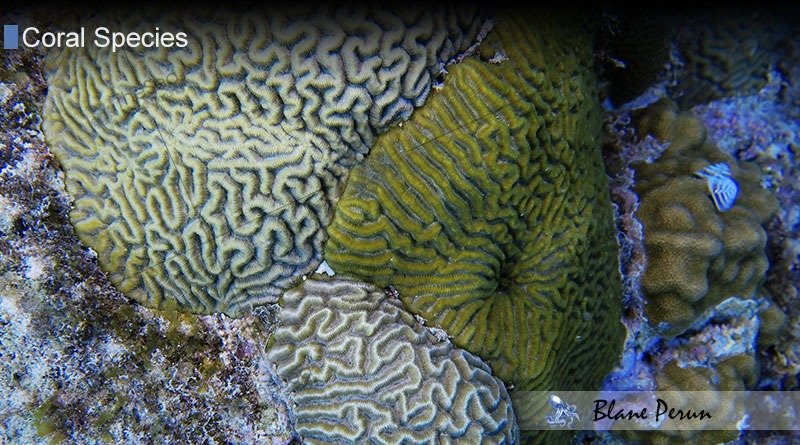
Brain coral is among the most recognizable coral in the ocean — its surface etched with deep, meandering grooves that unmistakably resemble the folds of a human brain. These massive, slow-growing corals are among the oldest living animals on any reef, with the largest documented specimens over 1,000 years old. Brain corals are major contributors to reef structure across the Caribbean, Atlantic, and Indo-Pacific, and their tolerance of environmental stress makes them important survivors as coral reefs face increasing pressure from warming and acidifying oceans.
What Is Brain Coral?
Brain coral is a common name applied to several genera of reef-building corals (order Scleractinia) that share the distinctive maze-like surface pattern. The most well-known genera include:
- Diploria: Found in the Caribbean and western Atlantic; Diploria labyrinthiformis (grooved brain coral) and Diploria strigosa (symmetrical brain coral) are the most common species
- Colpophyllia: Colpophyllia natans, the boulder brain coral, is one of the largest brain coral species in the Caribbean
- Pseudodiploria: Formerly classified within Diploria; includes Pseudodiploria strigosa
- Symphyllia: Indo-Pacific brain corals; large, colorful, and common on Indo-Pacific reefs
- Lobophyllia: Another Indo-Pacific genus with brain-like surface patterns; highly variable in color
- Platygyra: Widespread across the Indo-Pacific; small polyps arranged in long valleys
Despite the common name grouping them together, these genera are not all closely related — the brain-like surface pattern has evolved independently multiple times across different coral lineages, a striking example of convergent evolution driven by similar ecological constraints.
The Brain Pattern: What Are Those Grooves?
The characteristic surface pattern of brain corals is not decorative — it is structural. The “grooves” are valleys of living coral polyp tissue, and the “ridges” between the valleys are walls of calcium carbonate skeleton. Each valley contains a row of polyps arranged side by side, sharing tissue along the crest walls but maintaining individual mouths along the valley floor.
This arrangement is called meandroid — from the Greek word for a winding river pattern, the same root as “meander.” In meandroid corals, polyps in a valley share a common gastrovascular cavity, meaning food captured by one polyp can be distributed to its neighbors. The valleys and ridges form during colony growth as new polyps bud from existing ones and the skeleton grows upward and outward simultaneously.
The depth, width, and spacing of the valleys vary by species and are primary identification features. The color — which ranges from yellow-green to brown, grey, cream, and occasionally bright green — comes from the zooxanthellae algae living in the coral tissue.
How Brain Coral Grows
Brain corals are massive corals — they grow in dome or hemisphere shapes rather than branching or plate-like forms. This massive growth form makes them structurally robust: they can survive storm impacts that shatter branching corals. The tradeoff is growth rate: brain corals typically grow only 3–10 mm per year, compared to branching corals like staghorn (Acropora) that can grow several centimeters per year.
The slow growth rate means large brain coral colonies represent enormous investments of time. A brain coral colony 1 meter in diameter may be 100–200 years old. The largest documented brain coral (Colpophyllia natans at about 1.8 meters tall and 2.6 meters across, in Tobago) is estimated at over 500 years old. Claims of brain corals over 1,000 years old have been made but require careful radiometric dating to verify.
Brain Coral Reproduction
Brain corals reproduce both sexually and asexually:
Broadcast Spawning
Like most reef-building corals, brain corals participate in mass spawning events — typically occurring once or twice per year, often synchronized with lunar cycles. Colonies release egg-sperm bundles simultaneously into the water column, where fertilization occurs and larvae (planulae) develop. Successful planulae eventually settle on a substrate and metamorphose into juvenile polyps that begin building their calcium carbonate base. Only a tiny fraction of released gametes successfully establish new colonies.
Asexual Reproduction
Colonies grow asexually through the budding of new polyps — either intratentacular budding (where new polyps form inside the oral disk of an existing polyp) or extratentacular budding (where new polyps form between existing polyps). This is how the colony expands in size over time, not by adding genetically distinct individuals but by adding genetically identical copies of the founding polyp.
Brain Coral and Environmental Stress
Brain corals are generally considered more resilient to environmental stress than fast-growing branching corals, but they are not immune:
Bleaching Resistance
Massive corals including brain corals typically bleach at higher temperatures and for shorter durations than branching corals under the same thermal stress events. Some studies suggest that brain corals may harbor more thermally tolerant zooxanthellae strains than branching corals. They also have deeper tissue layers, meaning some zooxanthellae may survive bleaching events in tissue that is partially sheltered from peak thermal stress. This relative tolerance makes brain corals important survivors and reef-rebuilders after major bleaching events.
Disease Susceptibility
Several coral diseases specifically affect massive corals including brain corals. Stony Coral Tissue Loss Disease (SCTLD) — first identified in Florida waters in 2014 and subsequently spreading throughout the Caribbean — is highly pathogenic to Diploria and Colpophyllia, causing rapid tissue loss that kills colonies far faster than bleaching typically does. SCTLD is considered one of the most damaging disease events in Caribbean coral reef history.
Ocean Acidification
As CO2 dissolves in seawater, ocean pH decreases — a process called ocean acidification. Lower pH reduces the availability of carbonate ions that coral polyps need to build their calcium carbonate skeletons. Studies on brain corals project that ongoing acidification will reduce calcification rates, slow growth, weaken skeletal density, and increase dissolution of existing reef structure. Massive corals may be particularly vulnerable to acidification effects on skeletal density.
Frequently Asked Questions
How old can brain coral get?
Brain corals are among the oldest living animals on Earth. Large specimens are confirmed at several hundred years old, with credible estimates of the oldest individuals exceeding 1,000 years. The extreme slow growth rate (3–10mm per year) means a 1-meter colony is likely 100–300 years old depending on species and conditions.
What causes the brain pattern on brain coral?
The brain pattern results from the meandroid colony growth form, in which polyps are arranged in rows within long valleys separated by skeletal ridges. New polyps bud along the valley floor and walls as the colony grows, extending the valley system outward. The resulting labyrinthine pattern of ridges and valleys creates the brain-like appearance. The exact pattern and valley dimensions are species-specific and used as identification features.
Is brain coral a plant or animal?
Brain coral is an animal — specifically, a colony of thousands of individual coral polyps, each a small, cup-shaped animal related to jellyfish and anemones. The coral’s plant-like appearance comes from its sessile (non-moving) nature and its partnership with zooxanthellae algae that live in its tissue and photosynthesize. The coral structure itself is made of calcium carbonate skeleton secreted by the polyps.
Where does brain coral live?
Brain coral genera are found across the world’s tropical and subtropical seas. Caribbean/Atlantic brain corals (Diploria, Colpophyllia, Pseudodiploria) are common from Florida through the Caribbean to Brazil and West Africa. Indo-Pacific brain corals (Platygyra, Symphyllia, Lobophyllia) are widespread from the Red Sea and East Africa through the Indian Ocean to the Pacific. They typically live from the surface to about 40 meters depth, with different species favoring different depth ranges.
How does brain coral eat?
Brain coral polyps feed in two ways. Primarily, they rely on their symbiotic zooxanthellae algae to photosynthesize and provide sugars — up to 90% of their energy needs under good conditions. Secondarily, the polyps extend their tentacles at night to capture zooplankton and organic particles from the water column, delivering them to the central mouth. This dual energy strategy makes brain coral flexible across varying nutrient conditions.