Black Sea — The World’s Largest Body of Oxygen-Free Water
The Black Sea is a large inland sea between south-eastern Europe and western Asia, covering about 436,400 km² (168,500 sq mi) and reaching a maximum depth of 2,212 m. Six countries border it: Turkey, Bulgaria, Romania, Ukraine, Russia and Georgia. It is connected to the Mediterranean only through the narrow Bosporus, and below about 150–200 m its water contains no oxygen at all — more than 90% of its deep volume is anoxic and laced with hydrogen sulfide, making it the largest such body of water on Earth.
The Black Sea is one of the most unusual bodies of water on the planet: a brackish inland sea, fed by some of Europe’s largest rivers, that sits on top of a vast, lifeless reservoir of oxygen-free water. This guide covers where it is, how big and deep it is, why it is called black, how it became salty, what lives in it, how its water moves and what threatens it today.
Where is the Black Sea?
The Black Sea lies between the Balkans and Ukraine to the west and north, Russia and the Caucasus to the north-east and east, and Turkey’s Anatolian coast to the south. The Crimean Peninsula juts into it from the north, and the shallow Sea of Azov connects through the Kerch Strait. To the south-west, the 700-m-wide Bosporus at Istanbul leads to the Sea of Marmara, the Dardanelles, the Aegean and the Mediterranean.
The six coastal states are Turkey, Bulgaria, Romania, Ukraine, Russia and Georgia, but its drainage basin is enormous: about 2 million km² across parts of 24 countries, carried in by the Danube, Dnieper, Dniester, Don and other rivers. I have visited Odessa on its northern shore, Ukraine’s historic Black Sea port.
Why is it called the Black Sea?
Nobody knows for sure. One leading theory links it to an ancient colour system, possibly Persian, in which compass directions had colours: black for north, red for south — which would make the Red Sea its southern counterpart. Others point to the sea’s dark appearance under winter storms, its dangerous navigation, or the black sediment its oxygen-free depths leave on anchors. The ancient Greeks called it Pontos Axeinos, the “inhospitable sea,” later changed to Pontos Euxeinos, the “hospitable sea.”
Why does the Black Sea have no oxygen at depth?
The Black Sea is meromictic: its layers never mix. Rivers pour in so much fresh water that the surface layer is only about half as salty as the ocean, around 17–18 PSU. Meanwhile, saltier, denser Mediterranean water flows in along the bottom of the Bosporus and sinks. The result is a sharp density boundary at roughly 100–200 m that wind and winter cooling cannot break. Oxygen from the air never reaches the deep layer, and bacteria decomposing sinking organic matter there produce hydrogen sulfide instead.
That makes more than 90% of the deep Black Sea anoxic — the largest volume of oxygen-free water on the planet. Only microbes survive there. But the lack of oxygen also stops the shipworms and bacteria that normally destroy wood, so shipwrecks are astonishingly well preserved. In 2018, the Black Sea Maritime Archaeology Project announced an intact ancient Greek trading ship, about 2,400 years old, lying upright at more than 2,000 m — among the oldest intact shipwrecks known. See more shipwrecks.
Black Sea — key figures
| Measure | Value | Note |
|---|---|---|
| Surface area | 436,400 km² | 168,500 sq mi, excluding Azov |
| Volume | ~547,000 km³ | |
| Average depth | 1,253 m | |
| Maximum depth | 2,212 m | Central abyssal plain |
| Bordering countries | 6 | Turkey, Bulgaria, Romania, Ukraine, Russia, Georgia |
| Surface salinity | ~17–18 PSU | Deep water ~22 PSU |
| Oxygenated layer | Top ~100–200 m | Below: anoxic, hydrogen sulfide |
| Drainage basin | ~2 million km² | 24 countries |
Was the Black Sea once a lake?
Yes. During the last ice age, with sea levels much lower, the Black Sea was cut off from the Mediterranean and became a large freshwater lake. When rising seas topped the Bosporus sill several thousand years ago, salt water flowed in. Geologists William Ryan and Walter Pitman proposed in 1997 that this happened catastrophically around 5600 BC, flooding coastal settlements — the “Black Sea deluge hypothesis.” Others argue for a gradual rise. Explorer Robert Ballard found an ancient shoreline about 150 m deep off Turkey in 2000, but the speed of the flooding is still debated.
How did the Black Sea basin form?
The Black Sea is far older than the flooding debated above. Geologists generally regard it as a remnant of the ancient seaways that once separated Europe from Asia and Africa, the Tethys Ocean and its northern offshoot, the Paratethys. As the African and Arabian plates pushed north and the Alpine and Caucasus mountain belts rose, these seaways were squeezed into a chain of isolated basins. The Black Sea, the Caspian Sea and the Sea of Azov are the largest survivors of that chain.
Beneath its floor the Black Sea is really two deep basins, a western one and an eastern one, separated by a submarine ridge that runs roughly from the Crimean Peninsula toward the Turkish coast. Both basins are filled with a thick pile of sediments carried in by rivers over millions of years, and both are surrounded by a shelf that is narrow along the mountainous Turkish and Caucasus coasts but very broad in the north-west, off Romania, Ukraine and Bulgaria. That wide, shallow north-western shelf is where most of the sea’s fishing, river input and pollution problems are concentrated, while the deep central plain lies below 2,000 m.
The sea’s isolation is the key to everything else on this page. Its only link with the world ocean is the Bosporus, a strait less than a kilometre wide at its narrowest and only a few tens of metres deep at its sill. Whenever global sea level fell far enough during the ice ages, that link was cut, and the basin was left to fill with river water. Whenever sea level rose again, salty Mediterranean water spilled back in. Each switch left a layer of sediment that geologists can read like a diary of the last few hundred thousand years.
How does water move in the Black Sea?
The Black Sea has a simple but powerful circulation. A strong boundary current, known as the Rim Current, flows anticlockwise around the whole basin, hugging the continental slope. Inside that loop, two large cyclonic gyres turn over the western and eastern basins, and smaller eddies spin off along the coasts. Winds, river inflow and the shape of the coastline all help drive the pattern, and it changes with the seasons, strengthening in winter.
The exchange with the Mediterranean works like a two-way street. At the surface, relatively fresh Black Sea water flows south-west through the Bosporus into the Sea of Marmara. Underneath it, along the bottom of the strait, a counter-current of much saltier and denser Mediterranean water flows north into the Black Sea. When that heavy water spills over the Bosporus sill, it sinks down the slope and slowly renews the deep layer. Because rivers supply far more fresh water than evaporation removes, the sea as a whole exports water to the Mediterranean, and its surface stays brackish.
This two-layer system is exactly why the deep sea has no oxygen. The inflowing Mediterranean water is too salty to mix upward, and the fresh surface layer is too light to sink, so the boundary between them, the halocline and oxycline at roughly 100–200 m, acts like a lid. Anything below it is cut off from the atmosphere for centuries.
The circulation also explains why pollution and plankton blooms spread the way they do. Nutrients from the Danube, Dnieper and Dniester tend to be carried south along the western coast by the Rim Current, so the shelves off Romania and Bulgaria feel the effects of river pollution first, while the open centre of the sea receives far less.
What lives in the Black Sea?
Life is concentrated in the thin oxygenated surface layer. The brackish, nutrient-rich water is highly productive but low in species diversity compared with the Mediterranean.
- Anchovy — the European anchovy dominates the fishery; Turkey’s fleet lands roughly 300,000 tonnes a year in good seasons.
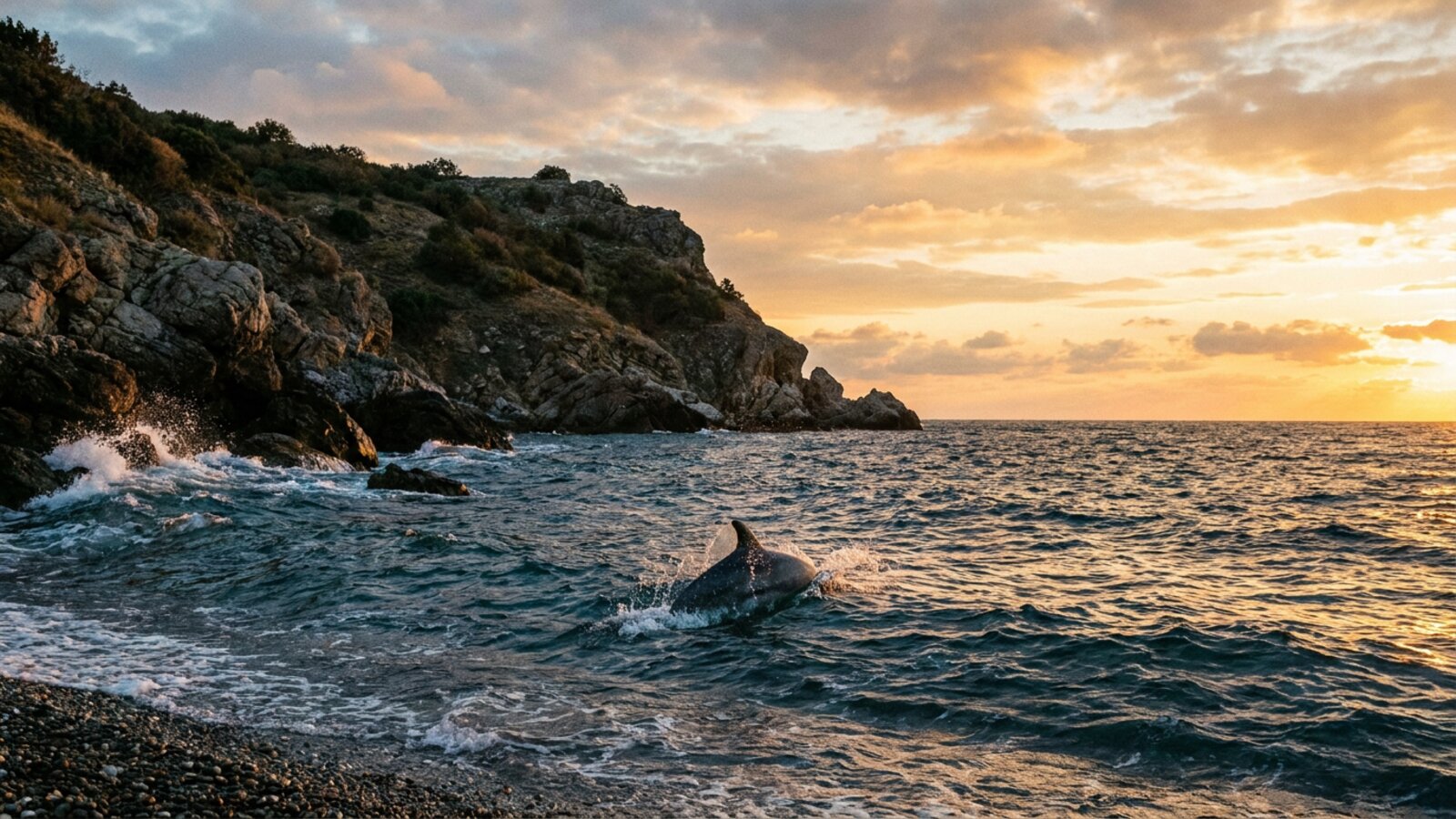
- Dolphins and porpoises — distinct Black Sea subspecies of bottlenose dolphin, short-beaked common dolphin and harbour porpoise, all listed as threatened.
- Fish — turbot, sprat, horse mackerel, bluefish, mullets, and critically endangered sturgeons that spawn in the Danube.
- Invaders — the American comb jelly Mnemiopsis leidyi exploded in the late 1980s, eating fish eggs and zooplankton and helping collapse the anchovy fishery; see comb jellies.
- Seaweed beds — Zernov’s Phyllophora field on the north-western shelf was once one of the largest red-algae meadows in the world, before pollution shrank it drastically.
Ports, beaches and the Danube Delta
For all its strange chemistry, the Black Sea is a busy, lived-in sea. Its coast is lined with major ports and resort towns: Istanbul on the Bosporus, Constanța in Romania, Varna and Burgas in Bulgaria, Odesa in Ukraine, Novorossiysk and Sochi in Russia, Batumi in Georgia, and Samsun and Trabzon on the Turkish shore. In summer its beaches draw millions of visitors, and the warm, gently shelving western coast is especially popular with swimmers.
Shipping through the Turkish Straits is governed by the Montreux Convention of 1936, which guarantees free passage for merchant vessels in peacetime while placing limits on warships from countries outside the Black Sea. The sea is also a major route for grain, oil and other cargo from Ukraine, Russia and the Caucasus to world markets.
At the north-western corner, the Danube ends in one of Europe’s largest and best-preserved wetlands. The Danube Delta, mostly in Romania with a smaller part in Ukraine, is a UNESCO World Heritage Site and a biosphere reserve, famous for its reed beds, channels and lakes and for colonies of pelicans and other water birds. The delta also filters and traps part of the nutrient and sediment load the river carries toward the sea, which is why its health matters for the Black Sea as a whole.
Winter can be harsh. Cold air from the north can drop sea-surface temperatures sharply on the shallow north-western shelf, and in severe winters parts of that shelf near the coast, along with the neighbouring Sea of Azov, can ice over. The open, deep sea does not freeze.
What threatens the Black Sea?
From the 1960s to the 1990s, fertiliser runoff from the Danube and other rivers caused massive eutrophication: algal blooms, seasonal dead zones on the north-western shelf, and mass die-offs of bottom life. Combined with overfishing and the comb jelly invasion, the ecosystem nearly collapsed by the early 1990s. Reduced agricultural runoff after the Soviet collapse allowed partial recovery. Today the main concerns are warming surface water, which strengthens the stratification and is thought to be thinning the oxygenated layer, continuing pollution, and the effects of the war in Ukraine, including the 2023 destruction of the Kakhovka Dam, mines and damage to coastal habitats.
- The Black Sea is a 436,400-km² inland sea bordered by six countries.
- It reaches 2,212 m deep, but more than 90% of its deep water has no oxygen.
- Its surface water is only about half as salty as the ocean.
- The anoxic depths preserve ancient shipwrecks almost intact.
- Pollution, invasive comb jellies and overfishing nearly collapsed it in the 1990s.
Why is it called the Black Sea?
The origin is uncertain. Popular theories include an ancient colour system for directions (black for north), its dark, stormy appearance, and the black sulfide sediment of its oxygen-free depths.
How deep is the Black Sea?
Its average depth is about 1,253 m and its maximum depth is 2,212 m (7,257 ft).
Which countries border the Black Sea?
Six: Turkey, Bulgaria, Romania, Ukraine, Russia and Georgia.
Why is there no oxygen in the deep Black Sea?
Fresh river water floats on top of denser salty water from the Mediterranean, and the layers never mix. Oxygen cannot reach the deep water, so more than 90% of it is anoxic and contains hydrogen sulfide.
Is the Black Sea salty?
Yes, but only about half as salty as the ocean at the surface (around 17–18 PSU) because of large river inflows.
Can you swim in the Black Sea?
Yes. Its beaches in Bulgaria, Romania, Georgia and Turkey are popular in summer, when surface water warms to about 24–27 °C. The oxygen-free layer is far below swimming depth.
Are there sharks in the Black Sea?
Only small, harmless species such as the spiny dogfish, which is the most common shark there. There are no dangerous sharks.
Blane Perun has been exploring Earth’s oceans and marine life for over 25 years. Founder of TheSea.Org in 1999, underwater photographer, coral aquaculture pioneer, and explorer of 80+ countries.
About Blane Perun → More on Seas →