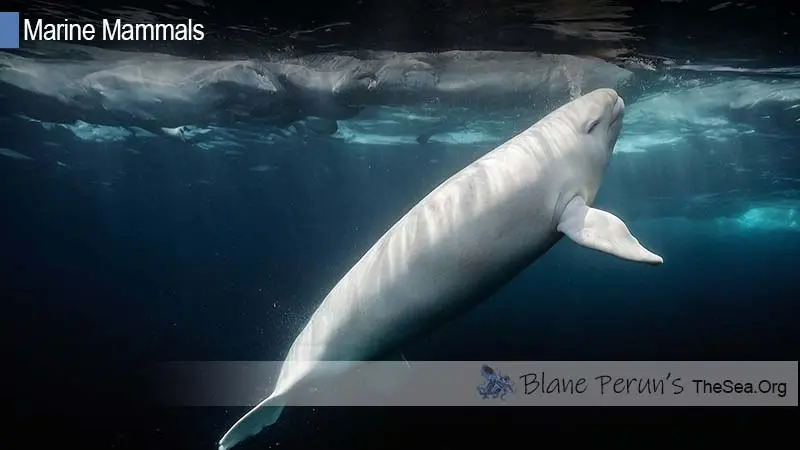
The beluga whale (Delphinapterus leucas) is one of the most distinctive and vocal cetaceans alive — an all-white whale with a highly mobile, expressive face, a prominent forehead melon that changes shape during sound production, and a reputation for extraordinary vocalizations that earned it the nickname “canary of the sea.” Belugas are among the most socially complex of all whales, forming tight-knit pods with sophisticated communication, cultural learning, and behaviors that researchers are only beginning to decode. They are also increasingly threatened by climate change, pollution, and habitat disruption.
Beluga Whale Appearance
- Color: Adults are white — the only all-white whale species. Calves are born grey or brownish and gradually whiten over 5–7 years.
- Size: Males 3.5–5.5 meters, 700–1,600 kg; females slightly smaller at 3–4 meters
- Forehead melon: The large, rounded forehead (melon) is a fatty organ used for echolocation. Unlike most cetaceans, the beluga’s melon is highly flexible — it changes shape visibly as the whale manipulates sounds, contributing to their wide range of facial expressions.
- No dorsal fin: Belugas lack a dorsal fin — an adaptation for swimming under sea ice without snagging
- Flexible neck: Belugas are one of very few cetaceans able to turn their heads — their cervical vertebrae are not fused, allowing nodding and turning movements
Where Do Beluga Whales Live?
Belugas are Arctic and subarctic animals found in Canada, Alaska, Russia, Norway, and Greenland. They have some of the best-studied populations of any cetacean:
- Cook Inlet, Alaska: A small, critically endangered population of ~280 individuals — isolated and declining despite protection
- St. Lawrence River, Canada: A famous population of ~900 belugas living in an unusually southern location — heavily studied and significantly contaminated by industrial pollution
- Hudson Bay and James Bay: Large summer aggregations, particularly at Churchill, Manitoba — a world-famous beluga whale watching destination
- Russian Arctic: The largest populations globally — hundreds of thousands in the Beaufort, Bering, and Chukchi Seas
Belugas are highly migratory, following sea ice edges and moving between summer estuaries (where they calve and molt) and offshore winter feeding areas. They can navigate under ice using echolocation to find breathing holes.
Beluga Whale Vocalizations
Belugas produce the most diverse repertoire of sounds of any cetacean — clicks, whistles, chirps, squeals, squeaks, claps, moos, and bell-like tones. The diversity and volume of their calls — audible through the hulls of ships — earned them the “canary of the sea” nickname from 19th-century Arctic sailors. Key functions include:
- Echolocation: Clicks produced and focused by the melon to detect prey and navigate under ice
- Social communication: Pods maintain contact and coordinate behavior through complex vocal exchanges
- Individual recognition: Each beluga has a signature whistle
- Cultural transmission: Dialects vary between populations — evidence of cultural learning
What Do Beluga Whales Eat?
Belugas are opportunistic generalist feeders:
- Fish — Arctic cod, capelin, herring, salmon, smelt
- Squid and octopus
- Crustaceans — shrimp, crabs
- Worms and other invertebrates on the seafloor
Their flexible lips allow them to suck prey from the seafloor and manipulate food items — a capability unusual among whales. They can also spit water to flush prey from hiding. Belugas are deep divers, capable of descending to 700+ meters, though most foraging occurs in shallower water.
Beluga Whale Social Behavior
Belugas are highly social, living in pods that range from a few individuals to groups of hundreds during seasonal aggregations. Social bonds are strong and long-lasting. Key behaviors:
- Calves stay with mothers for 2–3 years; extended family groups maintain cohesion beyond weaning
- Play behavior — including object play, surface splashing, and social games — is common at all ages
- Summer molting aggregations in warm, shallow estuaries appear to have a social as well as physiological function
- A 2018 study documented a narwhal adopted into a beluga pod — accepted and integrated as a full group member over multiple years
Conservation Status
The global beluga population is estimated at 150,000–200,000. IUCN lists the species as Least Concern overall, but several subpopulations are in serious trouble:
- Cook Inlet, Alaska: Critically Endangered (~280 animals, declining)
- St. Lawrence River: Endangered (~900 animals, heavily contaminated)
- East Greenland: Status uncertain
Threats include Arctic sea ice loss (disrupting migration and prey availability), pollution (PCBs, heavy metals — St. Lawrence belugas carry some of the highest contaminant loads of any marine mammal), hunting (regulated in Canada, Russia, and Greenland), entanglement in fishing gear, and noise from shipping and industrial development in the Arctic.
Key Facts
- Scientific name: Delphinapterus leucas
- Length: 3.5–5.5 meters (males)
- Weight: 700–1,600 kg
- Color: White (adults); grey/brown (calves)
- Lifespan: 35–50 years
- Dive depth: 700+ meters
- Conservation status: Least Concern globally; some subpopulations Critically Endangered
- Population: 150,000–200,000 globally
Frequently Asked Questions
Why are beluga whales white?
The white coloration develops gradually as belugas mature and is thought to provide camouflage against ice and snow in their Arctic environment. Calves are grey-brown (better camouflage against open water) and whiten over 5–7 years. The white adult coloration may also play a role in social signaling.
Can beluga whales change the shape of their head?
Yes — the melon (forehead) is filled with fat and oil and is under muscular control. Belugas can change its shape during sound production, a feature visible to observers watching them produce different vocalizations. This flexibility may allow fine-tuned sound directional control beyond what a rigid melon could achieve.
Are beluga whales friendly to humans?
Belugas in the wild are curious and sometimes approach boats. Captive belugas (which exist in aquariums and marine parks) are known for interactive behavior with human caretakers. Wild belugas should be observed at respectful distances — feeding or touching wild belugas is illegal and harmful to their behavioral health.