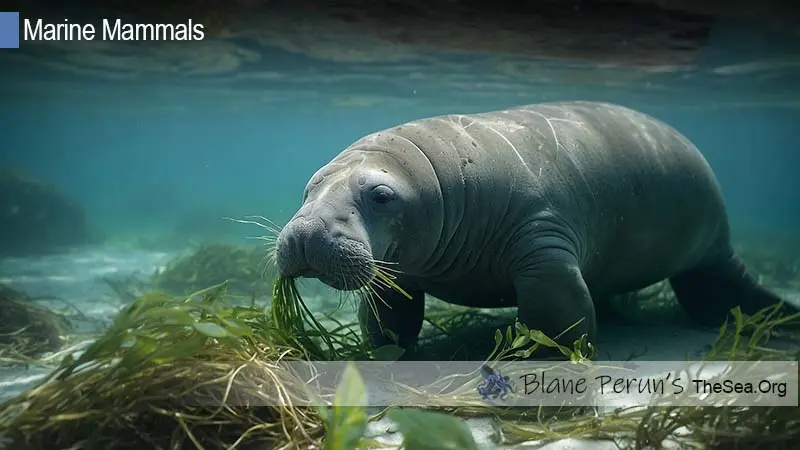
Manatees are large, slow-moving aquatic mammals found in shallow coastal waters, rivers, and estuaries across the tropical and subtropical Atlantic. Often called “sea cows,” they are gentle herbivores that graze on seagrass, aquatic vegetation, and algae for up to eight hours a day. There are three living manatee species, all in the genus Trichechus, and all are threatened or endangered. Despite their placid nature and protected status, manatees face serious ongoing threats from boat strikes, habitat loss, and cold stress — making them one of the most conservation-challenged marine mammals in North America.
The Three Manatee Species
- West Indian manatee (Trichechus manatus): The most studied species, found from Florida through the Caribbean and along the Atlantic coast of Central and South America to Brazil. Two subspecies: the Florida manatee (T. m. latirostris) and the Antillean manatee (T. m. manatus). Listed as Vulnerable by the IUCN; the Florida manatee was downlisted from Endangered to Threatened in 2017, a controversial decision given ongoing decline.
- Amazonian manatee (Trichechus inunguis): The smallest manatee species, found exclusively in the Amazon River basin. The only fully freshwater manatee. Listed as Vulnerable. Heavily hunted historically; populations are difficult to assess across the vast river system.
- West African manatee (Trichechus senegalensis): Found in coastal waters and rivers of West Africa from Senegal to Angola. The least-studied of the three species. Listed as Vulnerable; hunting and habitat loss are primary threats.
Manatee Size and Appearance
Manatees are large, rounded mammals with a distinctive body plan adapted entirely for aquatic life:
- Length: Adults typically 2.7–3.5 meters; large individuals reach 4 meters
- Weight: 400–600 kg typical; females are slightly larger than males
- Body: Grey, wrinkled skin with sparse hair covering the entire body (manatees have more hair than most marine mammals). Skin frequently colonized by algae, giving a greenish tinge.
- Tail: Broad, rounded, paddle-shaped fluke — the clearest distinguishing feature from dugongs, which have a forked, whale-like fluke
- Flippers: Two rounded front flippers used for steering and bottom-walking; vestigial nails are visible on the flippers of West Indian and West African manatees (absent in Amazonian manatees)
- Face: Highly mobile, prehensile upper lip split into two lobes — used to grasp and manipulate vegetation
What Do Manatees Eat?
Manatees are obligate herbivores — they eat only plants and algae. An adult manatee consumes 4–9% of its body weight in vegetation daily — roughly 30–50 kg for a typical adult. Primary food sources include:
- Seagrass — the most important food source for West Indian manatees
- Freshwater aquatic plants — hydrilla, water hyacinth, water lettuce
- Algae — both marine and freshwater species
- Mangrove leaves and overhanging vegetation
Manatees graze continuously and slowly across the seafloor, clipping vegetation with their divided upper lip and chewing with a set of molars that are continuously replaced throughout life — new teeth erupt at the back and move forward as front teeth wear down, similar to elephant dentition.
Manatee Behavior and Intelligence
Manatees are gentle, slow-moving, and non-territorial. They are generally solitary except during mating events and when females are with calves. Key behaviors:
- Breathing: Surface every 3–5 minutes when active; can hold their breath up to 20 minutes at rest
- Thermoregulation: Manatees have almost no body fat for insulation and are extremely sensitive to cold. Water temperatures below 20°C trigger cold stress syndrome — a potentially fatal metabolic shutdown. Florida manatees congregate at natural warm-water springs and power plant outfalls in winter.
- Communication: Manatees communicate through a range of vocalizations — chirps, squeaks, and squeals — used between mothers and calves and during mating aggregations
- Intelligence: Manatees have performed well in discrimination learning tasks in research settings, demonstrating pattern recognition and problem-solving abilities despite the misconception that their small brain relative to body size indicates low intelligence
Manatee Reproduction
Manatees reproduce slowly — a key factor in their conservation vulnerability:
- Gestation: approximately 12–14 months
- Litter size: almost always a single calf (twins extremely rare)
- Birth weight: approximately 30 kg
- Nursing duration: 1–2 years
- Reproductive interval: females typically give birth every 2–5 years
- Sexual maturity: 3–5 years (females); 5–9 years (males)
- Lifespan: 40–60 years in the wild
Threats and Conservation
All three manatee species face serious threats:
- Boat strikes: The leading cause of Florida manatee mortality. Virtually every adult Florida manatee carries propeller scars, and these scars are used to identify individuals. Speed zones in manatee habitats have helped but boat traffic continues to increase.
- Cold stress: Florida manatees are at the northern edge of their thermal tolerance. Unusually cold winters cause mass mortality events. Climate change creates uncertainty — warmer winters may benefit individuals but may also allow expansion of harmful algal blooms.
- Harmful algal blooms (red tide): The 2021 die-off of over 1,100 Florida manatees — the largest single-year mortality event on record — was partly driven by starvation from the collapse of seagrass beds, exacerbated by algal blooms fueled by nutrient runoff.
- Hunting: Historical and ongoing in parts of West Africa and Amazonia
- Habitat loss: Coastal development, seagrass decline from pollution and boat propeller damage, and loss of warm-water refuges
Key Facts
- Order: Sirenia — their closest living relatives are elephants and hyraxes
- Species: 3 (West Indian, Amazonian, West African)
- Length: 2.7–4 meters
- Weight: 400–600 kg
- Diet: Strictly herbivorous — seagrass, aquatic plants, algae
- Lifespan: 40–60 years
- Conservation status: All species Vulnerable or Threatened
- Closest relative: Dugong (order Sirenia); elephants and hyraxes (distant)
Frequently Asked Questions
Are manatees related to elephants?
Yes — manatees belong to the order Sirenia, which diverged from the same ancestral lineage as elephants and hyraxes. Their closest living relatives in the ocean are dugongs. Fossil evidence shows that the common ancestors of manatees and elephants were terrestrial mammals that returned to the water.
Can manatees live in freshwater?
West Indian manatees move freely between salt and fresh water. The Amazonian manatee lives exclusively in freshwater. All manatees need access to warm water — in Florida, many depend on warm freshwater springs year-round.
Why are manatees so slow?
Manatees have an exceptionally slow metabolic rate and limited capacity for sustained exertion — adaptations for an herbivorous diet in warm, stable environments. Their low-calorie food source doesn’t fuel high-speed activity. Typical cruising speed is 5–8 km/h; maximum speed in short bursts reaches 30 km/h.
Do manatees have predators?
Adult manatees have virtually no natural predators — their size and habitat provide substantial protection. Calves may occasionally be taken by large sharks or crocodilians. Humans, through boat strikes and habitat degradation, are by far the most significant source of manatee mortality.